

current along the western coast of the United States may have transferred
zinc 65 from the mouth of the Columbia River to tuna sh ultimately caught
off San Diego. The radioactive substance probably came from the Hanford
plutonium plant, which discharged radioactive zinc into the Columbia River
at that time [35]. Most of the Hanford reactors have now been Shut down, but
radionuclides continue to accumulate in the ocean due to both civilian and
military uses of nuclear power. “Individually, none of these sources adds sig—
nicant amounts of radioactivity to the ocean. Taken together, however, the
increases could be of signicant concern,” concluded the council on Environ—
mental Quality in its 1970 report to the President on ocean dumping [36].
The most thorough study of the effects of ocean dumping has been con—
ducted in the New York Bight, an area of the continental shelf oil New York
Bay which contains ofcial disposal grounds for a variety of castofls. A 1970
report by Dr. M. Grant Gross and associates at the State University of New
York, Stony Brook, presented estimates of the total amounts of oxidizable carbon—presumed to place a heavy demand on the dissolved oxygen
content of
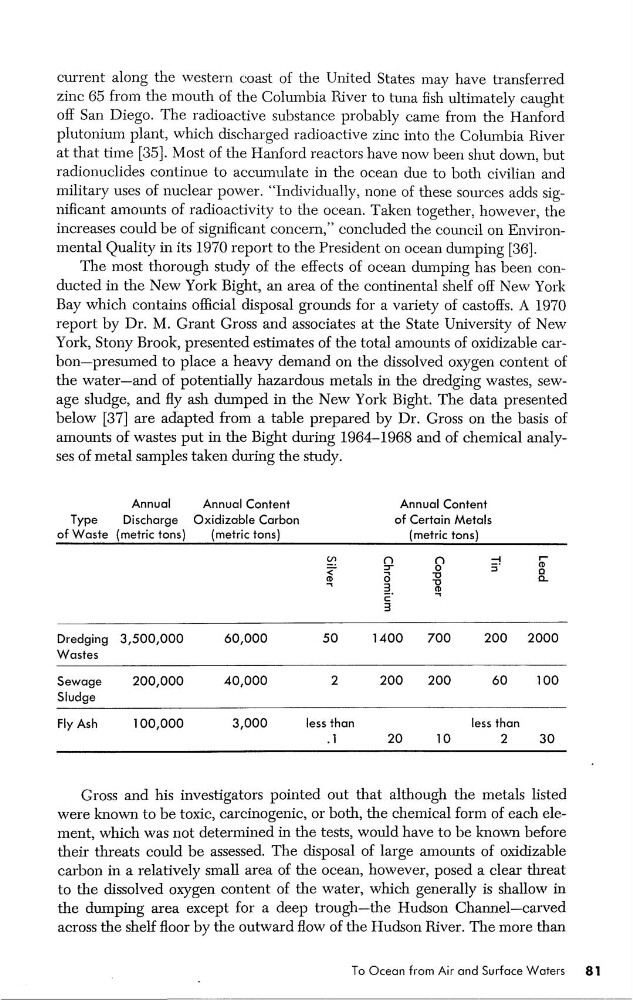
the water—and of potentially hazardous metals in the dredging wastes, sewage sludge, and y ash dumped in the New York Eight. The data presented
below [37] are adapted from a table prepared by Dr. Gross on the basis of
amounts of wastes put in the Eight during 1964—1968 and of chemical analyses of metal samples taken during the study.
Annual
Annual Content
Annual Content
Type
Dîscharge
Oxidizable Carbon
of Certain Metals
of Waste (metric tons)
(metric tons)
(metric tons)
;
9
9
a!
5
m
3
%
Q—
“
â.
9
%
Dreclging 3,500,000
60,000
50
1400
700
200
2000
Wastes
Sewage
200,000
40,000
2
200
200
60
100
Sludge
Fly Ash
100,000
3,000
less than
less than
.1
20
10
2
30
Gross and his investigators pointed out that although the metals listed
were known to be toxic, carcinogenic, or both, the chemical form of each ele—
ment, which was not determined in the tests, would have to be known before
their threats could be assessed. The disposal of large amounts of oxidizable
carbon in a relatively small area of the ocean, however, posed a clear threat
to the dissolved oxygen
content of the water, which generally is shallow in
the dumping area except for a deep trough—the Hudson Channel—carved
across the shelf oor by the outward ow of the Hudson River. The more than
To Ocean from Air and Surface Waters
81
zinc 65 from the mouth of the Columbia River to tuna sh ultimately caught
off San Diego. The radioactive substance probably came from the Hanford
plutonium plant, which discharged radioactive zinc into the Columbia River
at that time [35]. Most of the Hanford reactors have now been Shut down, but
radionuclides continue to accumulate in the ocean due to both civilian and
military uses of nuclear power. “Individually, none of these sources adds sig—
nicant amounts of radioactivity to the ocean. Taken together, however, the
increases could be of signicant concern,” concluded the council on Environ—
mental Quality in its 1970 report to the President on ocean dumping [36].
The most thorough study of the effects of ocean dumping has been con—
ducted in the New York Bight, an area of the continental shelf oil New York
Bay which contains ofcial disposal grounds for a variety of castofls. A 1970
report by Dr. M. Grant Gross and associates at the State University of New
York, Stony Brook, presented estimates of the total amounts of oxidizable carbon—presumed to place a heavy demand on the dissolved oxygen
content of
the water—and of potentially hazardous metals in the dredging wastes, sewage sludge, and y ash dumped in the New York Eight. The data presented
below [37] are adapted from a table prepared by Dr. Gross on the basis of
amounts of wastes put in the Eight during 1964—1968 and of chemical analyses of metal samples taken during the study.
Annual
Annual Content
Annual Content
Type
Dîscharge
Oxidizable Carbon
of Certain Metals
of Waste (metric tons)
(metric tons)
(metric tons)
;
9
9
a!
5
m
3
%
Q—
“
â.
9
%
Dreclging 3,500,000
60,000
50
1400
700
200
2000
Wastes
Sewage
200,000
40,000
2
200
200
60
100
Sludge
Fly Ash
100,000
3,000
less than
less than
.1
20
10
2
30
Gross and his investigators pointed out that although the metals listed
were known to be toxic, carcinogenic, or both, the chemical form of each ele—
ment, which was not determined in the tests, would have to be known before
their threats could be assessed. The disposal of large amounts of oxidizable
carbon in a relatively small area of the ocean, however, posed a clear threat
to the dissolved oxygen
content of the water, which generally is shallow in
the dumping area except for a deep trough—the Hudson Channel—carved
across the shelf oor by the outward ow of the Hudson River. The more than
To Ocean from Air and Surface Waters
81