

-
“:‘ç‘
Ë‘::‘-$Hl‘l‘è ““‘—“‘“
‘
‘
‘
‘
“‘
‘
'
.
_
…
‘
,\Ï
_
‘
\
.
‘e
l
'
,
‘
-
‘:
,
:..
._
? ‘>
"
Ο'\Ÿ’ :
-
“
ŸWÆ Ÿ‘
Ÿ
.
.
'.
»
M
‘
.
.
f
—
Ÿ
Ÿïe
*
‘
.
._
.
—
Ÿ:
‘Ï .
.
.
‘
'
-‘—
.â<
€.
-
-,‘.,
?.e.
—
*:_
‘__….
.
‘.
;
.‘1
\
‘
-
:
_
Ÿ
.
.
"
\
‘
*"
'
’
:
…
.:
:
»
,.
,
=”—
..
'
‘Ï
-
‘
.
ÎÊ\.‘
_
‘
=
‘
m
\
__
t i‘'
'_
-
,
.
&
|
-
î.
-
*
"…:, I
w».
/
î
_
‘
d“
‘
'
_
:.“ —« :… ?
…,
.
..
_
"
.
L
:“.‘f: ”"
…
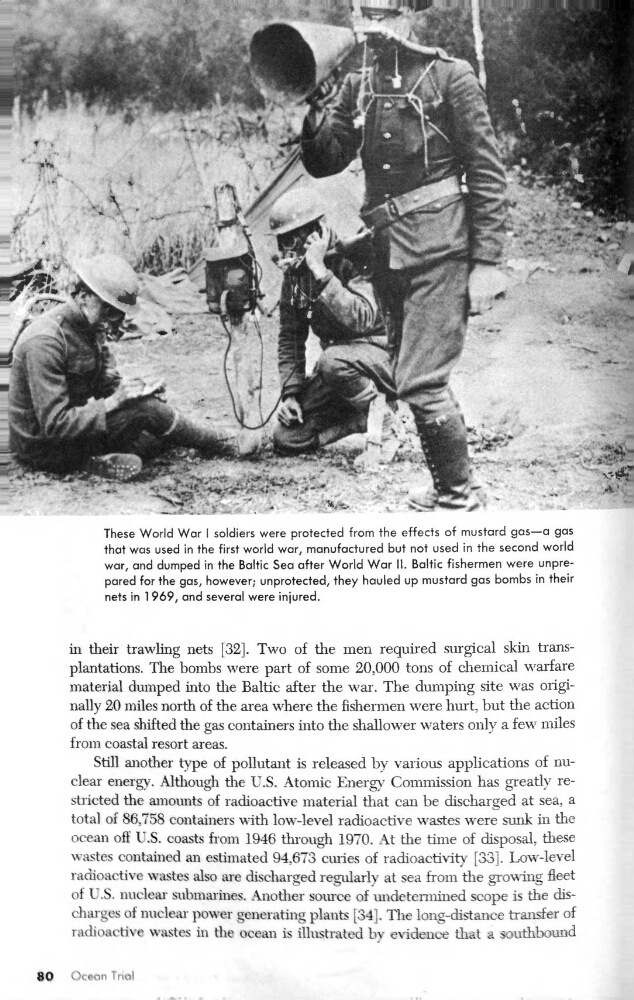
These World War | soldiers were protected from the effects of mustord gas—o gas
that was used in the first world war, monufoctured but not used in the second world
war, and dumped in the Boltic Sea after World War ll. Bolc fishermen were unprepared for the gas, however; unprotected, they houled up mustord gas bombs in their
nets in 1969, and several were iniured.
in their trawling nets [32]. Two of the men required surgical skin trans—
plantations. The bombs were part of some 20,000 tons of chemical wa1fare
material dumped into the Baltic after the war. The dumping site was origi—
nally 20 miles north of the area where the shermen were
but the action
of the sea shifted the gas containers into the shallower waters 0111},7 a few miles
from coastal resort areas.
Still another type of pollutant is released by various applications of nu—
clear energy. Although the US. Atomic Energy Commission has greatly restricted the amounts of radioactive material that can be discharged at sea… &
total of 86,758 containers With low—level radioactive wastes were sunk in the
ocean o U.S. coasts from 1946 tln‘0ugh 1970. At the time of disposal: these
wastes contained an estimated 94,673 curies of radioacüty [33]. Low—level
radioactive wastes also are discharged regularlv at sea from the growing
eet
oi U.S. nuclear submarines. Another source of undetemned scope
is the dis—
charges oi nuclear power generating plants [3—il. ‘The long—distance transfer of
_
radioactive wastes in the ocean is illustrated bv evidence that a sonthhoun
.
80
Ocean l:iol
“:‘ç‘
Ë‘::‘-$Hl‘l‘è ““‘—“‘“
‘
‘
‘
‘
“‘
‘
'
.
_
…
‘
,\Ï
_
‘
\
.
‘e
l
'
,
‘
-
‘:
,
:..
._
? ‘>
"
Ο'\Ÿ’ :
-
“
ŸWÆ Ÿ‘
Ÿ
.
.
'.
»
M
‘
.
.
f
—
Ÿ
Ÿïe
*
‘
.
._
.
—
Ÿ:
‘Ï .
.
.
‘
'
-‘—
.â<
€.
-
-,‘.,
?.e.
—
*:_
‘__….
.
‘.
;
.‘1
\
‘
-
:
_
Ÿ
.
.
"
\
‘
*"
'
’
:
…
.:
:
»
,.
,
=”—
..
'
‘Ï
-
‘
.
ÎÊ\.‘
_
‘
=
‘
m
\
__
t i‘'
'_
-
,
.
&
|
-
î.
-
*
"…:, I
w».
/
î
_
‘
d“
‘
'
_
:.“ —« :… ?
…,
.
..
_
"
.
L
:“.‘f: ”"
…
These World War | soldiers were protected from the effects of mustord gas—o gas
that was used in the first world war, monufoctured but not used in the second world
war, and dumped in the Boltic Sea after World War ll. Bolc fishermen were unprepared for the gas, however; unprotected, they houled up mustord gas bombs in their
nets in 1969, and several were iniured.
in their trawling nets [32]. Two of the men required surgical skin trans—
plantations. The bombs were part of some 20,000 tons of chemical wa1fare
material dumped into the Baltic after the war. The dumping site was origi—
nally 20 miles north of the area where the shermen were
but the action
of the sea shifted the gas containers into the shallower waters 0111},7 a few miles
from coastal resort areas.
Still another type of pollutant is released by various applications of nu—
clear energy. Although the US. Atomic Energy Commission has greatly restricted the amounts of radioactive material that can be discharged at sea… &
total of 86,758 containers With low—level radioactive wastes were sunk in the
ocean o U.S. coasts from 1946 tln‘0ugh 1970. At the time of disposal: these
wastes contained an estimated 94,673 curies of radioacüty [33]. Low—level
radioactive wastes also are discharged regularlv at sea from the growing
eet
oi U.S. nuclear submarines. Another source of undetemned scope
is the dis—
charges oi nuclear power generating plants [3—il. ‘The long—distance transfer of
_
radioactive wastes in the ocean is illustrated bv evidence that a sonthhoun
.
80
Ocean l:iol