

,,
,
_4
,'
‘,._ ,
E—
‘
:
_j;
'
.
..'»1
&
'…
'
…
'
…
'
.
,
/
…
-Î
.
:
.
«
1’
‘
Ë
»
"
»
,
_
_
……
E
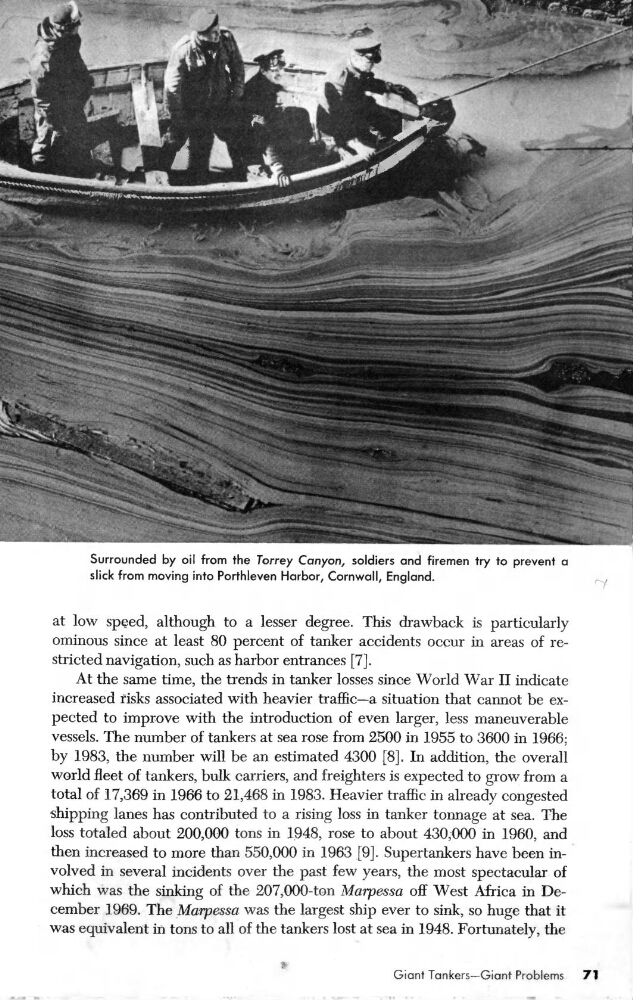
Surrounded by oil from the Torrey Canyon, soldiers and firemen try to prevent (:
slîck from moving into Porthleven Harbor, Cornwall, England.
"î’
at low speed, although to a lesser degree. This drawback is particularly
ominous since at least 80 percent of tanker accidents occur in areas of restricted navigation, such as harbor entrances [7].
At the same time, the trends in tanker lossessince World War II indicate
increased risks associated with heavier trafc—a situation that cannot be ex—
pected to improve with the introduction of even larger, less maneuverable
vessels. The number of tankers at sea rose from 2500 in 1955 to 3600 in 1966;
by 1983, the number willbe an estimated 4300 [8]. In addition, the overall
world eet of tankers, bulk carriers, and freighters is expected to grow from a
total of 17,369 in 1966 to 21,468 in 1983. Heavier traic in already congested
shipping lanes has contributed to & rising loss in tanker tonnage at sea. The
loss totaled about 200,000 tons in 1948, rose to about 430,000 in 1960, and
then increased to more than 550,000 in 1963 [9]. Supertankers have been in—
volved in several incidents over the past few years, the mostspectacular of
which Was the sinking of the 207,000—t0n Mamessa off West Africa in De—
cember 1969. The _Ma1pessa was the largest ship ever to sink, so huge that it
'
was equivalent in tons to all of the tankers lost at sea in 1948. Fortunately, the
.
?
Giant Tonkers—Giont Problems
71
,
_4
,'
‘,._ ,
E—
‘
:
_j;
'
.
..'»1
&
'…
'
…
'
…
'
.
,
/
…
-Î
.
:
.
«
1’
‘
Ë
»
"
»
,
_
_
……
E
Surrounded by oil from the Torrey Canyon, soldiers and firemen try to prevent (:
slîck from moving into Porthleven Harbor, Cornwall, England.
"î’
at low speed, although to a lesser degree. This drawback is particularly
ominous since at least 80 percent of tanker accidents occur in areas of restricted navigation, such as harbor entrances [7].
At the same time, the trends in tanker lossessince World War II indicate
increased risks associated with heavier trafc—a situation that cannot be ex—
pected to improve with the introduction of even larger, less maneuverable
vessels. The number of tankers at sea rose from 2500 in 1955 to 3600 in 1966;
by 1983, the number willbe an estimated 4300 [8]. In addition, the overall
world eet of tankers, bulk carriers, and freighters is expected to grow from a
total of 17,369 in 1966 to 21,468 in 1983. Heavier traic in already congested
shipping lanes has contributed to & rising loss in tanker tonnage at sea. The
loss totaled about 200,000 tons in 1948, rose to about 430,000 in 1960, and
then increased to more than 550,000 in 1963 [9]. Supertankers have been in—
volved in several incidents over the past few years, the mostspectacular of
which Was the sinking of the 207,000—t0n Mamessa off West Africa in De—
cember 1969. The _Ma1pessa was the largest ship ever to sink, so huge that it
'
was equivalent in tons to all of the tankers lost at sea in 1948. Fortunately, the
.
?
Giant Tonkers—Giont Problems
71