

Dissolved Oxygen
Temperature
Density
…
Content
(°C)
(°F)
(groms
centimeter)
(milligramsper liter)
0
32
099987
14.6
4
39.2
1.00000
13.1
“___—___—
5
41
099999
1 2. 8
___________
10
50
099973
11.3
15
59
099913
10.2
20
68
099823
9.2
25
77
099707
8.4
30
86
099567
7.6
35
95
099406
7.1
40
104
0,99224
6.6
___—___—
Many biological events—for example, the spring and fall blooms of algae
which occur in many lakes—are closely linked to the timing of turnover, or
mixing, in thermally—stratied lakes. The addition of large amounts of heated
water—thus changing the water’s density—could prevent tumover from oc—
curring, particularly in small lakes. Even if turnovers were not prevented, a
delay in turnover time in the fall could lengthen the growing season and pro—
duce overgrowths of algae; since exchange of gases does not occur until turn—
over time, and oxygen
in the bottom layer becomes depleted as the summer
progresses, a delay in turnover time could also have drastic effects on the sh
population. Cornell scientists, studying the site of a proposed nuclear power
plant in Cayuga Lake in New York, concluded that since the power plant op—
eration would withdraw approximately ten percent of the average volume of
the lake and return this water at a higher temperature, the possible changes
in stratication pattern could seriously threaten the lake’s ecological balance
[17].
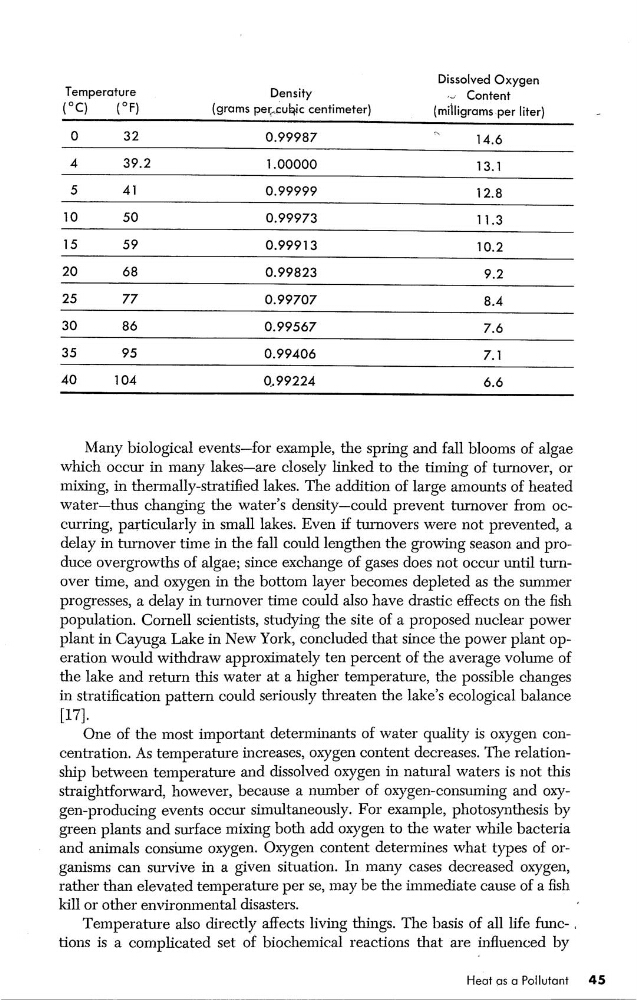
One of the most important determinants of water quality is oxygen con—
centration. As temperature increases, oxygen
content decreases. The relation—
ship between temperature and dissolved oxygen in natural waters is not this
straightforward, however, because a number of oxygen—comu1ning and oxy—
gen—producing events occur simultaneously. For example, photosynthesis by
green plants and surface mixing both add oxygen
to the water while bacteria
and animals consùme oxygen. Oxygen content determines what types of or—
ganisms can survive in a given situation. In many cases decreased oxygen,
rather than elevated temperature per se, may be the immediate cause of a sh
kill or other environmental disasters.
'
Temperature also directly affects living things. The basis of all life func.
tions is a complicated set of biochemical reactions that are inuenced by
Heat as (: Pollutant
45
Temperature
Density
…
Content
(°C)
(°F)
(groms
centimeter)
(milligramsper liter)
0
32
099987
14.6
4
39.2
1.00000
13.1
“___—___—
5
41
099999
1 2. 8
___________
10
50
099973
11.3
15
59
099913
10.2
20
68
099823
9.2
25
77
099707
8.4
30
86
099567
7.6
35
95
099406
7.1
40
104
0,99224
6.6
___—___—
Many biological events—for example, the spring and fall blooms of algae
which occur in many lakes—are closely linked to the timing of turnover, or
mixing, in thermally—stratied lakes. The addition of large amounts of heated
water—thus changing the water’s density—could prevent tumover from oc—
curring, particularly in small lakes. Even if turnovers were not prevented, a
delay in turnover time in the fall could lengthen the growing season and pro—
duce overgrowths of algae; since exchange of gases does not occur until turn—
over time, and oxygen
in the bottom layer becomes depleted as the summer
progresses, a delay in turnover time could also have drastic effects on the sh
population. Cornell scientists, studying the site of a proposed nuclear power
plant in Cayuga Lake in New York, concluded that since the power plant op—
eration would withdraw approximately ten percent of the average volume of
the lake and return this water at a higher temperature, the possible changes
in stratication pattern could seriously threaten the lake’s ecological balance
[17].
One of the most important determinants of water quality is oxygen con—
centration. As temperature increases, oxygen
content decreases. The relation—
ship between temperature and dissolved oxygen in natural waters is not this
straightforward, however, because a number of oxygen—comu1ning and oxy—
gen—producing events occur simultaneously. For example, photosynthesis by
green plants and surface mixing both add oxygen
to the water while bacteria
and animals consùme oxygen. Oxygen content determines what types of or—
ganisms can survive in a given situation. In many cases decreased oxygen,
rather than elevated temperature per se, may be the immediate cause of a sh
kill or other environmental disasters.
'
Temperature also directly affects living things. The basis of all life func.
tions is a complicated set of biochemical reactions that are inuenced by
Heat as (: Pollutant
45