

‘
,
î
."
'.
;
…
'fî
f
““.—”"‘
.
\
_
,
_
'
'
“
“::.—==.
—
,
!
…
;,
/
! '
"‘- -—
‘
î,
'
—ç
_
fr:
'
"\'
-
‘
,
"
.
.
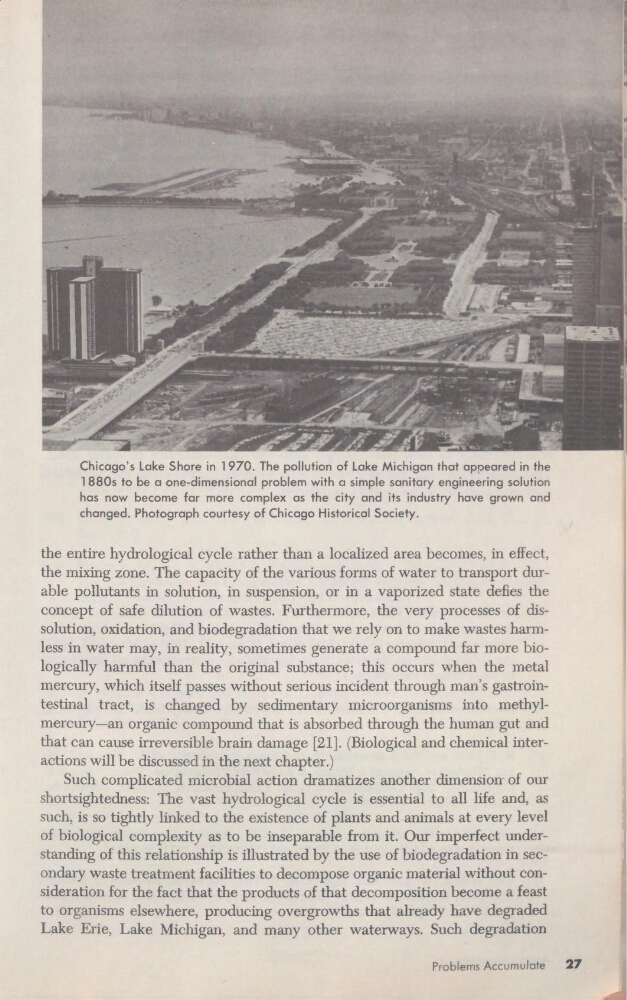
Chicago's Lake Shore in 1970. The pollution of Lake Michigan that appeared in the
18805 to be a one-dimensional problem with a simple sanitarÿ engineering solùtion
has now become for more complex as the city and its industry have grown and
changed. Photograph courtesy of Chicago Historical Society.
the entire hydrological cycle rather than a localized area becomes, in effect,
the mixing zone. The capacity of the various forms of water to transport durable pollutants in solution, in suspension, or in a vaporized state dees the
concept of safe dilution of wastes. Furthermore, the very processes of dis—
_
solution, oxidation, and biodegradaon that we rely on to make wastes harm—
less in water may, in reality, sometimes generate a compound far more bio—
logically harmful than the original substance; this occurs when the metal
mercury, which itself passes without serious incident through man’s gastroin—
‘
testinal tract, is changed by sedimentary microorganisms into methyl—
mercury—an organic compound that is absorbed through the human gut and
that can cause irreversible brain damage [21]. (Biological and chemical inter_
actions Will be discussed in the next chapter.)
Such complicated microbial action dramatizes another dimension of our
shortsightedness: The vast hydrological cycle is essential to all life and, as
l
such, is so tightly linked to the existence of plants andanimals at every level
of biological complexity as to be inseparable from it. Our imperfect under—
standing of this relationship is illustrated by the use of biodegradaüon in secl
ondary waste treatment facilities to decompose organic material without conÎ
sideration for the fact that the products of that decomposition become a feast
to organisms elsewhere, producing overgrowths that already have degraded
Lake Erie, Lake Michigan, and many other waterways. Such degradation
Problems Accumulate‘
E
,
î
."
'.
;
…
'fî
f
““.—”"‘
.
\
_
,
_
'
'
“
“::.—==.
—
,
!
…
;,
/
! '
"‘- -—
‘
î,
'
—ç
_
fr:
'
"\'
-
‘
,
"
.
.
Chicago's Lake Shore in 1970. The pollution of Lake Michigan that appeared in the
18805 to be a one-dimensional problem with a simple sanitarÿ engineering solùtion
has now become for more complex as the city and its industry have grown and
changed. Photograph courtesy of Chicago Historical Society.
the entire hydrological cycle rather than a localized area becomes, in effect,
the mixing zone. The capacity of the various forms of water to transport durable pollutants in solution, in suspension, or in a vaporized state dees the
concept of safe dilution of wastes. Furthermore, the very processes of dis—
_
solution, oxidation, and biodegradaon that we rely on to make wastes harm—
less in water may, in reality, sometimes generate a compound far more bio—
logically harmful than the original substance; this occurs when the metal
mercury, which itself passes without serious incident through man’s gastroin—
‘
testinal tract, is changed by sedimentary microorganisms into methyl—
mercury—an organic compound that is absorbed through the human gut and
that can cause irreversible brain damage [21]. (Biological and chemical inter_
actions Will be discussed in the next chapter.)
Such complicated microbial action dramatizes another dimension of our
shortsightedness: The vast hydrological cycle is essential to all life and, as
l
such, is so tightly linked to the existence of plants andanimals at every level
of biological complexity as to be inseparable from it. Our imperfect under—
standing of this relationship is illustrated by the use of biodegradaüon in secl
ondary waste treatment facilities to decompose organic material without conÎ
sideration for the fact that the products of that decomposition become a feast
to organisms elsewhere, producing overgrowths that already have degraded
Lake Erie, Lake Michigan, and many other waterways. Such degradation
Problems Accumulate‘
E