

_
-
_
_
_
":..
î _…
’
“""
.
.
_
:*
.
‘
'
,’=
.,
..»//
.
.,
“’
‘
ff‘ît
“’
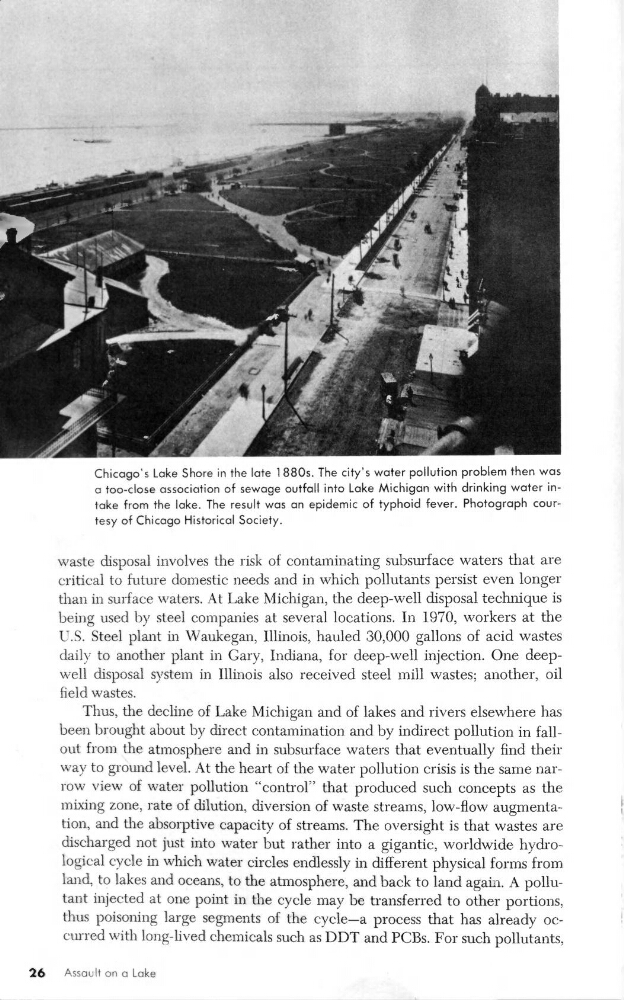
Chicogo's Lake Shore in the late l8805. The city’s water pollution problem then was
(: too-close association of sewoge outfoll into Lake Michigan with drinking water intake from the lake. The result was on epidemic of typhoid fever. Photogroph courtesy of Chicago Historical Society.
waste disposal involves the risk of contaminating subsurface waters that are
critical to future domestic needs and in which pollutants persist even longer
than in surface waters. At Lake Michigan, the deep—well disposal technique is
being used by steel companies at several locations. In 1970, workers at the
US. Steel plant in Waukegan, Illinois, hauled 80,000 gallons of acid wastes
daily to another plant in Gary, Indiana, for deep—well injection. One deep—
well disposal system in Illinois also received steel mill wastes; another, oil
eld wastes.
Thus, the decline of Lake Michigan and of lakes and rivers elsewhere has
been brought about by direct contamination and by indirect pollution in fall—
out from the atmosphere and in subsurface waters that eventually nd their
way
to ground level. At the heart of the water pollution crisis is the same nar—
row view of water pollution “control” that produced such concepts as the
mixing zone, rate of dilution, diversion of waste streams, low—ow augmenta—
tion, and the absorptive capacity of streams. The oversight is that wastes are
discharged not just into water but rather into a gigantic, worldwide hydro—
logical cycle in which water circles endlessly in diËerent physical forms from
land to lakes and oceans, to the atmosphere, and back to land again. A pollu—
tant injected at one point in the cycle may be transferred to other portions,
thus poisoning large segments of the cycle—a process that has already occru‘œd with long—lived chemicals such as DDT and PCBS. For such pollutants,
26
Assoult on c Luke
-
_
_
_
":..
î _…
’
“""
.
.
_
:*
.
‘
'
,’=
.,
..»//
.
.,
“’
‘
ff‘ît
“’
Chicogo's Lake Shore in the late l8805. The city’s water pollution problem then was
(: too-close association of sewoge outfoll into Lake Michigan with drinking water intake from the lake. The result was on epidemic of typhoid fever. Photogroph courtesy of Chicago Historical Society.
waste disposal involves the risk of contaminating subsurface waters that are
critical to future domestic needs and in which pollutants persist even longer
than in surface waters. At Lake Michigan, the deep—well disposal technique is
being used by steel companies at several locations. In 1970, workers at the
US. Steel plant in Waukegan, Illinois, hauled 80,000 gallons of acid wastes
daily to another plant in Gary, Indiana, for deep—well injection. One deep—
well disposal system in Illinois also received steel mill wastes; another, oil
eld wastes.
Thus, the decline of Lake Michigan and of lakes and rivers elsewhere has
been brought about by direct contamination and by indirect pollution in fall—
out from the atmosphere and in subsurface waters that eventually nd their
way
to ground level. At the heart of the water pollution crisis is the same nar—
row view of water pollution “control” that produced such concepts as the
mixing zone, rate of dilution, diversion of waste streams, low—ow augmenta—
tion, and the absorptive capacity of streams. The oversight is that wastes are
discharged not just into water but rather into a gigantic, worldwide hydro—
logical cycle in which water circles endlessly in diËerent physical forms from
land to lakes and oceans, to the atmosphere, and back to land again. A pollu—
tant injected at one point in the cycle may be transferred to other portions,
thus poisoning large segments of the cycle—a process that has already occru‘œd with long—lived chemicals such as DDT and PCBS. For such pollutants,
26
Assoult on c Luke