

…,
,
,
_r
_
"T
.
_,“i ‘,‘J |
=
%
‘
.,
,
.
€ ,'_
‘-—
.
i‘
‘
_
.,
{
-—
-
4—
1
,
_
'
_
4
tua-m… & www:
,
—-«:_; .
”:“;
«’
-
__ ‘:î\
,
‘
Α
,»'_
‘
.
:“
..
“. I
È
|
-«——-….«….
_Ï
.
_
1
’
“e……
:s
/
_
M—‘
…
3.::\
__
___,
_
_
*…
_
4°:}%
‘\"
.
‘— …
*
°
2
’
_— ‘.
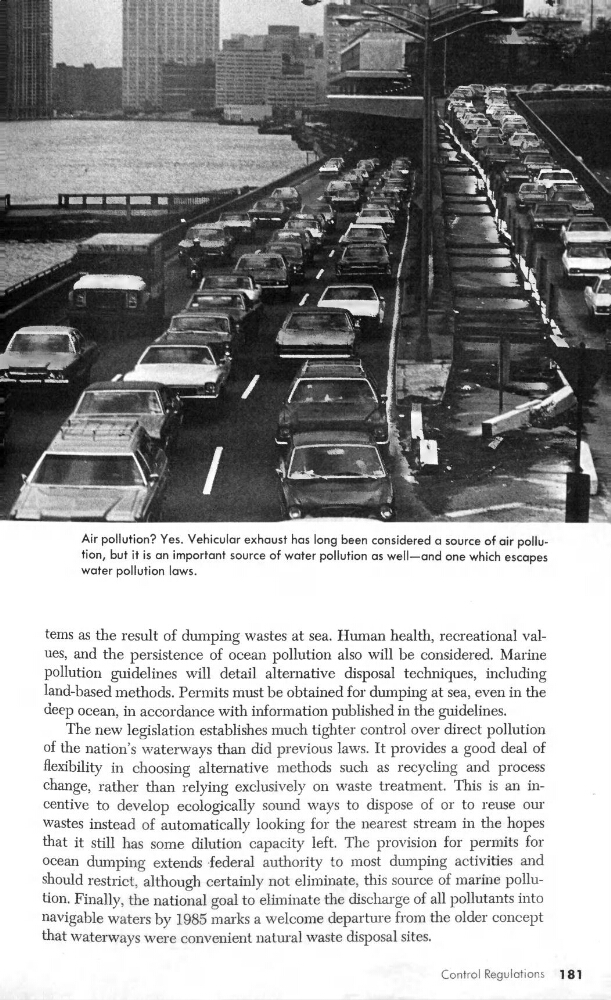
Air pollution? Yes. Vehicular exhaust has long been considered a source of air pollution, but it is an important source of water pollution as well—and one which escapes
water pollution laws.
terms as the result of dumping wastes at sea. Human health, recreational val—
ues, and the persistence of ocean pollution also will be considered. Marine
pollution guidelines will detail alternative disposal techniques, including
land—based methods. Permits must be obtained for dumping at sea, even in the
deep ocean, in accordance with information published in the guidelines.
The new legislation establishes much tighter control over direct pollution
of the nation’s waterways than did previous laws. It provides a good deal of
exibility in choosing alternative methods such as recycling and process
Change, rather than relying exclusively on waste treatment. This is an in—
centive to develop ecologically sound ways
to dispose of or to reuse our
Wastes instead of automatically looking for the nearest stream in the hopes
that it still has some dilution capacity left. The provision for permits for
ocean dumping extends federal authority to most dumping activiües and
should restrict, although certainly not eliminate, this source of marine pollu—
tion. Finally, the national goal to eliminate the discharge of all pollutants into
navigable waters by 1985 marks a welcome departure from the older concept
that waterways were convenient natural waste disposal sites.
_
Control Regulations
181
,
,
_r
_
"T
.
_,“i ‘,‘J |
=
%
‘
.,
,
.
€ ,'_
‘-—
.
i‘
‘
_
.,
{
-—
-
4—
1
,
_
'
_
4
tua-m… & www:
,
—-«:_; .
”:“;
«’
-
__ ‘:î\
,
‘
Α
,»'_
‘
.
:“
..
“. I
È
|
-«——-….«….
_Ï
.
_
1
’
“e……
:s
/
_
M—‘
…
3.::\
__
___,
_
_
*…
_
4°:}%
‘\"
.
‘— …
*
°
2
’
_— ‘.
Air pollution? Yes. Vehicular exhaust has long been considered a source of air pollution, but it is an important source of water pollution as well—and one which escapes
water pollution laws.
terms as the result of dumping wastes at sea. Human health, recreational val—
ues, and the persistence of ocean pollution also will be considered. Marine
pollution guidelines will detail alternative disposal techniques, including
land—based methods. Permits must be obtained for dumping at sea, even in the
deep ocean, in accordance with information published in the guidelines.
The new legislation establishes much tighter control over direct pollution
of the nation’s waterways than did previous laws. It provides a good deal of
exibility in choosing alternative methods such as recycling and process
Change, rather than relying exclusively on waste treatment. This is an in—
centive to develop ecologically sound ways
to dispose of or to reuse our
Wastes instead of automatically looking for the nearest stream in the hopes
that it still has some dilution capacity left. The provision for permits for
ocean dumping extends federal authority to most dumping activiües and
should restrict, although certainly not eliminate, this source of marine pollu—
tion. Finally, the national goal to eliminate the discharge of all pollutants into
navigable waters by 1985 marks a welcome departure from the older concept
that waterways were convenient natural waste disposal sites.
_
Control Regulations
181