

“\Ï\
‘
\\
4
.
’
\\Ï\
,_
—
Il
-
'
_
,
*l
/
-
‘
.
g
.
,
\
l
.
:: E'
»
& ,:> |
'
‘
:::
……
:
!
z—î
‘Ëâ
W
;?
.-.
_
Ï
‘!
;
à
*
‘
_
«
.
&“ ; ….Ï
_
‘Ï
s—
.
‘
\Ë‘
*
"L'—3“……
………_… …………
_
,_
«…
_
_
_
|
—
_.
.
.
_
‘
:
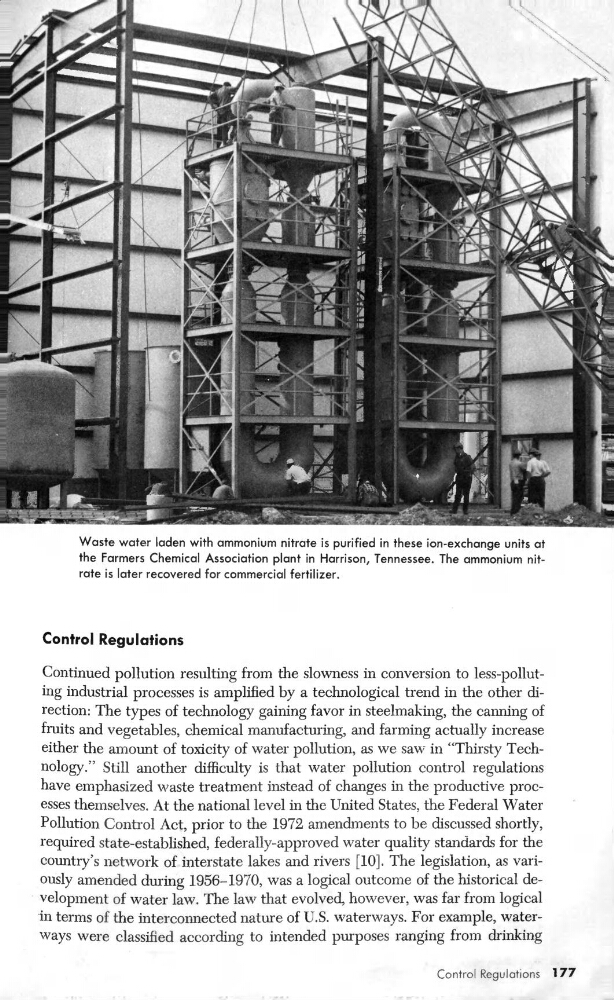
Waste water laden with ammonium nitrate is purified in these ion-exchange units at
the Farmers Chemical Association plant in Harrison, Tennessee. The ammonium nitrate is later recovered for commercial fertilizer.
Control Regulations
Continued pollution resulting from the slowness in conversion to less—pollut—
ing industrial processes
is amplied by a technological trend in the other di—
rection: The types of technology gaining favor in steelmaking, the canning of
fruits and vegetables, chemical manufacturing, and farming actually increase
either the amount of toxicity of water pollution, as we saw in “Thirsty Tech—
nology.” Still another diiculty is that water pollution control regulations
have emphasized waste treatment instead of changes in the productive processes themselves. At the national level in the United States, the Federal Water
Pollution Control Act, prior to the 1972 amendments to be discussed shortly,
required state—established, federally—approved water quality standards for the
country’s network ofinterstate lakes and rivers [10]. The legislation, as vari—
oùsly amended during 1956—1970, was a logical outcome of the historical de—
"
velopment of water law. The law that evolved, however, was far from logical
in terms of the interconnected nature of U.S. waterways. For example, water—_
Ways were classied according to intended purposes ranging from drinking
Control Regulations 177
‘
\\
4
.
’
\\Ï\
,_
—
Il
-
'
_
,
*l
/
-
‘
.
g
.
,
\
l
.
:: E'
»
& ,:> |
'
‘
:::
……
:
!
z—î
‘Ëâ
W
;?
.-.
_
Ï
‘!
;
à
*
‘
_
«
.
&“ ; ….Ï
_
‘Ï
s—
.
‘
\Ë‘
*
"L'—3“……
………_… …………
_
,_
«…
_
_
_
|
—
_.
.
.
_
‘
:
Waste water laden with ammonium nitrate is purified in these ion-exchange units at
the Farmers Chemical Association plant in Harrison, Tennessee. The ammonium nitrate is later recovered for commercial fertilizer.
Control Regulations
Continued pollution resulting from the slowness in conversion to less—pollut—
ing industrial processes
is amplied by a technological trend in the other di—
rection: The types of technology gaining favor in steelmaking, the canning of
fruits and vegetables, chemical manufacturing, and farming actually increase
either the amount of toxicity of water pollution, as we saw in “Thirsty Tech—
nology.” Still another diiculty is that water pollution control regulations
have emphasized waste treatment instead of changes in the productive processes themselves. At the national level in the United States, the Federal Water
Pollution Control Act, prior to the 1972 amendments to be discussed shortly,
required state—established, federally—approved water quality standards for the
country’s network ofinterstate lakes and rivers [10]. The legislation, as vari—
oùsly amended during 1956—1970, was a logical outcome of the historical de—
"
velopment of water law. The law that evolved, however, was far from logical
in terms of the interconnected nature of U.S. waterways. For example, water—_
Ways were classied according to intended purposes ranging from drinking
Control Regulations 177