

duction techniques that produce less rather than more pollution. In the tan—
ning and nishing of leather, for example, industrial growth has been limited
by both foreign competition and plastic and rubber substitutes for leather
[19]. A trend toward reduced waste discharges has been attributed, in part, to
the increased use of centralized tanneries in large cities rather than those in
remote country locations used in the nineteenth century. The city tanneries
are nearer the slaughterhouses, their source of hides, but an added advantage
is the proximity of municipal waste treatment plants to which organic tan—
nery
wastes can be routed. An estimated 80 percent of tannery wastes are
now discharged to municipal sewers as compared with 60 percent in 1950.
Another reason for this decreased waste load is the trend toward synthetic
substitutes for sole leather, which is tanned by older methods that produce
large organic waste leads. One other factor that may have an indirect effect
on tannery pollution in the years ahead is the price of hair that can be recov—
ered from the hides and sold as a by—*pi‘oduct. If the hair is not removed me—
chanically for this use, it is pulped chemically by a technique that croates
wastes With high contents of lime, sodium sulde, and dissolved proteins.
These economic considerations, then, rather than less pollüting tech—
nology will determine future waste leads from the leather ‘tanning and nish—
-
ing processes. According to government investigators: ‘—‘The imporätàtgeneralizations are that the tanning indûsty has notmàde great improvement in
reducing pollution produced per u'nitof hide proce55edg modern
.
chinery
not designed withwasteload reduction in mind; and no real
throughs are in sight.” [20]
_
g
Ï‘ Ü
‘
*
_
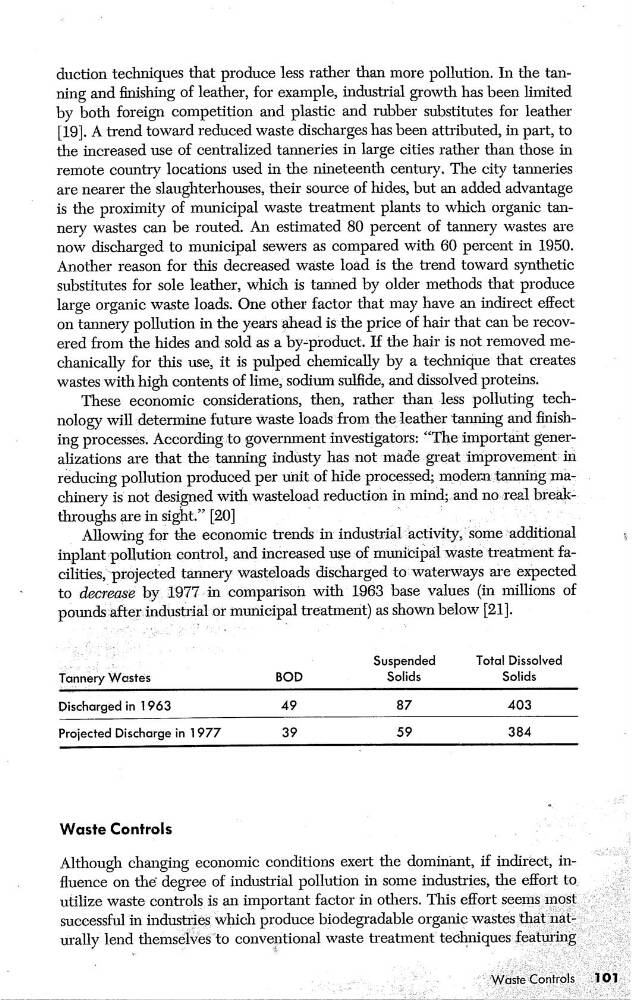
Allowing for the economic trendsin
control,
inCreased use of
treatment fa—
ciliti‘es,‘projected tannery wasteloads discharged towaterWays are expected
‘
to decrease by, 1977 in comparison with 1963 base values (in millions of
or municipal treatment) as shown below [21].
Suspended
Total Dissolved
Tounery
Wastés
BOD
.
Solids
Solids
Dîscharg’ed in 1963
49
87
403
Proiected Discharge in 1977
39
59
384
-
___—___…
Waste Controls
'
_
.Ÿ
Although changing economic conditions exert the dominant, if indirect, in—
.
nance on the” degree of industrial pollution in some industries, the eËort to…
utilize waste
is an important factor in others. This eÉo‘rt seems most
successful in industries Which produce biodegradable organic wastesthatnat—
urally lend themselves ”to conventional
waste tmatmenttèc‘hniques featmmg
ning and nishing of leather, for example, industrial growth has been limited
by both foreign competition and plastic and rubber substitutes for leather
[19]. A trend toward reduced waste discharges has been attributed, in part, to
the increased use of centralized tanneries in large cities rather than those in
remote country locations used in the nineteenth century. The city tanneries
are nearer the slaughterhouses, their source of hides, but an added advantage
is the proximity of municipal waste treatment plants to which organic tan—
nery
wastes can be routed. An estimated 80 percent of tannery wastes are
now discharged to municipal sewers as compared with 60 percent in 1950.
Another reason for this decreased waste load is the trend toward synthetic
substitutes for sole leather, which is tanned by older methods that produce
large organic waste leads. One other factor that may have an indirect effect
on tannery pollution in the years ahead is the price of hair that can be recov—
ered from the hides and sold as a by—*pi‘oduct. If the hair is not removed me—
chanically for this use, it is pulped chemically by a technique that croates
wastes With high contents of lime, sodium sulde, and dissolved proteins.
These economic considerations, then, rather than less pollüting tech—
nology will determine future waste leads from the leather ‘tanning and nish—
-
ing processes. According to government investigators: ‘—‘The imporätàtgeneralizations are that the tanning indûsty has notmàde great improvement in
reducing pollution produced per u'nitof hide proce55edg modern
.
chinery
not designed withwasteload reduction in mind; and no real
throughs are in sight.” [20]
_
g
Ï‘ Ü
‘
*
_
Allowing for the economic trendsin
control,
inCreased use of
treatment fa—
ciliti‘es,‘projected tannery wasteloads discharged towaterWays are expected
‘
to decrease by, 1977 in comparison with 1963 base values (in millions of
or municipal treatment) as shown below [21].
Suspended
Total Dissolved
Tounery
Wastés
BOD
.
Solids
Solids
Dîscharg’ed in 1963
49
87
403
Proiected Discharge in 1977
39
59
384
-
___—___…
Waste Controls
'
_
.Ÿ
Although changing economic conditions exert the dominant, if indirect, in—
.
nance on the” degree of industrial pollution in some industries, the eËort to…
utilize waste
is an important factor in others. This eÉo‘rt seems most
successful in industries Which produce biodegradable organic wastesthatnat—
urally lend themselves ”to conventional
waste tmatmenttèc‘hniques featmmg