

-
matoes, peaches, and other fruits usually are peeled by hot—lye immersion or
spray. Despite recirculation to conserve the lye, the highly alkaline peeling
solution pollutes waterways and carries along With it dissolved organic mate—
rial from the produce.
Another trend with mixed blessings in this industry has been its increased
discharge of wastes to public sewer systems to take advantage of municipal
waste treatment facilities. This trend has decreased direct discharges to
waterways but increased certain municipal treatment problems. About 50
'
percent of canning wastes were discharged to sewers in 1950; this will rise to
an estimated 69 percent by 1977. Some 20 percent of wastes from the frozen
food industry entered the sewers in 1950, compared with a projected estimate
of 35 percent in 1977. Wastewater volumes also have increased in both cases,
so
that the absolute waste quantity has risen as well as the percentage
pumped into the sewers. In many areas, the large seasonal inux of wastes
,
from these industries has exceeded the treatment capacity of public waste
treatment plants. This has been a particularly serious problem in California
where the fruit and vegetable industries are highly concentrated and where
summer low—ow rates in waterways coincide with heavy waste discharges
from the plants. Furthermore, sudden inuxes of large quantities of pollutants
from lye—peeling or blanching operations Carry enough alkaline wastes to dis—
_
rupt some biological and chemical processes at the treatment plants.
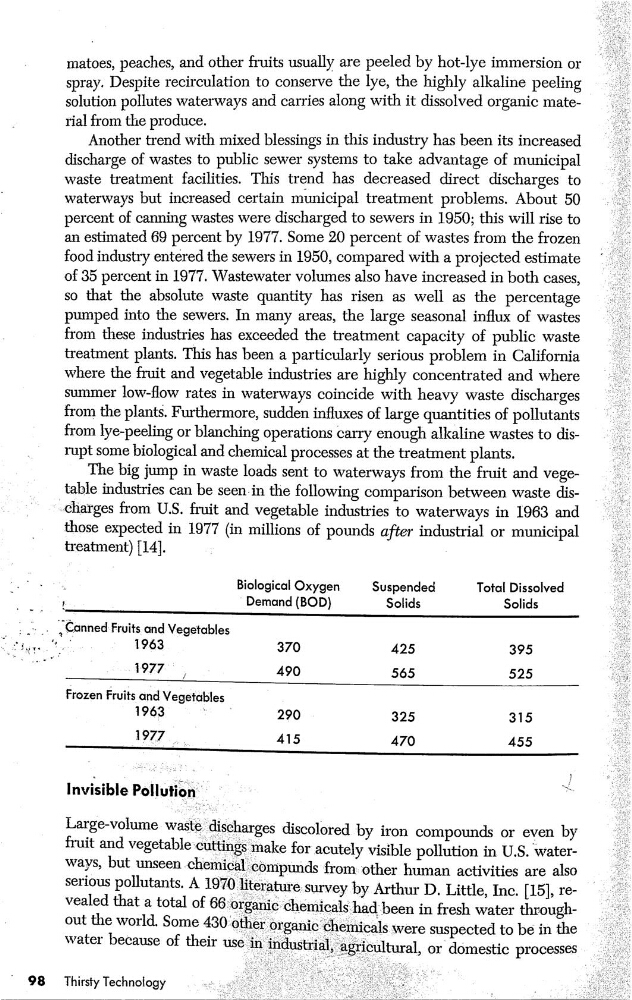
The big jump in waste loads sent to waterways from the fruit and vegetable industries can be seenin the following comparison between waste dis…cha‘rges from U.S. fruit and vegetable industries to waterways in 1963 and
_
-
those expected in 1977 (in millions of pounds after industrial or municipal
treatment) [14].
_
.
’
—
Biological Oxygen
Suspended
Total Dissolvecl
'
Demand (BCD)
Solids
Solids
"
"_——————_
_.
and Vege”tables
ÎÏ__
“
…
_
1953
370
425
395
'
1977
,
490
555
525
1963
‘
290
325
315
1977
.
415
470
455
Invisible
“
Large—volume WætedlS€harg€s discolo'red by iron compounds or even by
fruit and vegetablecutüngsmake for acutely visible pollution in US.
ways,
but
from-other human activities are also
serious pollutants. A 1970hteiature survey by Arthur D. Little, Inc. [15], re—
'
vealed that a total Of 66°rgmcc}lemlcaÏShadïbeen in fresh water through—
,
out the world. Some 430016ï0rgamcchem1calswere suspected to be in the '
water beCause of their usem1ndustr1al,agr1eulünal, ord0mestic processes
'98Wmmmm
matoes, peaches, and other fruits usually are peeled by hot—lye immersion or
spray. Despite recirculation to conserve the lye, the highly alkaline peeling
solution pollutes waterways and carries along With it dissolved organic mate—
rial from the produce.
Another trend with mixed blessings in this industry has been its increased
discharge of wastes to public sewer systems to take advantage of municipal
waste treatment facilities. This trend has decreased direct discharges to
waterways but increased certain municipal treatment problems. About 50
'
percent of canning wastes were discharged to sewers in 1950; this will rise to
an estimated 69 percent by 1977. Some 20 percent of wastes from the frozen
food industry entered the sewers in 1950, compared with a projected estimate
of 35 percent in 1977. Wastewater volumes also have increased in both cases,
so
that the absolute waste quantity has risen as well as the percentage
pumped into the sewers. In many areas, the large seasonal inux of wastes
,
from these industries has exceeded the treatment capacity of public waste
treatment plants. This has been a particularly serious problem in California
where the fruit and vegetable industries are highly concentrated and where
summer low—ow rates in waterways coincide with heavy waste discharges
from the plants. Furthermore, sudden inuxes of large quantities of pollutants
from lye—peeling or blanching operations Carry enough alkaline wastes to dis—
_
rupt some biological and chemical processes at the treatment plants.
The big jump in waste loads sent to waterways from the fruit and vegetable industries can be seenin the following comparison between waste dis…cha‘rges from U.S. fruit and vegetable industries to waterways in 1963 and
_
-
those expected in 1977 (in millions of pounds after industrial or municipal
treatment) [14].
_
.
’
—
Biological Oxygen
Suspended
Total Dissolvecl
'
Demand (BCD)
Solids
Solids
"
"_——————_
_.
and Vege”tables
ÎÏ__
“
…
_
1953
370
425
395
'
1977
,
490
555
525
1963
‘
290
325
315
1977
.
415
470
455
Invisible
“
Large—volume WætedlS€harg€s discolo'red by iron compounds or even by
fruit and vegetablecutüngsmake for acutely visible pollution in US.
ways,
but
from-other human activities are also
serious pollutants. A 1970hteiature survey by Arthur D. Little, Inc. [15], re—
'
vealed that a total Of 66°rgmcc}lemlcaÏShadïbeen in fresh water through—
,
out the world. Some 430016ï0rgamcchem1calswere suspected to be in the '
water beCause of their usem1ndustr1al,agr1eulünal, ord0mestic processes
'98Wmmmm