

tanks. The magnitude of this discharge alone intensies the waste treatment
problem,
since even a waste stream owing at 10,000—25,000 gallons-per—
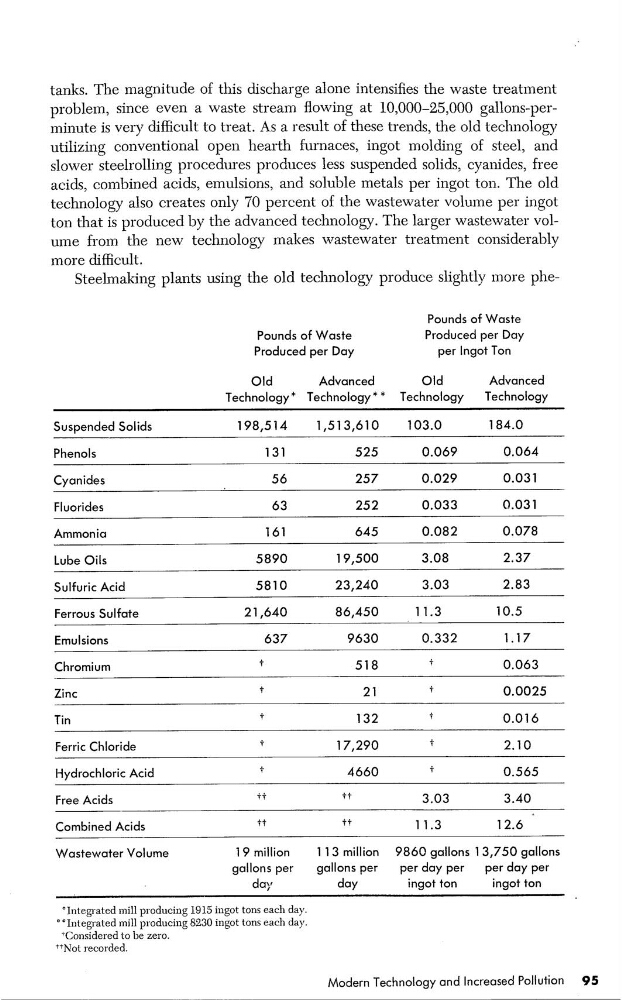
minute is very difcult to treat. As a result of these trends, the old technology
utilizing conventional open hearth furnaces, ingot molding of steel, and
slower steelrolling procedures produces less suspended solids, cyanides, free
acids, combined acids, emulsions, and soluble metals per ingot ton. The old
technology also creates only 70 percent of the wastewater volume per ingot
ton that is produced by the advanced technology. The larger wastewater vol—
ume
from the new technology makes wastewater treatment considerably
more difcult.
Steelmaking plants using the old technology produce slightly more phe—
Pounds of Waste
Pounds of Waste
Produced per Day
Produced per Day
per lngot Ton
Old
Advanced
Old
Advanced
Technology* Technology
* *
Technology
Technology
Suspended Solids
198,514
1,513,610
103.0
184.0
Phenols
131
525
0.069
0.064
Cyanîdes
56
257
0.029
0.031
Fluorides
63
252
0.033
0.031
Ammonia
161
645
0.082
0.078
Lube 0115
5890
19,500
3.08
2.37
Sulfuric Acid
5810
23,240
3.03
2.83
Ferrous Sulfate
21,640
86,450
1 1.3
10.5
Emulsions
637
9630
0.332
1.17
Chromium
"
518
1
0.063
Zinc
1
21
0.0025
Tin
1
132
1
0.016
Ferric Chloride
“
17,290
1
2.10
Hydrochloric Acid
1
4660
1
0.565
Free Acids
11
3.03
3.40
Combined Acids
**
**
1 1.3
12.6
.
Wastewater Volume
19 million
1 13 million
9860 gallons 1 3,750 gallons
gallons per
gallons per
per day per
per day per
-
day
clay
ingot ton
ingot ton
”Integrated mill producing 1915 ingot tons each day.
" “Integrated mil] producing 8280 ingot tons each day.
*Considered to be zero.
”Not recorded.
Modern Technology and Increased Pollution
95
problem,
since even a waste stream owing at 10,000—25,000 gallons-per—
minute is very difcult to treat. As a result of these trends, the old technology
utilizing conventional open hearth furnaces, ingot molding of steel, and
slower steelrolling procedures produces less suspended solids, cyanides, free
acids, combined acids, emulsions, and soluble metals per ingot ton. The old
technology also creates only 70 percent of the wastewater volume per ingot
ton that is produced by the advanced technology. The larger wastewater vol—
ume
from the new technology makes wastewater treatment considerably
more difcult.
Steelmaking plants using the old technology produce slightly more phe—
Pounds of Waste
Pounds of Waste
Produced per Day
Produced per Day
per lngot Ton
Old
Advanced
Old
Advanced
Technology* Technology
* *
Technology
Technology
Suspended Solids
198,514
1,513,610
103.0
184.0
Phenols
131
525
0.069
0.064
Cyanîdes
56
257
0.029
0.031
Fluorides
63
252
0.033
0.031
Ammonia
161
645
0.082
0.078
Lube 0115
5890
19,500
3.08
2.37
Sulfuric Acid
5810
23,240
3.03
2.83
Ferrous Sulfate
21,640
86,450
1 1.3
10.5
Emulsions
637
9630
0.332
1.17
Chromium
"
518
1
0.063
Zinc
1
21
0.0025
Tin
1
132
1
0.016
Ferric Chloride
“
17,290
1
2.10
Hydrochloric Acid
1
4660
1
0.565
Free Acids
11
3.03
3.40
Combined Acids
**
**
1 1.3
12.6
.
Wastewater Volume
19 million
1 13 million
9860 gallons 1 3,750 gallons
gallons per
gallons per
per day per
per day per
-
day
clay
ingot ton
ingot ton
”Integrated mill producing 1915 ingot tons each day.
" “Integrated mil] producing 8280 ingot tons each day.
*Considered to be zero.
”Not recorded.
Modern Technology and Increased Pollution
95