

'
a
»
….
_
,
'
.
’Ï : '
-
/
Ï
i
_
_
»
,
_:
,
,
’
'
’
*
%
f
=
,
’
,
à
«…
,
.
-…
«aw.
‘
‘
-
—‘
.
"f……
_
…»
;
:
_
&
.;
.
—
;»;
‘
*——
_:€.'v s‘
î
_
.
'
…
::
\‘*
'
'
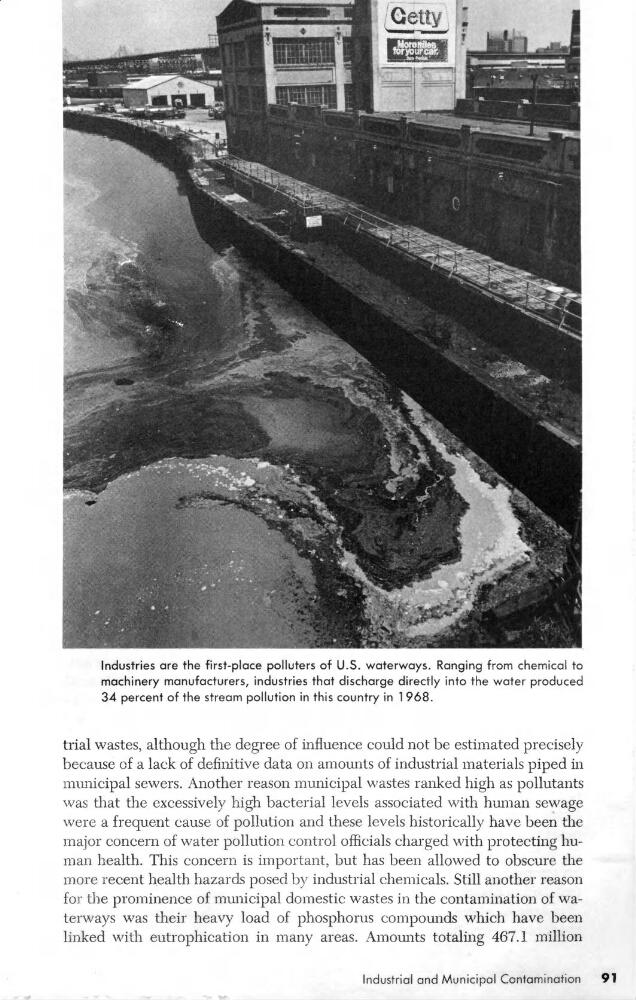
Industries are the rst-place polluters of U.S. waterways. Ranging from chemical to
machinery manufacturers, industries that discharge directly into the water produced
34 percent of the stream pollution in this country in 1968.
trial wastes, although the degree of inuence could not be estimated precisely
because of a lack of denitive data on amounts of industrial materials piped in
municipal sewers. Another reason municipal wastes ranked high as pollutants
was that the excessively high bacterial levels associated with human sewage
were a frequent cause of pollution and these levels historically have been the
major concern of water pollution control ofcials charged with protecting hu—
man health. This concern is important, but has been allowed to obscure the
more recent health hazards posed by industrial chemicals. Still another reason
for the prominence of municipal domestic wastes in the contamination of wa—
terways was their heavy load of phosphorus compounds which have been
linked with eutrophication in many areas. Amounts totaling 467.1 million
Industrial and Municipal Contamination
91
a
»
….
_
,
'
.
’Ï : '
-
/
Ï
i
_
_
»
,
_:
,
,
’
'
’
*
%
f
=
,
’
,
à
«…
,
.
-…
«aw.
‘
‘
-
—‘
.
"f……
_
…»
;
:
_
&
.;
.
—
;»;
‘
*——
_:€.'v s‘
î
_
.
'
…
::
\‘*
'
'
Industries are the rst-place polluters of U.S. waterways. Ranging from chemical to
machinery manufacturers, industries that discharge directly into the water produced
34 percent of the stream pollution in this country in 1968.
trial wastes, although the degree of inuence could not be estimated precisely
because of a lack of denitive data on amounts of industrial materials piped in
municipal sewers. Another reason municipal wastes ranked high as pollutants
was that the excessively high bacterial levels associated with human sewage
were a frequent cause of pollution and these levels historically have been the
major concern of water pollution control ofcials charged with protecting hu—
man health. This concern is important, but has been allowed to obscure the
more recent health hazards posed by industrial chemicals. Still another reason
for the prominence of municipal domestic wastes in the contamination of wa—
terways was their heavy load of phosphorus compounds which have been
linked with eutrophication in many areas. Amounts totaling 467.1 million
Industrial and Municipal Contamination
91