

170
FREEZE—DRYING
,
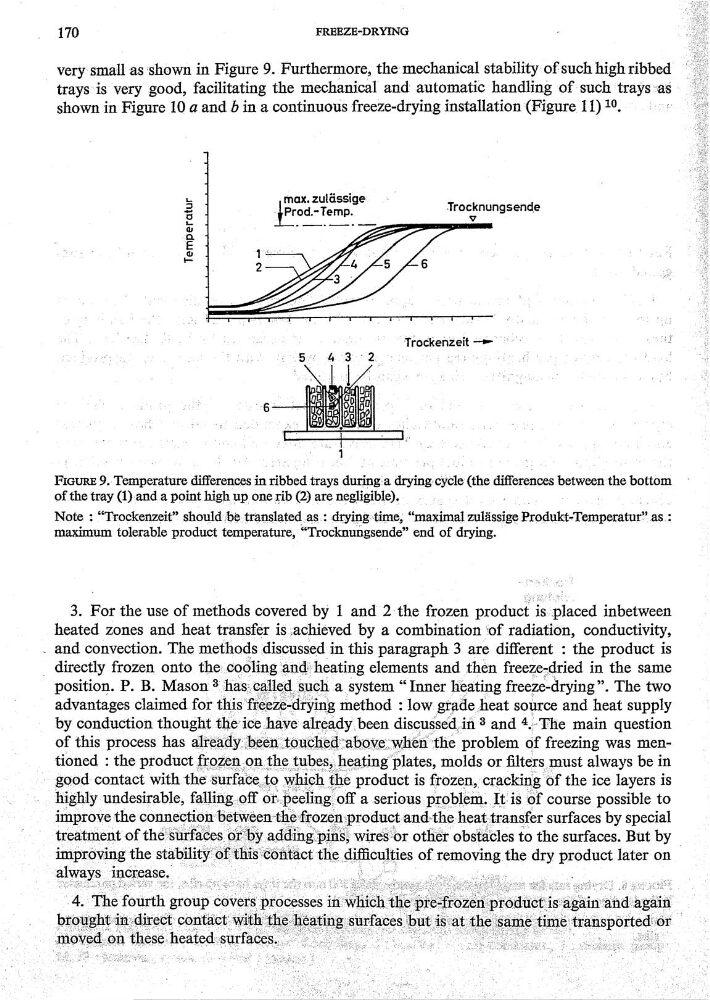
Very small as shown in Figure 9. Furthermore, the mechanical stability of such high ribbed
trays is very good, facilitating the mechanical and automatic handling of such 'traÿs
shown in Figure 10 a and b in a continuous freeZe-drying installation (Figure 11) 1°.
4 '
‘
%:
'
_
'
;
"
‘
'
TEockehzeit -'—> ï‘
,
_
,
M$." 5‘
FIGURE 9.Temperature differences in ribbed trays duringia dryingcÿde (the differences betweenthe bottom
‘
of the tray (l)andapoint high up one rib (2)are negligible).
,
,
_
_
Note : “Trockehzeit” should be,traælaædau
“maximal zulässige Produkt—Temperatu’ as:
maximum tolerable product temperature, “Trocknungsende” end of drying.
3. For the use of methods covered by 1 and 2—the frozen product isplaced inbctween
heated zones and heat transfer is achieved by a combination
radiatio‘n, conductivity,
and convection. The methods
this paragraph 3 are dierent : the product is
_
directly frozen onto thecodling 'iandë—g heating elements and then freeze;dried in the same
position. P. B. Mason
a System
“ Inner heating
”. The two
'
advantages claimed for thlsfreeze-drymg method : low grade—heat source and heat supply
'
by conduction thought the icehave‘ already been
3 and
main question
of this process has alreadybeent0u0hedab0Vewhenthe problem Qf freezing was men—
tioned : the product
molds or ltei‘s_must always bein
good contact With the
WhIChthe product is r0zen,
the ice layers is
_
‘
,
highly undesirable,
a serious problem. It1s of course possible to
ih1pr0Ve the
surfaces by special
'
_
‘
treatment of thesurfaœsorby addingp1ns,
obs‘têi‘cles to the surfaces. But by
improving
the
of removingthe dry product later on
‘
64. ‘The'fourth
?
?
«
broughtmdect contactWlththeheaüngsurfacesbutwatthesametunetransportedor
FREEZE—DRYING
,
Very small as shown in Figure 9. Furthermore, the mechanical stability of such high ribbed
trays is very good, facilitating the mechanical and automatic handling of such 'traÿs
shown in Figure 10 a and b in a continuous freeZe-drying installation (Figure 11) 1°.
4 '
‘
%:
'
_
'
;
"
‘
'
TEockehzeit -'—> ï‘
,
_
,
M$." 5‘
FIGURE 9.Temperature differences in ribbed trays duringia dryingcÿde (the differences betweenthe bottom
‘
of the tray (l)andapoint high up one rib (2)are negligible).
,
,
_
_
Note : “Trockehzeit” should be,traælaædau
“maximal zulässige Produkt—Temperatu’ as:
maximum tolerable product temperature, “Trocknungsende” end of drying.
3. For the use of methods covered by 1 and 2—the frozen product isplaced inbctween
heated zones and heat transfer is achieved by a combination
radiatio‘n, conductivity,
and convection. The methods
this paragraph 3 are dierent : the product is
_
directly frozen onto thecodling 'iandë—g heating elements and then freeze;dried in the same
position. P. B. Mason
a System
“ Inner heating
”. The two
'
advantages claimed for thlsfreeze-drymg method : low grade—heat source and heat supply
'
by conduction thought the icehave‘ already been
3 and
main question
of this process has alreadybeent0u0hedab0Vewhenthe problem Qf freezing was men—
tioned : the product
molds or ltei‘s_must always bein
good contact With the
WhIChthe product is r0zen,
the ice layers is
_
‘
,
highly undesirable,
a serious problem. It1s of course possible to
ih1pr0Ve the
surfaces by special
'
_
‘
treatment of thesurfaœsorby addingp1ns,
obs‘têi‘cles to the surfaces. But by
improving
the
of removingthe dry product later on
‘
64. ‘The'fourth
?
?
«
broughtmdect contactWlththeheaüngsurfacesbutwatthesametunetransportedor