

FOOD PRODUCTS
171
W. C. Rockwell, V. F. Kaufman, E. Lowe, and A. l. Morgan, Jr. 11 have described an
experimental dryer with an hexagonal rotary drying tube in a stationary vacuum chamber.
Figure 12 shows a photo of a pilot installation following a somewhat similar principle :
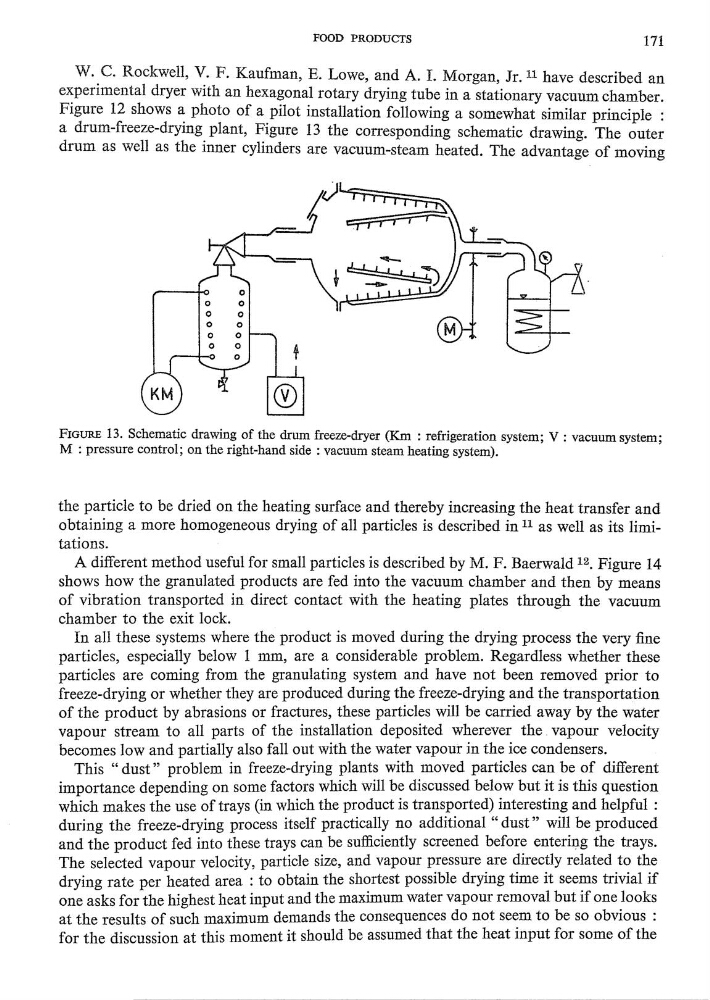
a drum—freeze—drying plant, Figure 13 the corresponding schematic drawing. The enter
drum as well as the inner cylinders are vacuum—steam heated. The advantage of moving
…
_
_
—=—.
°
.
'
.
°
_.
“>
A
0
O
'
3
3
gä
0
O
3
t
.r‘
'
FIGURE l3. Schematic drawing of the drum freeze-dryer (Km : refrigeration system; V : vacuum system;
M : pressure control; on the right—hand side : vacuum steam heating system).
the particle to be dried on the heating surface and thereby increasing the heat transfer and
obtaining a more homogeneous drying of all particles is described in 11
as well as its limitations.
A different method useful for small particles is described by M. F. Baerwald 12. Figure 14
shows how the granulated products are fed into the vacuum chamber and then by means
of vibration transported in direct contact with the heating plates through the vacuum
chamber to the exit lock.
In all these systems where the product is moved during the drying process the very ne
particles, especially below 1 mm, are a considerable problem. Regardless whether these
particles are coming from the granulating system and have not been removed prior to
freeze-drying or whether they are produced during the freeze—drying and the transportation
of the product by abrasions or fractures, these particles will be carried away by the water
vapeur stream to all parts of the installation deposited wherever the
_
vapeur velocity
becomes low and partially also fall out with the water vapeur in the ice condensers.
This “ dust” problem in freeze—drying plants With moved particles can be of different
importance depending on some factors which will be discussed below but it is this question
which makes the use of trays (in which the product is transported) interesting and helpful :
during the freeze-drying process itself practically ne additional “dust” will
be produced
and the product fed into these trays can be suîoiently screened before enter1ng the trays.
The selected vapeur velocity, particle size, and vapeur pressure are directly
related to the
drying rate per heated area : to obtain the shortest poss1ble drying t1me 1t seems
tr1v1al 1f
one asks for the highest heat input and the maximum water vapeur removal but if one looks
at the results of such maximum demands the consequences de net seem to be so obv1ous :
for the discussion at this moment it should be assumed that the heat input for some of the
171
W. C. Rockwell, V. F. Kaufman, E. Lowe, and A. l. Morgan, Jr. 11 have described an
experimental dryer with an hexagonal rotary drying tube in a stationary vacuum chamber.
Figure 12 shows a photo of a pilot installation following a somewhat similar principle :
a drum—freeze—drying plant, Figure 13 the corresponding schematic drawing. The enter
drum as well as the inner cylinders are vacuum—steam heated. The advantage of moving
…
_
_
—=—.
°
.
'
.
°
_.
“>
A
0
O
'
3
3
gä
0
O
3
t
.r‘
'
FIGURE l3. Schematic drawing of the drum freeze-dryer (Km : refrigeration system; V : vacuum system;
M : pressure control; on the right—hand side : vacuum steam heating system).
the particle to be dried on the heating surface and thereby increasing the heat transfer and
obtaining a more homogeneous drying of all particles is described in 11
as well as its limitations.
A different method useful for small particles is described by M. F. Baerwald 12. Figure 14
shows how the granulated products are fed into the vacuum chamber and then by means
of vibration transported in direct contact with the heating plates through the vacuum
chamber to the exit lock.
In all these systems where the product is moved during the drying process the very ne
particles, especially below 1 mm, are a considerable problem. Regardless whether these
particles are coming from the granulating system and have not been removed prior to
freeze-drying or whether they are produced during the freeze—drying and the transportation
of the product by abrasions or fractures, these particles will be carried away by the water
vapeur stream to all parts of the installation deposited wherever the
_
vapeur velocity
becomes low and partially also fall out with the water vapeur in the ice condensers.
This “ dust” problem in freeze—drying plants With moved particles can be of different
importance depending on some factors which will be discussed below but it is this question
which makes the use of trays (in which the product is transported) interesting and helpful :
during the freeze-drying process itself practically ne additional “dust” will
be produced
and the product fed into these trays can be suîoiently screened before enter1ng the trays.
The selected vapeur velocity, particle size, and vapeur pressure are directly
related to the
drying rate per heated area : to obtain the shortest poss1ble drying t1me 1t seems
tr1v1al 1f
one asks for the highest heat input and the maximum water vapeur removal but if one looks
at the results of such maximum demands the consequences de net seem to be so obv1ous :
for the discussion at this moment it should be assumed that the heat input for some of the