

.
FOOD PRODUCTS
É
169
With suCh a combined freezing and drying system is to nd products which do not,peel or
break off from their supporting structure until they are nally dry, and which can be easily
and completely removed at the end of the drying period.
_
DRYING
.
—
For the freeze-drying process itself four di‘erent principles. are in use or have been sug—
gested to use :
1. The product is placed in what might be called
trays lled with the product
up to a height of mostly between 10 mm and 20 mm. For larger systems the handling of
these trays can be mechanized or partly automated, as described by F. K. Lawler 6. The
load per tray—or per heating—area per charge-varies widely with the nature of the product,
but as an order of magnitude 10 kg/m2 can be expected.
2. Additional devices are used to improve
heat transfer to the product. Spikes7
especially for meat products, sandwiches of product __expanded metal and heated plates8
and high (approx. 70 mm) ribbed trays9 (Figure 7) are‘three well known methods to improve
the throughput of a given product per time and heating area. The load of such ribbed trays
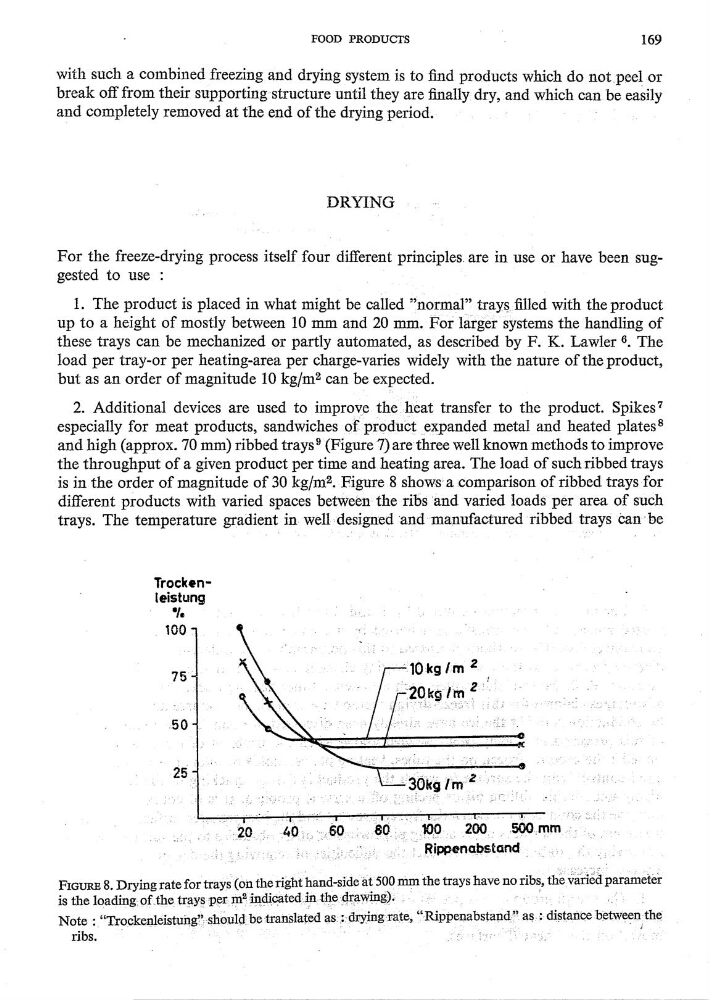
is in the order of magnitude of 30 kg/m2. Figure 8 shows*a comparison of ribbed trays for
different products with varied spaces betWe“enthe ribS
varied loads per area of such
trays. The temperature gradient in well designed and manufactured ribbed trays Canbe
Trocken_
‘
leîstung
'
'
,
l0kglm
,
_
Rippenqbstand
FIGURE 8. Drying rate for
(on the right hand—side ”at 500 mm the trays have no ribs,
thevaned parameter
is the loading—,,ofthetrays
the:dräWï%)-' .
'
-
,
:
;
:
'
-
-.ÎÏ
:
Note ;
be=trans1a.ted as?drym‘
‘,eripPenabstànd”
* distanœbäWæë
ribs.
‘
‘
'
-
‘
,
il
:« ‘
2
w
Ï
FOOD PRODUCTS
É
169
With suCh a combined freezing and drying system is to nd products which do not,peel or
break off from their supporting structure until they are nally dry, and which can be easily
and completely removed at the end of the drying period.
_
DRYING
.
—
For the freeze-drying process itself four di‘erent principles. are in use or have been sug—
gested to use :
1. The product is placed in what might be called
trays lled with the product
up to a height of mostly between 10 mm and 20 mm. For larger systems the handling of
these trays can be mechanized or partly automated, as described by F. K. Lawler 6. The
load per tray—or per heating—area per charge-varies widely with the nature of the product,
but as an order of magnitude 10 kg/m2 can be expected.
2. Additional devices are used to improve
heat transfer to the product. Spikes7
especially for meat products, sandwiches of product __expanded metal and heated plates8
and high (approx. 70 mm) ribbed trays9 (Figure 7) are‘three well known methods to improve
the throughput of a given product per time and heating area. The load of such ribbed trays
is in the order of magnitude of 30 kg/m2. Figure 8 shows*a comparison of ribbed trays for
different products with varied spaces betWe“enthe ribS
varied loads per area of such
trays. The temperature gradient in well designed and manufactured ribbed trays Canbe
Trocken_
‘
leîstung
'
'
,
l0kglm
,
_
Rippenqbstand
FIGURE 8. Drying rate for
(on the right hand—side ”at 500 mm the trays have no ribs,
thevaned parameter
is the loading—,,ofthetrays
the:dräWï%)-' .
'
-
,
:
;
:
'
-
-.ÎÏ
:
Note ;
be=trans1a.ted as?drym‘
‘,eripPenabstànd”
* distanœbäWæë
ribs.
‘
‘
'
-
‘
,
il
:« ‘
2
w
Ï