

154
'
FREEZ&DRYING
'reaches the consumer.
Therefore keeping quality characteristics, as used ;for the time; _
temperature-relati0nship, are often indieating storage time—for the rst detectable quality
change of the Specic product.
«
'
.
1
Figure 3 shows the keeping time of few selected frozen foods until they have endured
some loss of quaty—plotted in a semi-logarithmic diagram aboVe storage temperature.
Here We get sometimes nearly straight linesbecause for many products the keepin'g
timein‘c‘reas'es almost exponentially-with thelow‘ering of the temperature.
'.
‘
—
The temperature during storage and distribution “of frozen foodstus should remain
constant.
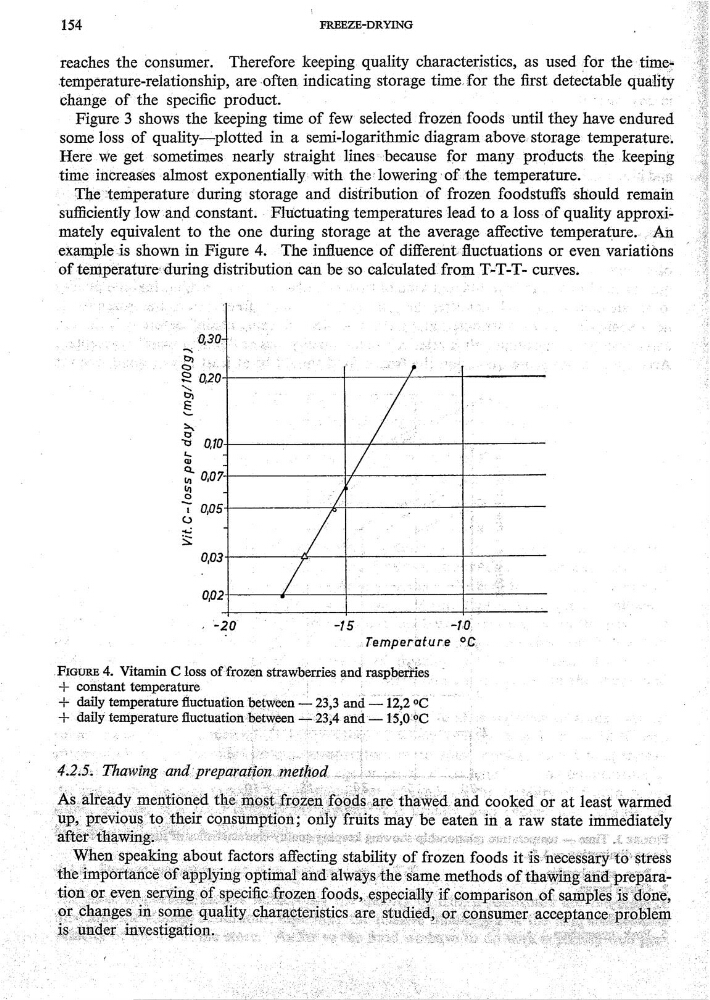
Fluctuating temperatures lead to a loss of quality
mately equivalent to the one during storage at the average affective temperature- ,An
eXamplezis shown in Figure 4. The inuence of
or even variati0ns
'of temperature: during distribution can be so ca10ulated from T—‘T—T— curves.
,
.
‘
.
Q'
‘
,
—
.
'
.…«7
.
,
.
,
_
_
\
Ê
-..
>\
D
am
.
r—
a
__
T 0,05
A
‘.
'
,
'
0.02 __
'
LŸ
'
'
,
‘
'
,
‘-20‘
'
—
—15
'
'
{
«
"
Ÿ
,
r
-
'
-
Temper'atune °C
-
'
FIGURE 4. Vitamin C loss offrozen sti‘awberries and raspbemes ‘ _
_
,
,
'
+ constant temperature
,
f
'
.
-
‘
+ daily tempetaüue uctuationbetWèen
-—'— 23,3 and ——- 12,2 ?C
+ daily temperature
442334
'
'
,
'
‘
‘
"
,
'
4.2.5. Thawing andpreparatËi‘on…metÿod
…
,
_
,
'
'
up, prev1ous
fruits 'iaÿΑhe 'eaten
a raw state immediately
'
afterthawmg
,.
"
"
about factors affecting stabilityoi frozen foods 1t15necessaryto “stress
the1mportanooof £'àÏjÇip“_lÿir'1g"'?Îopjtimal°and! alwaystho Same methods of thawmgandprepara—
.
t10n0revenservmg°fspeœofroænfoodsespeœawfcwpasonofs&mplewsdone
°f°hangesmsemequalitycharactŒ—‘lsücsarestudœdorconsumeracceptanœpmblem
,
«
? lsudefmesügaüw
f
'
FREEZ&DRYING
'reaches the consumer.
Therefore keeping quality characteristics, as used ;for the time; _
temperature-relati0nship, are often indieating storage time—for the rst detectable quality
change of the Specic product.
«
'
.
1
Figure 3 shows the keeping time of few selected frozen foods until they have endured
some loss of quaty—plotted in a semi-logarithmic diagram aboVe storage temperature.
Here We get sometimes nearly straight linesbecause for many products the keepin'g
timein‘c‘reas'es almost exponentially-with thelow‘ering of the temperature.
'.
‘
—
The temperature during storage and distribution “of frozen foodstus should remain
constant.
Fluctuating temperatures lead to a loss of quality
mately equivalent to the one during storage at the average affective temperature- ,An
eXamplezis shown in Figure 4. The inuence of
or even variati0ns
'of temperature: during distribution can be so ca10ulated from T—‘T—T— curves.
,
.
‘
.
Q'
‘
,
—
.
'
.…«7
.
,
.
,
_
_
\
Ê
-..
>\
D
am
.
r—
a
__
T 0,05
A
‘.
'
,
'
0.02 __
'
LŸ
'
'
,
‘
'
,
‘-20‘
'
—
—15
'
'
{
«
"
Ÿ
,
r
-
'
-
Temper'atune °C
-
'
FIGURE 4. Vitamin C loss offrozen sti‘awberries and raspbemes ‘ _
_
,
,
'
+ constant temperature
,
f
'
.
-
‘
+ daily tempetaüue uctuationbetWèen
-—'— 23,3 and ——- 12,2 ?C
+ daily temperature
442334
'
'
,
'
‘
‘
"
,
'
4.2.5. Thawing andpreparatËi‘on…metÿod
…
,
_
,
'
'
up, prev1ous
fruits 'iaÿΑhe 'eaten
a raw state immediately
'
afterthawmg
,.
"
"
about factors affecting stabilityoi frozen foods 1t15necessaryto “stress
the1mportanooof £'àÏjÇip“_lÿir'1g"'?Îopjtimal°and! alwaystho Same methods of thawmgandprepara—
.
t10n0revenservmg°fspeœofroænfoodsespeœawfcwpasonofs&mplewsdone
°f°hangesmsemequalitycharactŒ—‘lsücsarestudœdorconsumeracceptanœpmblem
,
«
? lsudefmesügaüw
f