

FROZEN FOODS
153
packed and sealed in moisture proof packaging material, there is no signicant loss of
moisture and therefore the relative humidity of storage room is not of great importance;
in any case, it is kept as high as possible, especially if the food is unpacked or packed in
non—moisture proof material. The air circulation should be sufcient to assure a uniform
temperature in the cold store.
The temperature inuences the loss of quality of frozen
foods very strongly, because the rate of desiccation or of freezer burn and of chemical
and biochemical reactions are depending on it according to the law of van t’Ho‘. Therefore,
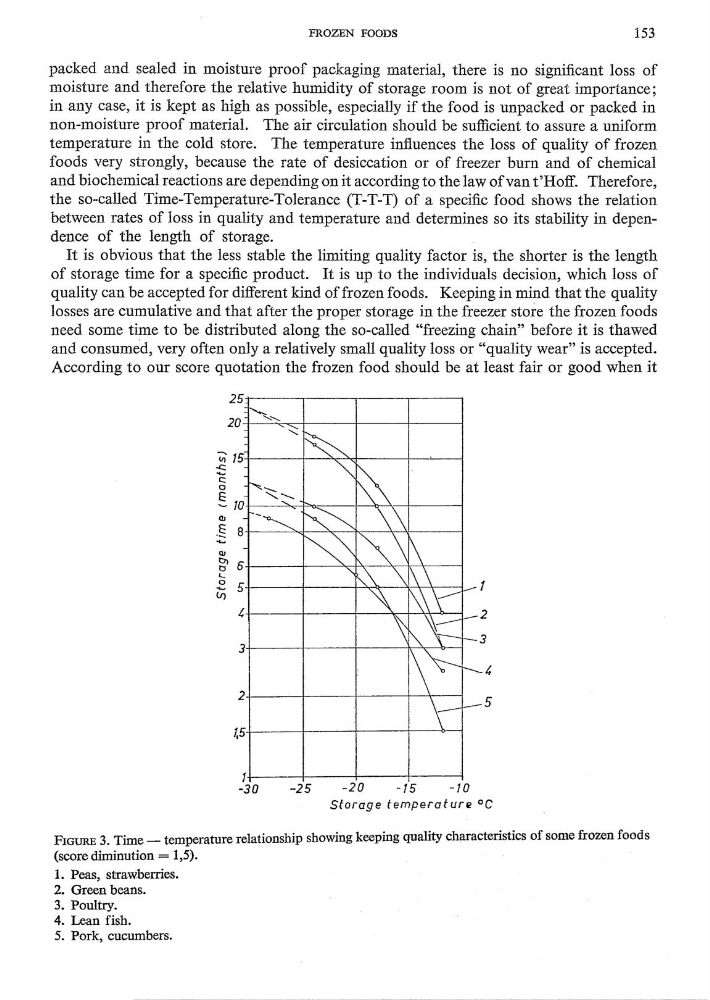
the so—called Time-Temperature—Tolerance (T—T—T) of a specic food shows the relation
between rates of loss in quality and temperature and determines so its stability in depen—
dence of the length of storage.
It is obvious that the less stable the limiting quality factor is, the shorter is the length
of storage time for a specic product. It is up to the individuals decision, which loss of
quality can be accepted for different kind of frozen foods. Keeping in mind that the quality
losses are cumulative and that after the proper storage in the freezer store the frozen foods
need some time to be distributed along the so-called “freezing chain” before it is thawed
and consumed, very often only a relatively small quality loss or “quality wear” is accepted.
According to our score quotation the frozen food should be at least fair or good when it
25
20
-ä-"u? 75
‘
—Q
ë
‘
.
E
70
ë ,
mum-k\h\
U
5
‘_
5 5
-—… ‘
,
"’
--“&\Ë
4
-
2
.
‘
3
—
3
Z...“
5
....
7
-30
-—25
—20
—
75
-70
Storage temperature °C
_
FIGURE 3. Time -— temperature relationship showing keeping quality characteristics of some frozen foods
(score diminution = 1,5).
1. Peas, strawberrîes.
2. Green beans.
3. Poultry.
'
4. Lean fish.
5. Pork, cucumbers.
153
packed and sealed in moisture proof packaging material, there is no signicant loss of
moisture and therefore the relative humidity of storage room is not of great importance;
in any case, it is kept as high as possible, especially if the food is unpacked or packed in
non—moisture proof material. The air circulation should be sufcient to assure a uniform
temperature in the cold store.
The temperature inuences the loss of quality of frozen
foods very strongly, because the rate of desiccation or of freezer burn and of chemical
and biochemical reactions are depending on it according to the law of van t’Ho‘. Therefore,
the so—called Time-Temperature—Tolerance (T—T—T) of a specic food shows the relation
between rates of loss in quality and temperature and determines so its stability in depen—
dence of the length of storage.
It is obvious that the less stable the limiting quality factor is, the shorter is the length
of storage time for a specic product. It is up to the individuals decision, which loss of
quality can be accepted for different kind of frozen foods. Keeping in mind that the quality
losses are cumulative and that after the proper storage in the freezer store the frozen foods
need some time to be distributed along the so-called “freezing chain” before it is thawed
and consumed, very often only a relatively small quality loss or “quality wear” is accepted.
According to our score quotation the frozen food should be at least fair or good when it
25
20
-ä-"u? 75
‘
—Q
ë
‘
.
E
70
ë ,
mum-k\h\
U
5
‘_
5 5
-—… ‘
,
"’
--“&\Ë
4
-
2
.
‘
3
—
3
Z...“
5
....
7
-30
-—25
—20
—
75
-70
Storage temperature °C
_
FIGURE 3. Time -— temperature relationship showing keeping quality characteristics of some frozen foods
(score diminution = 1,5).
1. Peas, strawberrîes.
2. Green beans.
3. Poultry.
'
4. Lean fish.
5. Pork, cucumbers.