

FROZEN FOODS
155
4.3. Stability of structure and composition
It is of great importance for the keeping quality of a frozen food to preserve its structure
as far as possible in an unchanged condition. The substances responsible for structure
of a food—which are in principle carbohydrate—water and protein—water gels—are
susceptible to freezing, storage and thawing. The reversibility of these processes depends, ;;:iÏ
on the ability of components of food (mainly carbohydrates and proteins) to re-absorb.
the water and to reconstitute the osmotic pressure within the cells or their turgescenÿiämm‘ï‘
after thawing. The texture may become soft or strawy, especially if the cell walls
damaged mechanically or by denaturation processes and drip is formed as result of
permeability of the whole system; it may occur that the structure collapses because of
severe alteration in the structure forming substances. The rate of deterioration is reduced
by proper handling of material, by the right choice of variety or stage of ripeness and by
lowering the storage temperature.
'
The texture 2 (rmness, tenderness, etc.) is usually determined by the chewing resistance
of the particular product. But there is research going on since about 30 years With the
task to replace the subjective organoleptical method by an objective measurement 3 of
the rmness or tenderness of tissues by measuring the shearing, cutting or_
friction forces
or even a force needed for some determined kind of size reduction 4'5.
The sensory assess—
ment of food consistency or rmness must be, of course, in a good correlation with the
measurable force value.
These values could be measured in texturometer or tester, penetrometer, consistometer, viscosimeter, etc.
_40
780
8
'
"'“…
'
…
'
2
A
“5
>.
0
È 30
760
6
V
A
".Q
o
g 25
_\
'750
ë
5
A‘
…
"
:
a 20
%
740
*;“4
3
Q
&
Ï5
730
3
—30
—20
.
-70
Storage
temperature (°C)
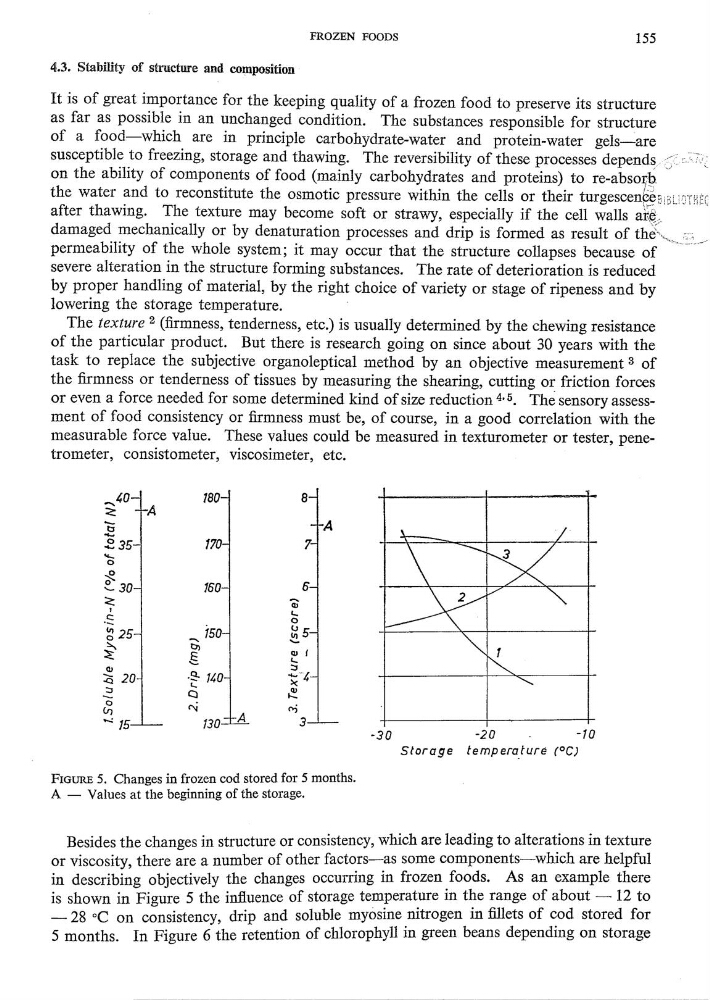
FIGURE 5
.
Changes in frozen cod stored for 5 months.
_
A — Values at the beginning of the storage.
Besides the changes in structure or consistency, which are leading to alterations in texture
or viscosity, there are a number of other factors—as some components—which are helpful
in describing objectively the changes occurring in frozen_foods.
As an example there
is shown in Figure 5 the inuence of storage temperature m the range of about — 12 to
—
28 °C on consistency, drip and soluble my0sine nitrogen in llets of cod
stored for
5 months.
In Figure 6 the retention of chlorophyll in green beans dependmg on storage
155
4.3. Stability of structure and composition
It is of great importance for the keeping quality of a frozen food to preserve its structure
as far as possible in an unchanged condition. The substances responsible for structure
of a food—which are in principle carbohydrate—water and protein—water gels—are
susceptible to freezing, storage and thawing. The reversibility of these processes depends, ;;:iÏ
on the ability of components of food (mainly carbohydrates and proteins) to re-absorb.
the water and to reconstitute the osmotic pressure within the cells or their turgescenÿiämm‘ï‘
after thawing. The texture may become soft or strawy, especially if the cell walls
damaged mechanically or by denaturation processes and drip is formed as result of
permeability of the whole system; it may occur that the structure collapses because of
severe alteration in the structure forming substances. The rate of deterioration is reduced
by proper handling of material, by the right choice of variety or stage of ripeness and by
lowering the storage temperature.
'
The texture 2 (rmness, tenderness, etc.) is usually determined by the chewing resistance
of the particular product. But there is research going on since about 30 years With the
task to replace the subjective organoleptical method by an objective measurement 3 of
the rmness or tenderness of tissues by measuring the shearing, cutting or_
friction forces
or even a force needed for some determined kind of size reduction 4'5.
The sensory assess—
ment of food consistency or rmness must be, of course, in a good correlation with the
measurable force value.
These values could be measured in texturometer or tester, penetrometer, consistometer, viscosimeter, etc.
_40
780
8
'
"'“…
'
…
'
2
A
“5
>.
0
È 30
760
6
V
A
".Q
o
g 25
_\
'750
ë
5
A‘
…
"
:
a 20
%
740
*;“4
3
Q
&
Ï5
730
3
—30
—20
.
-70
Storage
temperature (°C)
FIGURE 5
.
Changes in frozen cod stored for 5 months.
_
A — Values at the beginning of the storage.
Besides the changes in structure or consistency, which are leading to alterations in texture
or viscosity, there are a number of other factors—as some components—which are helpful
in describing objectively the changes occurring in frozen_foods.
As an example there
is shown in Figure 5 the inuence of storage temperature m the range of about — 12 to
—
28 °C on consistency, drip and soluble my0sine nitrogen in llets of cod
stored for
5 months.
In Figure 6 the retention of chlorophyll in green beans dependmg on storage