

1 16
FREEZE—DRYÏNG
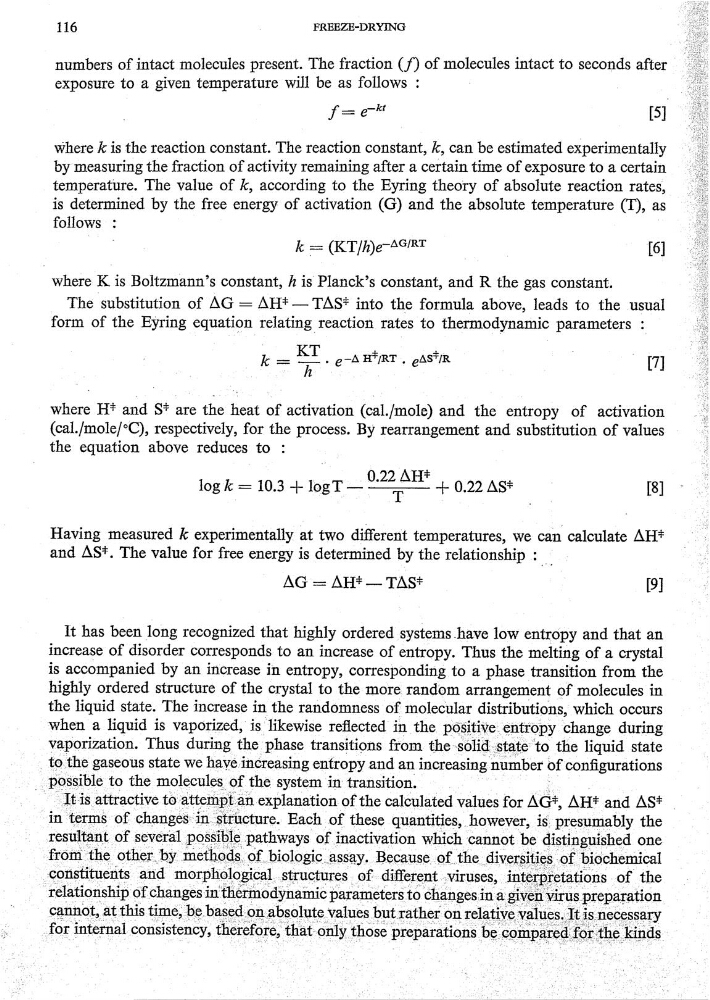
numbers of intact molecules present. The fraction (f) of molecules intact to seconds after
exposure to a given temperature Will be as follows :
,
Where k is the reaction constant. The reaction constant, k, can be estimated eXperimentally
by measuring the fraction of activity remaining after a certain time of exposure to a certain
temperature. The value of k, according to the Eyring theory of absolute reaction rates,
is determined by the free energy of activation (G) and the absolute temperature (T), as
follows :
‘
'
k _: (KT/h)e—AG/RT
_
[6]
Where K is Boltzmann’s constant, h is Planck’s constant, and R the gas constant.
The substitution of AG = AH*—TAS* into the formula above, leads to the usual
form of the Eyring equation relating reaction rates to thermodynamic parameters :_
»
k :
I_î_r . e—A H*;RT
,
eAS*/R
'
…
Where H* and
are the heat of activation {cal./mole) and the entropy of activation
_
(cal. /mole/ °C), respectively, for the process. By rearrangement and substitution of values
the equation above reduces to :
0.22 AH*
log k = 10.3 + logT ——
+ 0.22 AS*
’
[S]
“
”,
Having measured k experimentay at two di"erent temperatures, we can calculate AH*
_
and AS*. The value for free energy is determined by the relationship .:
AG = AH* —— TAS*
[9]
It has been long recognized that highly
have low entropy and that an
increase of disorder corresponds to an increase of entropy. Thus the melting of a crystal
is accompanied by an increase in entropy, corresp0nding to a phase transition from the
highly ordered structure of the crystal to the more rand0m arrangement of molecules in
the liquid state. The increase in the randomness of molecular distributions, Which occurs
When a liquid is vaporized, is likewise reected inthe
change during
vap“orization. Thus during the phase transitions from the solid
the liquid state
t9;the gaseous state we haÿcä…inôreasing entropy and an increasing number of congurations
_
possible to the
the system in transition.
“
_
‘
toattemptan explanation of the calculated values for AG*, AH* and AS*
_
_
interms of
Eachof these quantities, however, is; pre3umably the
‘
resultantof several poss1blepathways of ,mactivation which cannot be distinguished one
; from the;
by meth9@s… of
Because. of… the diversmes vof ? gbidch‘emical
and
mterpretaüons of the
,
relationship of changes
parameters to Changesin ag1vmv1rus prepaîaticn
’
"
cambtehî8ümebebasedonabsoluœvaluesbutrathonrelaüvevuesItîsneœssary
for internal consisteney, therefore,
those preparations becompaŒdf0ï'ChÔkldS
FREEZE—DRYÏNG
numbers of intact molecules present. The fraction (f) of molecules intact to seconds after
exposure to a given temperature Will be as follows :
,
Where k is the reaction constant. The reaction constant, k, can be estimated eXperimentally
by measuring the fraction of activity remaining after a certain time of exposure to a certain
temperature. The value of k, according to the Eyring theory of absolute reaction rates,
is determined by the free energy of activation (G) and the absolute temperature (T), as
follows :
‘
'
k _: (KT/h)e—AG/RT
_
[6]
Where K is Boltzmann’s constant, h is Planck’s constant, and R the gas constant.
The substitution of AG = AH*—TAS* into the formula above, leads to the usual
form of the Eyring equation relating reaction rates to thermodynamic parameters :_
»
k :
I_î_r . e—A H*;RT
,
eAS*/R
'
…
Where H* and
are the heat of activation {cal./mole) and the entropy of activation
_
(cal. /mole/ °C), respectively, for the process. By rearrangement and substitution of values
the equation above reduces to :
0.22 AH*
log k = 10.3 + logT ——
+ 0.22 AS*
’
[S]
“
”,
Having measured k experimentay at two di"erent temperatures, we can calculate AH*
_
and AS*. The value for free energy is determined by the relationship .:
AG = AH* —— TAS*
[9]
It has been long recognized that highly
have low entropy and that an
increase of disorder corresponds to an increase of entropy. Thus the melting of a crystal
is accompanied by an increase in entropy, corresp0nding to a phase transition from the
highly ordered structure of the crystal to the more rand0m arrangement of molecules in
the liquid state. The increase in the randomness of molecular distributions, Which occurs
When a liquid is vaporized, is likewise reected inthe
change during
vap“orization. Thus during the phase transitions from the solid
the liquid state
t9;the gaseous state we haÿcä…inôreasing entropy and an increasing number of congurations
_
possible to the
the system in transition.
“
_
‘
toattemptan explanation of the calculated values for AG*, AH* and AS*
_
_
interms of
Eachof these quantities, however, is; pre3umably the
‘
resultantof several poss1blepathways of ,mactivation which cannot be distinguished one
; from the;
by meth9@s… of
Because. of… the diversmes vof ? gbidch‘emical
and
mterpretaüons of the
,
relationship of changes
parameters to Changesin ag1vmv1rus prepaîaticn
’
"
cambtehî8ümebebasedonabsoluœvaluesbutrathonrelaüvevuesItîsneœssary
for internal consisteney, therefore,
those preparations becompaŒdf0ï'ChÔkldS