

THERMAL DEGRADA‘I‘ION OF VIRUSES
115
of biologie origin, reactions involving the inactivation of enzymes, denaturation of
proteins, fragmentation of nucleic acids, etc. have been both interesting and successful.
The Eyring theory of absolute reaction rates has proved to have several advantages in
studying kinetic data and planning kinetic experiments. The Eyring formulation can be
applied to a large variety of processes, e.g., viscous ow, di‘usion, etc., and to complex
reaction with the same ease as to simple reactions. _The fundamental difference between
Eyring’s formulation of rate theory and previous ones lies in the stress placed on the free
energy of activation rather than the heat or energy of activation. The somewhat nebulous
concept of “reactive” molecules, as distinguished from “normal” inactive molecules,
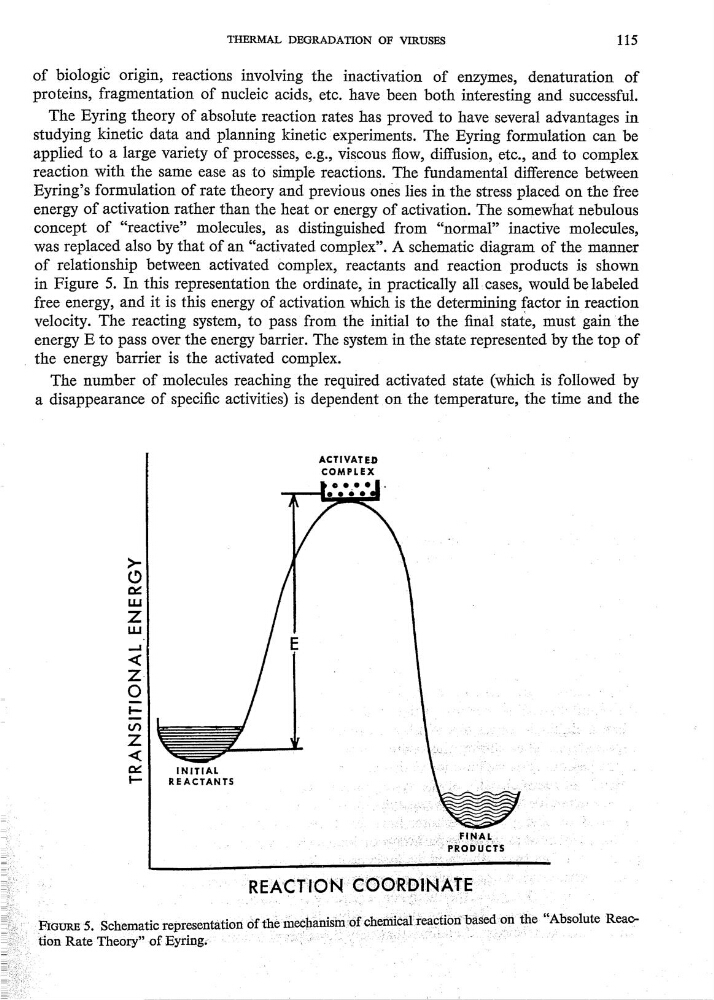
was replaced also by that of an “activated complex”. A schematic diagram of the manner
of relationship between activated Complex, reactants and reaction products is shown
in Figure 5. In this representation the ordinate, in practically allcases, would be labeled
free energy, and it is this energy of activation which is the determining factor in reaction
velocity. The reacting system, to pass from the initial to the nal state, must gain the
energy B to pass over the energy barrier. The system in the state represented by the top of
,
the energy barrier is the activated complex.
.
The number of molecules reaching the required activated state (which is followed by
a disappearance of specic activities) is dependent on the temperature, the time and the
ACTIVATED
COMPLEX
'
. o_o .
.
r.
.
.
>—
.
@
œ
u.:
_
2
Lu
_4'
E
.
<
Za:
INITIAL
'
»
!—
REACTANTS
,
_
_
_
_
_
'
…
—
a.
.
:_
»
._
'
f
‘
'
“
rigob'uc‘T‘s
”
_
:
REACTIONC°ÔRD‘NM‘E‘
'
FIGURE 5. Schematic representation of the
the
“Absolute Reac—
Theory” ofEyïing:
=
*
-
"
*
j
‘
‘
“
“
‘
‘
115
of biologie origin, reactions involving the inactivation of enzymes, denaturation of
proteins, fragmentation of nucleic acids, etc. have been both interesting and successful.
The Eyring theory of absolute reaction rates has proved to have several advantages in
studying kinetic data and planning kinetic experiments. The Eyring formulation can be
applied to a large variety of processes, e.g., viscous ow, di‘usion, etc., and to complex
reaction with the same ease as to simple reactions. _The fundamental difference between
Eyring’s formulation of rate theory and previous ones lies in the stress placed on the free
energy of activation rather than the heat or energy of activation. The somewhat nebulous
concept of “reactive” molecules, as distinguished from “normal” inactive molecules,
was replaced also by that of an “activated complex”. A schematic diagram of the manner
of relationship between activated Complex, reactants and reaction products is shown
in Figure 5. In this representation the ordinate, in practically allcases, would be labeled
free energy, and it is this energy of activation which is the determining factor in reaction
velocity. The reacting system, to pass from the initial to the nal state, must gain the
energy B to pass over the energy barrier. The system in the state represented by the top of
,
the energy barrier is the activated complex.
.
The number of molecules reaching the required activated state (which is followed by
a disappearance of specic activities) is dependent on the temperature, the time and the
ACTIVATED
COMPLEX
'
. o_o .
.
r.
.
.
>—
.
@
œ
u.:
_
2
Lu
_4'
E
.
<
Za:
INITIAL
'
»
!—
REACTANTS
,
_
_
_
_
_
'
…
—
a.
.
:_
»
._
'
f
‘
'
“
rigob'uc‘T‘s
”
_
:
REACTIONC°ÔRD‘NM‘E‘
'
FIGURE 5. Schematic representation of the
the
“Absolute Reac—
Theory” ofEyïing:
=
*
-
"
*
j
‘
‘
“
“
‘
‘