

330
Chapter 11 Images from Space
brightness values to a pixel. The sensor’s radiometric resolution refers to
its ability to measure fine differences in energy. For instance, a sensor with
8-bit radiometric resolution (also mentioned in Chapter 10) places the energy
radiance values on a scale of 0 (lowest radiance) to 255 (highest radiance).
The wider the range of measurements that can be made, the finer the sensor’s radiometric resolution is. The radiometric resolution (and the resultant
number of levels) is a measure of the number of the sensor’s bits of precision.
To calculate the number of levels, take the number of bits and apply it as an
exponent to the number 2. For instance, a 6-bit sensor would have 64 levels
(2
6
) ranging from a value of 0 to a value of 63. An 8-bit sensor would have 256
levels (2
8 ) ranging from 0 to 255. An 11-bit sensor would have 2048 levels
(2
11 ) ranging from 0 to 2047.
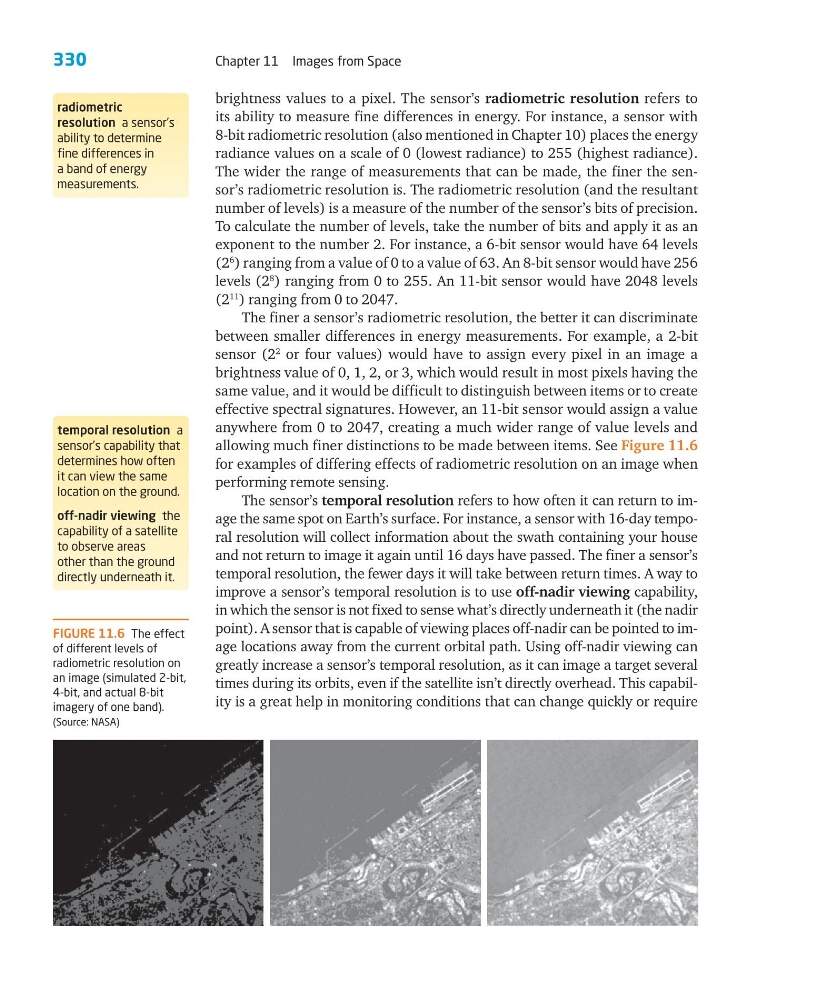
The finer a sensor’s radiometric resolution, the better it can discriminate
between smaller differences in energy measurements. For example, a 2-bit
sensor (2
2 or four values) would have to assign every pixel in an image a
brightness value of 0, 1, 2, or 3, which would result in most pixels having the
same value, and it would be difficult to distinguish between items or to create
effective spectral signatures. However, an 11-bit sensor would assign a value
anywhere from 0 to 2047, creating a much wider range of value levels and
allowing much finer distinctions to be made between items. See Figure 11.6
for examples of differing effects of radiometric resolution on an image when
performing remote sensing.
The sensor’s temporal resolution refers to how often it can return to image the same spot on Earth’s surface. For instance, a sensor with 16-day temporal resolution will collect information about the swath containing your house
and not return to image it again until 16 days have passed. The finer a sensor’s
temporal resolution, the fewer days it will take between return times. A way to
improve a sensor’s temporal resolution is to use off-nadir viewing capability,
in which the sensor is not fixed to sense what’s directly underneath it (the nadir
point). A sensor that is capable of viewing places off-nadir can be pointed to image locations away from the current orbital path. Using off-nadir viewing can
greatly increase a sensor’s temporal resolution, as it can image a target several
times during its orbits, even if the satellite isn’t directly overhead. This capability is a great help in monitoring conditions that can change quickly or require
temporal resolution a
sensor’s capability that
determines how often
it can view the same
location on the ground.
off-nadir viewing the
capability of a satellite
to observe areas
other than the ground
directly underneath it.
radiometric
resolution a sensor’s
ability to determine
fine differences in
a band of energy
measurements.
FIGURE 11.6 The effect
of different levels of
radiometric resolution on
an image (simulated 2-bit,
4-bit, and actual 8-bit
imagery of one band).
(Source: NASA)
Chapter 11 Images from Space
brightness values to a pixel. The sensor’s radiometric resolution refers to
its ability to measure fine differences in energy. For instance, a sensor with
8-bit radiometric resolution (also mentioned in Chapter 10) places the energy
radiance values on a scale of 0 (lowest radiance) to 255 (highest radiance).
The wider the range of measurements that can be made, the finer the sensor’s radiometric resolution is. The radiometric resolution (and the resultant
number of levels) is a measure of the number of the sensor’s bits of precision.
To calculate the number of levels, take the number of bits and apply it as an
exponent to the number 2. For instance, a 6-bit sensor would have 64 levels
(2
6
) ranging from a value of 0 to a value of 63. An 8-bit sensor would have 256
levels (2
8 ) ranging from 0 to 255. An 11-bit sensor would have 2048 levels
(2
11 ) ranging from 0 to 2047.
The finer a sensor’s radiometric resolution, the better it can discriminate
between smaller differences in energy measurements. For example, a 2-bit
sensor (2
2 or four values) would have to assign every pixel in an image a
brightness value of 0, 1, 2, or 3, which would result in most pixels having the
same value, and it would be difficult to distinguish between items or to create
effective spectral signatures. However, an 11-bit sensor would assign a value
anywhere from 0 to 2047, creating a much wider range of value levels and
allowing much finer distinctions to be made between items. See Figure 11.6
for examples of differing effects of radiometric resolution on an image when
performing remote sensing.
The sensor’s temporal resolution refers to how often it can return to image the same spot on Earth’s surface. For instance, a sensor with 16-day temporal resolution will collect information about the swath containing your house
and not return to image it again until 16 days have passed. The finer a sensor’s
temporal resolution, the fewer days it will take between return times. A way to
improve a sensor’s temporal resolution is to use off-nadir viewing capability,
in which the sensor is not fixed to sense what’s directly underneath it (the nadir
point). A sensor that is capable of viewing places off-nadir can be pointed to image locations away from the current orbital path. Using off-nadir viewing can
greatly increase a sensor’s temporal resolution, as it can image a target several
times during its orbits, even if the satellite isn’t directly overhead. This capability is a great help in monitoring conditions that can change quickly or require
temporal resolution a
sensor’s capability that
determines how often
it can view the same
location on the ground.
off-nadir viewing the
capability of a satellite
to observe areas
other than the ground
directly underneath it.
radiometric
resolution a sensor’s
ability to determine
fine differences in
a band of energy
measurements.
FIGURE 11.6 The effect
of different levels of
radiometric resolution on
an image (simulated 2-bit,
4-bit, and actual 8-bit
imagery of one band).
(Source: NASA)