

297
What Is Remote Sensing Actually Sensing?
Note that this process (and this chapter) describes passive remote
sensing—where the sensor doesn’t do anything but simply measures and
records reflected or emitted energy. A separate branch encompasses active
remote sensing, wherein the sensor generates its own energy, casts it at a
target, then measures the return of that form of energy. Radar is a good
example of active remote sensing—a device on a plane throws radar waves
(microwaves) at a target, those waves interact with the target, and the
device measures the backscatter of the returning radar waves.
What Is Remote Sensing Actually Sensing?
The information that is being sensed is the reflection of electromagnetic
(EM) energy off a target. There are two ways of thinking of light energy,
as either a particle or as a wave. For our purposes, we’ll stick to the concept of light energy as a wave. When the Sun radiates this energy, it radiates in the form of waves. Think of this like sitting on the beach and watching the waves come in from the ocean to crash on the shore. The distance
between the crests of two waves is called the wavelength (), with some
wavelengths being very long and some being very short. If it’s a calm day at
the ocean, you would see waves less frequently than you would if it was a
rough day, thus there will be a longer distance between waves (and a longer
wavelength). If it’s a rough day at the ocean, you’ll see waves a lot more
frequently and the distance between waves will be shorter (that is, a shorter
wavelength).
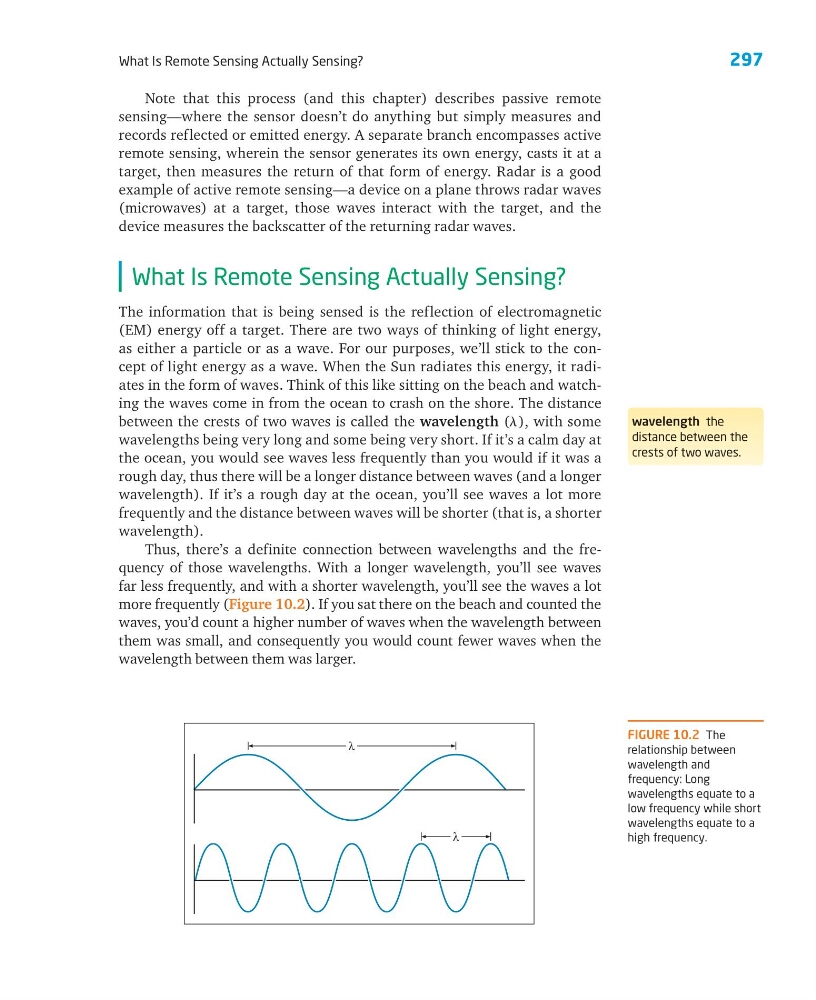
Thus, there’s a definite connection between wavelengths and the frequency of those wavelengths. With a longer wavelength, you’ll see waves
far less frequently, and with a shorter wavelength, you’ll see the waves a lot
more frequently (Figure 10.2). If you sat there on the beach and counted the
waves, you’d count a higher number of waves when the wavelength between
them was small, and consequently you would count fewer waves when the
wavelength between them was larger.
wavelength the
distance between the
crests of two waves.
FIGURE 10.2 The
relationship between
wavelength and
frequency: Long
wavelengths equate to a
low frequency while short
wavelengths equate to a
high frequency.
λ
λ
What Is Remote Sensing Actually Sensing?
Note that this process (and this chapter) describes passive remote
sensing—where the sensor doesn’t do anything but simply measures and
records reflected or emitted energy. A separate branch encompasses active
remote sensing, wherein the sensor generates its own energy, casts it at a
target, then measures the return of that form of energy. Radar is a good
example of active remote sensing—a device on a plane throws radar waves
(microwaves) at a target, those waves interact with the target, and the
device measures the backscatter of the returning radar waves.
What Is Remote Sensing Actually Sensing?
The information that is being sensed is the reflection of electromagnetic
(EM) energy off a target. There are two ways of thinking of light energy,
as either a particle or as a wave. For our purposes, we’ll stick to the concept of light energy as a wave. When the Sun radiates this energy, it radiates in the form of waves. Think of this like sitting on the beach and watching the waves come in from the ocean to crash on the shore. The distance
between the crests of two waves is called the wavelength (), with some
wavelengths being very long and some being very short. If it’s a calm day at
the ocean, you would see waves less frequently than you would if it was a
rough day, thus there will be a longer distance between waves (and a longer
wavelength). If it’s a rough day at the ocean, you’ll see waves a lot more
frequently and the distance between waves will be shorter (that is, a shorter
wavelength).
Thus, there’s a definite connection between wavelengths and the frequency of those wavelengths. With a longer wavelength, you’ll see waves
far less frequently, and with a shorter wavelength, you’ll see the waves a lot
more frequently (Figure 10.2). If you sat there on the beach and counted the
waves, you’d count a higher number of waves when the wavelength between
them was small, and consequently you would count fewer waves when the
wavelength between them was larger.
wavelength the
distance between the
crests of two waves.
FIGURE 10.2 The
relationship between
wavelength and
frequency: Long
wavelengths equate to a
low frequency while short
wavelengths equate to a
high frequency.
λ
λ