

298
Chapter 10 How Remote Sensing Works
Waves of energy work on a similar principle. Energy is moving at a constant speed, that is, the speed of light (c), which is about 300 million meters
per second. If you multiply the frequency times the wavelength, it is always
equal to the speed of light. When the value for the wavelength of light energy
is high, the frequency is low, and vice versa. So if the value for the frequency is
high, the value for the wavelength has to be lower to make the product of the
two values always come out to be the same number.
Electromagnetic energy at different wavelengths also has different
properties. Light energy with very long wavelengths will have different
characteristics than light that has very short wavelengths. The electromagnetic spectrum is used to examine the properties of light energy in
relation to the wavelengths of energy. The values of the wavelengths are
usually measured in extremely small units of measurement called micrometers (m), which is one-millionth of a meter (roughly the thickness
of bacteria), or an even smaller measurement called nanometers (nm),
which is one-billionth of a meter. Forms of electromagnetic energy with
very short wavelengths are cosmic rays, gamma rays, and x-rays, while
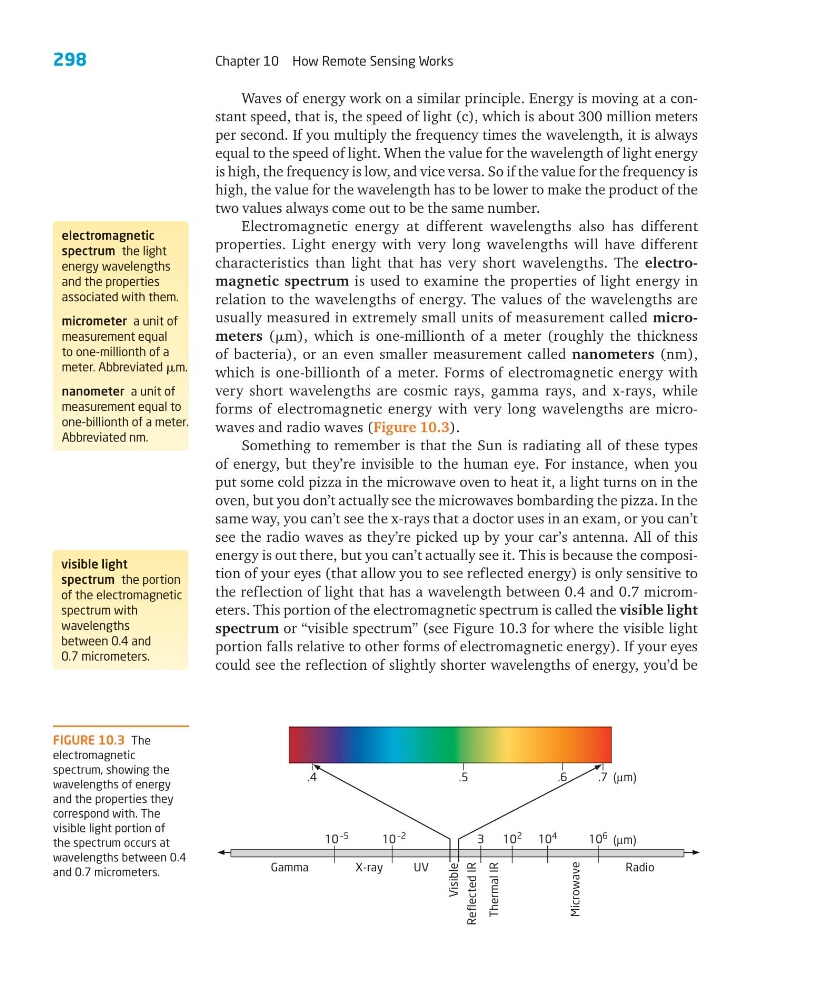
forms of electromagnetic energy with very long wavelengths are microwaves and radio waves (Figure 10.3).
Something to remember is that the Sun is radiating all of these types
of energy, but they’re invisible to the human eye. For instance, when you
put some cold pizza in the microwave oven to heat it, a light turns on in the
oven, but you don’t actually see the microwaves bombarding the pizza. In the
same way, you can’t see the x-rays that a doctor uses in an exam, or you can’t
see the radio waves as they’re picked up by your car’s antenna. All of this
energy is out there, but you can’t actually see it. This is because the composition of your eyes (that allow you to see reflected energy) is only sensitive to
the reflection of light that has a wavelength between 0.4 and 0.7 micrometers. This portion of the electromagnetic spectrum is called the visible light
spectrum or “ visible spectrum” (see Figure 10.3 for where the visible light
portion falls relative to other forms of electromagnetic energy). If your eyes
could see the reflection of slightly shorter wavelengths of energy, you’d be
visible light
spectrum the portion
of the electromagnetic
spectrum with
wavelengths
between 0.4 and
0.7 micrometers.
electromagnetic
spectrum the light
energy wavelengths
and the properties
associated with them.
micrometer a unit of
measurement equal
to one-millionth of a
meter. Abbreviated m.
nanometer a unit of
measurement equal to
one-billionth of a meter.
Abbreviated nm.
FIGURE 10.3 The
electromagnetic
spectrum, showing the
wavelengths of energy
and the properties they
correspond with. The
visible light portion of
the spectrum occurs at
wavelengths between 0.4
and 0.7 micrometers.
Gamma
X-ray
10
–5
10 –2
.4
31 0 2 10 4
10 6
UV
Visible
Reflected IR
Microwave
Radio
Thermal IR
.5
.6
(µm)
(µm)
.7
Chapter 10 How Remote Sensing Works
Waves of energy work on a similar principle. Energy is moving at a constant speed, that is, the speed of light (c), which is about 300 million meters
per second. If you multiply the frequency times the wavelength, it is always
equal to the speed of light. When the value for the wavelength of light energy
is high, the frequency is low, and vice versa. So if the value for the frequency is
high, the value for the wavelength has to be lower to make the product of the
two values always come out to be the same number.
Electromagnetic energy at different wavelengths also has different
properties. Light energy with very long wavelengths will have different
characteristics than light that has very short wavelengths. The electromagnetic spectrum is used to examine the properties of light energy in
relation to the wavelengths of energy. The values of the wavelengths are
usually measured in extremely small units of measurement called micrometers (m), which is one-millionth of a meter (roughly the thickness
of bacteria), or an even smaller measurement called nanometers (nm),
which is one-billionth of a meter. Forms of electromagnetic energy with
very short wavelengths are cosmic rays, gamma rays, and x-rays, while
forms of electromagnetic energy with very long wavelengths are microwaves and radio waves (Figure 10.3).
Something to remember is that the Sun is radiating all of these types
of energy, but they’re invisible to the human eye. For instance, when you
put some cold pizza in the microwave oven to heat it, a light turns on in the
oven, but you don’t actually see the microwaves bombarding the pizza. In the
same way, you can’t see the x-rays that a doctor uses in an exam, or you can’t
see the radio waves as they’re picked up by your car’s antenna. All of this
energy is out there, but you can’t actually see it. This is because the composition of your eyes (that allow you to see reflected energy) is only sensitive to
the reflection of light that has a wavelength between 0.4 and 0.7 micrometers. This portion of the electromagnetic spectrum is called the visible light
spectrum or “ visible spectrum” (see Figure 10.3 for where the visible light
portion falls relative to other forms of electromagnetic energy). If your eyes
could see the reflection of slightly shorter wavelengths of energy, you’d be
visible light
spectrum the portion
of the electromagnetic
spectrum with
wavelengths
between 0.4 and
0.7 micrometers.
electromagnetic
spectrum the light
energy wavelengths
and the properties
associated with them.
micrometer a unit of
measurement equal
to one-millionth of a
meter. Abbreviated m.
nanometer a unit of
measurement equal to
one-billionth of a meter.
Abbreviated nm.
FIGURE 10.3 The
electromagnetic
spectrum, showing the
wavelengths of energy
and the properties they
correspond with. The
visible light portion of
the spectrum occurs at
wavelengths between 0.4
and 0.7 micrometers.
Gamma
X-ray
10
–5
10 –2
.4
31 0 2 10 4
10 6
UV
Visible
Reflected IR
Microwave
Radio
Thermal IR
.5
.6
(µm)
(µm)
.7