

155
How Can You Perform Basic Spatial Analysis in GIS?
Layer 1
Layer 2
Overlay
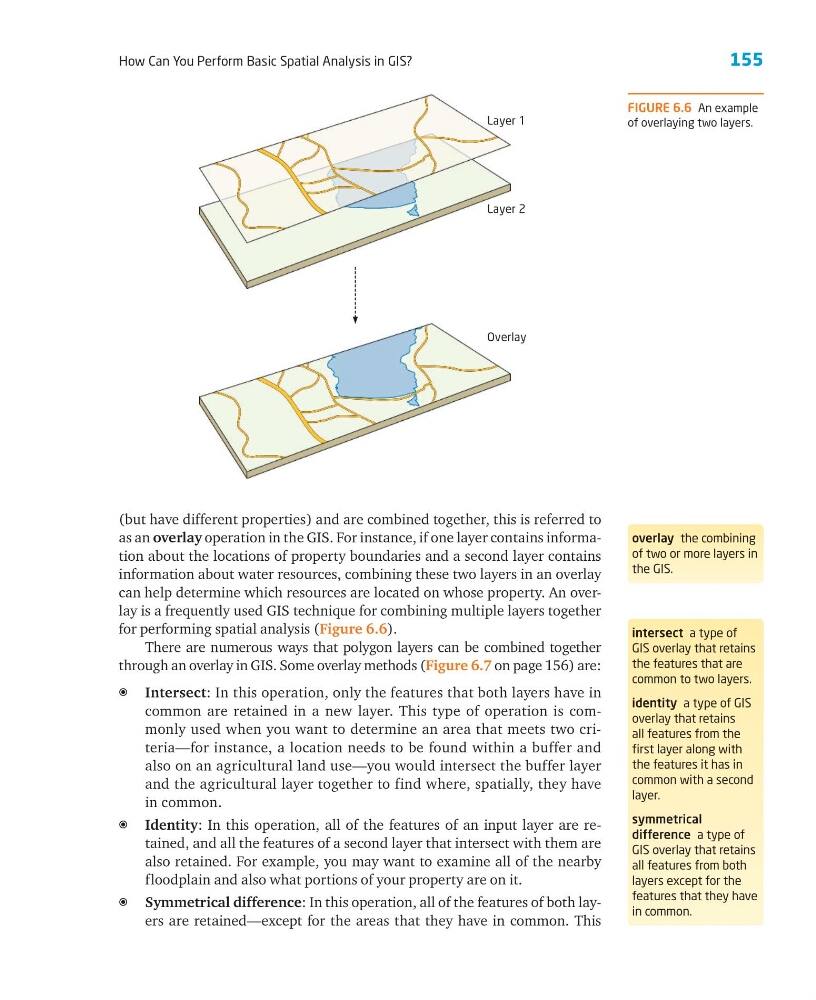
FIGURE 6.6 An example
of overlaying two layers.
(but have different properties) and are combined together, this is referred to
as an overlay operation in the GIS. For instance, if one layer contains information about the locations of property boundaries and a second layer contains
information about water resources, combining these two layers in an overlay
can help determine which resources are located on whose property. An overlay is a frequently used GIS technique for combining multiple layers together
for performing spatial analysis (Figure 6.6).
There are numerous ways that polygon layers can be combined together
through an overlay in GIS. Some overlay methods (Figure 6.7 on page 156) are:
a Intersect: In this operation, only the features that both layers have in
common are retained in a new layer. This type of operation is commonly used when you want to determine an area that meets two criteria—for instance, a location needs to be found within a buffer and
also on an agricultural land use—you would intersect the buffer layer
and the agricultural layer together to find where, spatially, they have
in common.
a Identity: In this operation, all of the features of an input layer are retained, and all the features of a second layer that intersect with them are
also retained. For example, you may want to examine all of the nearby
floodplain and also what portions of your property are on it.
a Symmetrical difference: In this operation, all of the features of both layers are retained—except for the areas that they have in common. This
overlay the combining
of two or more layers in
the GIS.
intersect a type of
GIS overlay that retains
the features that are
common to two layers.
identity a type of GIS
overlay that retains
all features from the
first layer along with
the features it has in
common with a second
layer.
symmetrical
difference a type of
GIS overlay that retains
all features from both
layers except for the
features that they have
in common.
How Can You Perform Basic Spatial Analysis in GIS?
Layer 1
Layer 2
Overlay
FIGURE 6.6 An example
of overlaying two layers.
(but have different properties) and are combined together, this is referred to
as an overlay operation in the GIS. For instance, if one layer contains information about the locations of property boundaries and a second layer contains
information about water resources, combining these two layers in an overlay
can help determine which resources are located on whose property. An overlay is a frequently used GIS technique for combining multiple layers together
for performing spatial analysis (Figure 6.6).
There are numerous ways that polygon layers can be combined together
through an overlay in GIS. Some overlay methods (Figure 6.7 on page 156) are:
a Intersect: In this operation, only the features that both layers have in
common are retained in a new layer. This type of operation is commonly used when you want to determine an area that meets two criteria—for instance, a location needs to be found within a buffer and
also on an agricultural land use—you would intersect the buffer layer
and the agricultural layer together to find where, spatially, they have
in common.
a Identity: In this operation, all of the features of an input layer are retained, and all the features of a second layer that intersect with them are
also retained. For example, you may want to examine all of the nearby
floodplain and also what portions of your property are on it.
a Symmetrical difference: In this operation, all of the features of both layers are retained—except for the areas that they have in common. This
overlay the combining
of two or more layers in
the GIS.
intersect a type of
GIS overlay that retains
the features that are
common to two layers.
identity a type of GIS
overlay that retains
all features from the
first layer along with
the features it has in
common with a second
layer.
symmetrical
difference a type of
GIS overlay that retains
all features from both
layers except for the
features that they have
in common.