

14.2.3 Local Spatial Rotation
The local spatial rotation is a convenient way for spatial orientation analysis as well
as for further compaction of the information through aligning the coordinate axis
along the strongest signal variation. This process consists of expressing the
transform coefficients in a coordinate system u; v that has been rotated by an
angle q with respect to the original coordinate system x; y. Furthermore, since
different orientation angles are chosen for different sampling cells p; q, this
operation is referred to a local spatial rotation. Figure 14.2 shows an example of
original (left image) versus rotated (right image) coefficients when displayed as
gray-level images.
While the local spatial rotation is a powerful analysis, the operation is computationally efficient and easy to implement because the rotated coefficients are
related with the original coefficients through linear combinations. The notation for
the MDHT coefficients in a rotated framework is now extended to z
k;q
n;m , which
includes also the rotation angle q. For further details on how the rotated coefficients
are computed, see Silván-Cárdenas and Escalante-Ramírez, 2001 (2006). In the
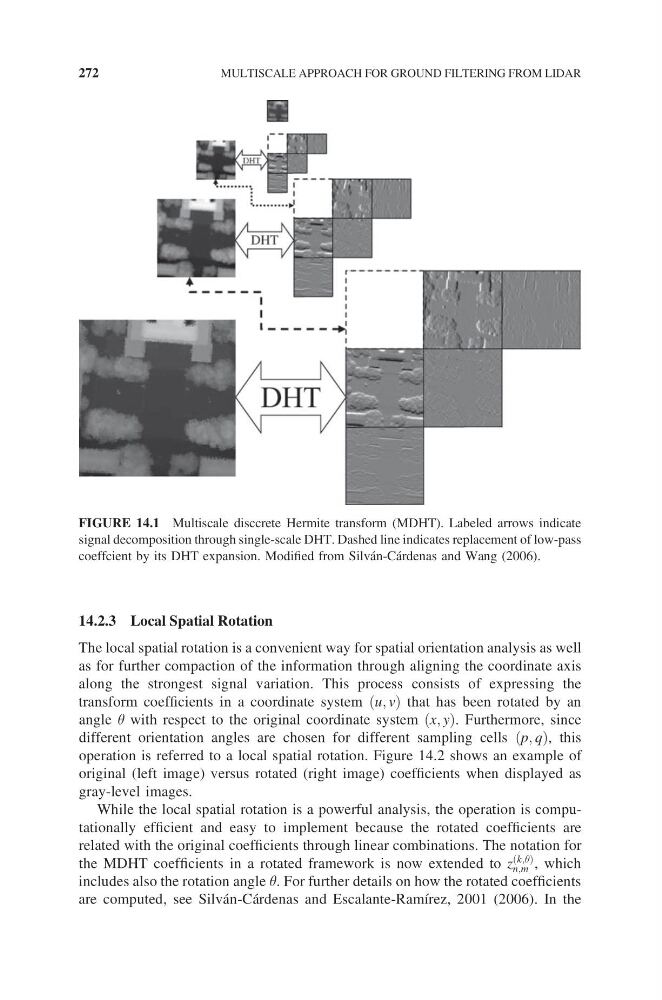
FIGURE 14.1 Multiscale disccrete Hermite transform (MDHT). Labeled arrows indicate
signal decomposition through single-scale DHT. Dashed line indicates replacement of low-pass
coeffcient by its DHT expansion. Modified from Silván-Cárdenas and Wang (2006).
272
MULTISCALE APPROACH FOR GROUND FILTERING FROM LIDAR
The local spatial rotation is a convenient way for spatial orientation analysis as well
as for further compaction of the information through aligning the coordinate axis
along the strongest signal variation. This process consists of expressing the
transform coefficients in a coordinate system u; v that has been rotated by an
angle q with respect to the original coordinate system x; y. Furthermore, since
different orientation angles are chosen for different sampling cells p; q, this
operation is referred to a local spatial rotation. Figure 14.2 shows an example of
original (left image) versus rotated (right image) coefficients when displayed as
gray-level images.
While the local spatial rotation is a powerful analysis, the operation is computationally efficient and easy to implement because the rotated coefficients are
related with the original coefficients through linear combinations. The notation for
the MDHT coefficients in a rotated framework is now extended to z
k;q
n;m , which
includes also the rotation angle q. For further details on how the rotated coefficients
are computed, see Silván-Cárdenas and Escalante-Ramírez, 2001 (2006). In the
FIGURE 14.1 Multiscale disccrete Hermite transform (MDHT). Labeled arrows indicate
signal decomposition through single-scale DHT. Dashed line indicates replacement of low-pass
coeffcient by its DHT expansion. Modified from Silván-Cárdenas and Wang (2006).
272
MULTISCALE APPROACH FOR GROUND FILTERING FROM LIDAR