

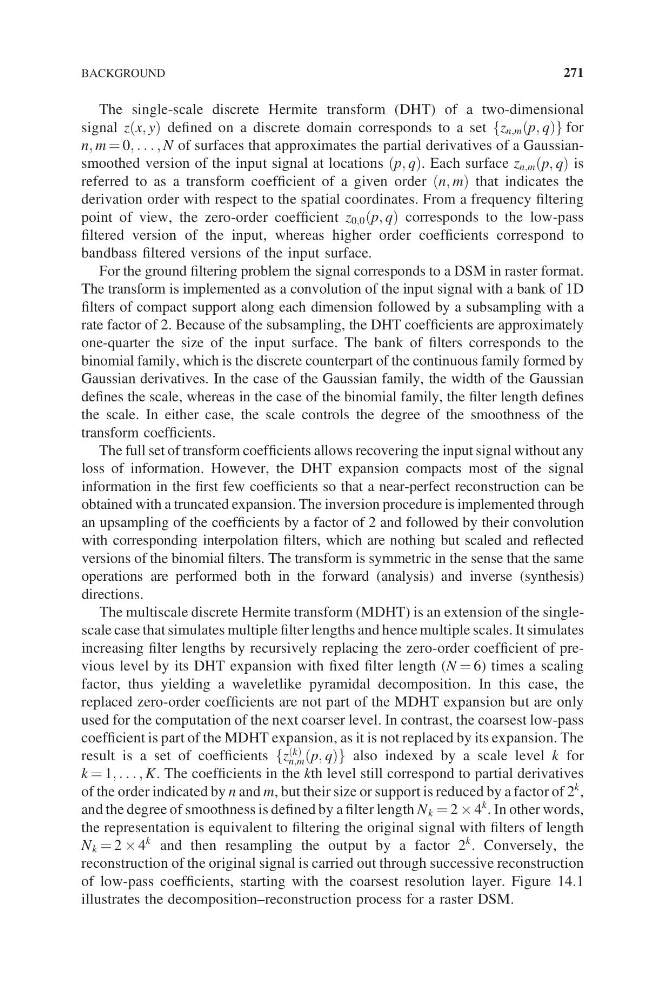
The single-scale discrete Hermite transform (DHT) of a two-dimensional
signal z x; y defined on a discrete domain corresponds to a set fz n;m p; qg for
n; m = 0; . . . ; N of surfaces that approximates the partial derivatives of a Gaussiansmoothed version of the input signal at locations p; q. Each surface z n;m p; q is
referred to as a transform coefficient of a given order n; m that indicates the
derivation order with respect to the spatial coordinates. From a frequency filtering
point of view, the zero-order coefficient z 0;0 p; q corresponds to the low-pass
filtered version of the input, whereas higher order coefficients correspond to
bandbass filtered versions of the input surface.
For the ground filtering problem the signal corresponds to a DSM in raster format.
The transform is implemented as a convolution of the input signal with a bank of 1D
filters of compact support along each dimension followed by a subsampling with a
rate factor of 2. Because of the subsampling, the DHT coefficients are approximately
one-quarter the size of the input surface. The bank of filters corresponds to the
binomial family, which is the discrete counterpart of the continuous family formed by
Gaussian derivatives. In the case of the Gaussian family, the width of the Gaussian
defines the scale, whereas in the case of the binomial family, the filter length defines
the scale. In either case, the scale controls the degree of the smoothness of the
transform coefficients.
The full set of transform coefficients allows recovering the input signal without any
loss of information. However, the DHT expansion compacts most of the signal
information in the first few coefficients so that a near-perfect reconstruction can be
obtained with a truncated expansion. The inversion procedure is implemented through
an upsampling of the coefficients by a factor of 2 and followed by their convolution
with corresponding interpolation filters, which are nothing but scaled and reflected
versions of the binomial filters. The transform is symmetric in the sense that the same
operations are performed both in the forward (analysis) and inverse (synthesis)
directions.
The multiscale discrete Hermite transform (MDHT) is an extension of the singlescale case that simulates multiple filter lengths and hence multiple scales. It simulates
increasing filter lengths by recursively replacing the zero-order coefficient of previous level by its DHT expansion with fixed filter length (N = 6) times a scaling
factor, thus yielding a waveletlike pyramidal decomposition. In this case, the
replaced zero-order coefficients are not part of the MDHT expansion but are only
used for the computation of the next coarser level. In contrast, the coarsest low-pass
coefficient is part of the MDHT expansion, as it is not replaced by its expansion. The
result is a set of coefficients fz
k
n;m p; qg also indexed by a scale level k for
k = 1; . . . ; K. The coefficients in the kth level still correspond to partial derivatives
of the order indicated by n and m, but their size or support is reduced by a factor of 2
k ,
and the degree of smoothness is defined by a filter length N k = 2 ´ 4
k . In other words,
the representation is equivalent to filtering the original signal with filters of length
N k = 2 ´ 4
k and then resampling the output by a factor 2
k . Conversely, the
reconstruction of the original signal is carried out through successive reconstruction
of low-pass coefficients, starting with the coarsest resolution layer. Figure 14.1
illustrates the decomposition–reconstruction process for a raster DSM.
BACKGROUND
271
signal z x; y defined on a discrete domain corresponds to a set fz n;m p; qg for
n; m = 0; . . . ; N of surfaces that approximates the partial derivatives of a Gaussiansmoothed version of the input signal at locations p; q. Each surface z n;m p; q is
referred to as a transform coefficient of a given order n; m that indicates the
derivation order with respect to the spatial coordinates. From a frequency filtering
point of view, the zero-order coefficient z 0;0 p; q corresponds to the low-pass
filtered version of the input, whereas higher order coefficients correspond to
bandbass filtered versions of the input surface.
For the ground filtering problem the signal corresponds to a DSM in raster format.
The transform is implemented as a convolution of the input signal with a bank of 1D
filters of compact support along each dimension followed by a subsampling with a
rate factor of 2. Because of the subsampling, the DHT coefficients are approximately
one-quarter the size of the input surface. The bank of filters corresponds to the
binomial family, which is the discrete counterpart of the continuous family formed by
Gaussian derivatives. In the case of the Gaussian family, the width of the Gaussian
defines the scale, whereas in the case of the binomial family, the filter length defines
the scale. In either case, the scale controls the degree of the smoothness of the
transform coefficients.
The full set of transform coefficients allows recovering the input signal without any
loss of information. However, the DHT expansion compacts most of the signal
information in the first few coefficients so that a near-perfect reconstruction can be
obtained with a truncated expansion. The inversion procedure is implemented through
an upsampling of the coefficients by a factor of 2 and followed by their convolution
with corresponding interpolation filters, which are nothing but scaled and reflected
versions of the binomial filters. The transform is symmetric in the sense that the same
operations are performed both in the forward (analysis) and inverse (synthesis)
directions.
The multiscale discrete Hermite transform (MDHT) is an extension of the singlescale case that simulates multiple filter lengths and hence multiple scales. It simulates
increasing filter lengths by recursively replacing the zero-order coefficient of previous level by its DHT expansion with fixed filter length (N = 6) times a scaling
factor, thus yielding a waveletlike pyramidal decomposition. In this case, the
replaced zero-order coefficients are not part of the MDHT expansion but are only
used for the computation of the next coarser level. In contrast, the coarsest low-pass
coefficient is part of the MDHT expansion, as it is not replaced by its expansion. The
result is a set of coefficients fz
k
n;m p; qg also indexed by a scale level k for
k = 1; . . . ; K. The coefficients in the kth level still correspond to partial derivatives
of the order indicated by n and m, but their size or support is reduced by a factor of 2
k ,
and the degree of smoothness is defined by a filter length N k = 2 ´ 4
k . In other words,
the representation is equivalent to filtering the original signal with filters of length
N k = 2 ´ 4
k and then resampling the output by a factor 2
k . Conversely, the
reconstruction of the original signal is carried out through successive reconstruction
of low-pass coefficients, starting with the coarsest resolution layer. Figure 14.1
illustrates the decomposition–reconstruction process for a raster DSM.
BACKGROUND
271