

The distribution of diversity: challenges and applications
85
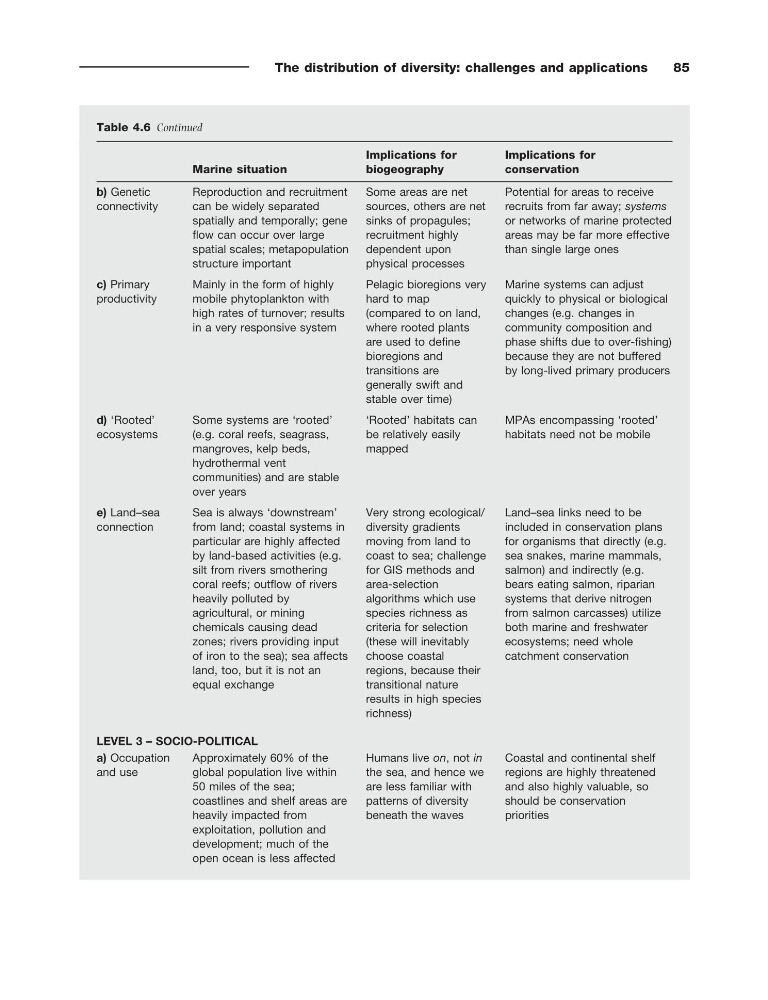
Table 4.6 Continued
Marine situation
Implications for
biogeography
Implications for
conservation
b) Genetic
connectivity
Reproduction and recruitment
can be widely separated
spatially and temporally; gene
fl ow can occur over large
spatial scales; metapopulation
structure important
Some areas are net
sources, others are net
sinks of propagules;
recruitment highly
dependent upon
physical processes
Potential for areas to receive
recruits from far away; systems
or networks of marine protected
areas may be far more effective
than single large ones
c) Primary
productivity
Mainly in the form of highly
mobile phytoplankton with
high rates of turnover; results
in a very responsive system
Pelagic bioregions very
hard to map
(compared to on land,
where rooted plants
are used to defi ne
bioregions and
transitions are
generally swift and
stable over time)
Marine systems can adjust
quickly to physical or biological
changes (e.g. changes in
community composition and
phase shifts due to over - fi shing)
because they are not buffered
by long - lived primary producers
d) ‘ Rooted ’
ecosystems
Some systems are ‘ rooted ’
(e.g. coral reefs, seagrass,
mangroves, kelp beds,
hydrothermal vent
communities) and are stable
over years
‘ Rooted ’ habitats can
be relatively easily
mapped
MPAs encompassing ‘ rooted ’
habitats need not be mobile
e) Land – sea
connection
Sea is always ‘ downstream ’
from land; coastal systems in
particular are highly affected
by land - based activities (e.g.
silt from rivers smothering
coral reefs; outfl ow of rivers
heavily polluted by
agricultural, or mining
chemicals causing dead
zones; rivers providing input
of iron to the sea); sea affects
land, too, but it is not an
equal exchange
Very strong ecological/
diversity gradients
moving from land to
coast to sea; challenge
for GIS methods and
area - selection
algorithms which use
species richness as
criteria for selection
(these will inevitably
choose coastal
regions, because their
transitional nature
results in high species
richness)
Land – sea links need to be
included in conservation plans
for organisms that directly (e.g.
sea snakes, marine mammals,
salmon) and indirectly (e.g.
bears eating salmon, riparian
systems that derive nitrogen
from salmon carcasses) utilize
both marine and freshwater
ecosystems; need whole
catchment conservation
LEVEL 3 – SOCIO - POLITICAL
a) Occupation
and use
Approximately 60% of the
global population live within
50 miles of the sea;
coastlines and shelf areas are
heavily impacted from
exploitation, pollution and
development; much of the
open ocean is less affected
Humans live on , not in
the sea, and hence we
are less familiar with
patterns of diversity
beneath the waves
Coastal and continental shelf
regions are highly threatened
and also highly valuable, so
should be conservation
priorities
85
Table 4.6 Continued
Marine situation
Implications for
biogeography
Implications for
conservation
b) Genetic
connectivity
Reproduction and recruitment
can be widely separated
spatially and temporally; gene
fl ow can occur over large
spatial scales; metapopulation
structure important
Some areas are net
sources, others are net
sinks of propagules;
recruitment highly
dependent upon
physical processes
Potential for areas to receive
recruits from far away; systems
or networks of marine protected
areas may be far more effective
than single large ones
c) Primary
productivity
Mainly in the form of highly
mobile phytoplankton with
high rates of turnover; results
in a very responsive system
Pelagic bioregions very
hard to map
(compared to on land,
where rooted plants
are used to defi ne
bioregions and
transitions are
generally swift and
stable over time)
Marine systems can adjust
quickly to physical or biological
changes (e.g. changes in
community composition and
phase shifts due to over - fi shing)
because they are not buffered
by long - lived primary producers
d) ‘ Rooted ’
ecosystems
Some systems are ‘ rooted ’
(e.g. coral reefs, seagrass,
mangroves, kelp beds,
hydrothermal vent
communities) and are stable
over years
‘ Rooted ’ habitats can
be relatively easily
mapped
MPAs encompassing ‘ rooted ’
habitats need not be mobile
e) Land – sea
connection
Sea is always ‘ downstream ’
from land; coastal systems in
particular are highly affected
by land - based activities (e.g.
silt from rivers smothering
coral reefs; outfl ow of rivers
heavily polluted by
agricultural, or mining
chemicals causing dead
zones; rivers providing input
of iron to the sea); sea affects
land, too, but it is not an
equal exchange
Very strong ecological/
diversity gradients
moving from land to
coast to sea; challenge
for GIS methods and
area - selection
algorithms which use
species richness as
criteria for selection
(these will inevitably
choose coastal
regions, because their
transitional nature
results in high species
richness)
Land – sea links need to be
included in conservation plans
for organisms that directly (e.g.
sea snakes, marine mammals,
salmon) and indirectly (e.g.
bears eating salmon, riparian
systems that derive nitrogen
from salmon carcasses) utilize
both marine and freshwater
ecosystems; need whole
catchment conservation
LEVEL 3 – SOCIO - POLITICAL
a) Occupation
and use
Approximately 60% of the
global population live within
50 miles of the sea;
coastlines and shelf areas are
heavily impacted from
exploitation, pollution and
development; much of the
open ocean is less affected
Humans live on , not in
the sea, and hence we
are less familiar with
patterns of diversity
beneath the waves
Coastal and continental shelf
regions are highly threatened
and also highly valuable, so
should be conservation
priorities