

86
Basic biogeography: estimating biodiversity and mapping nature
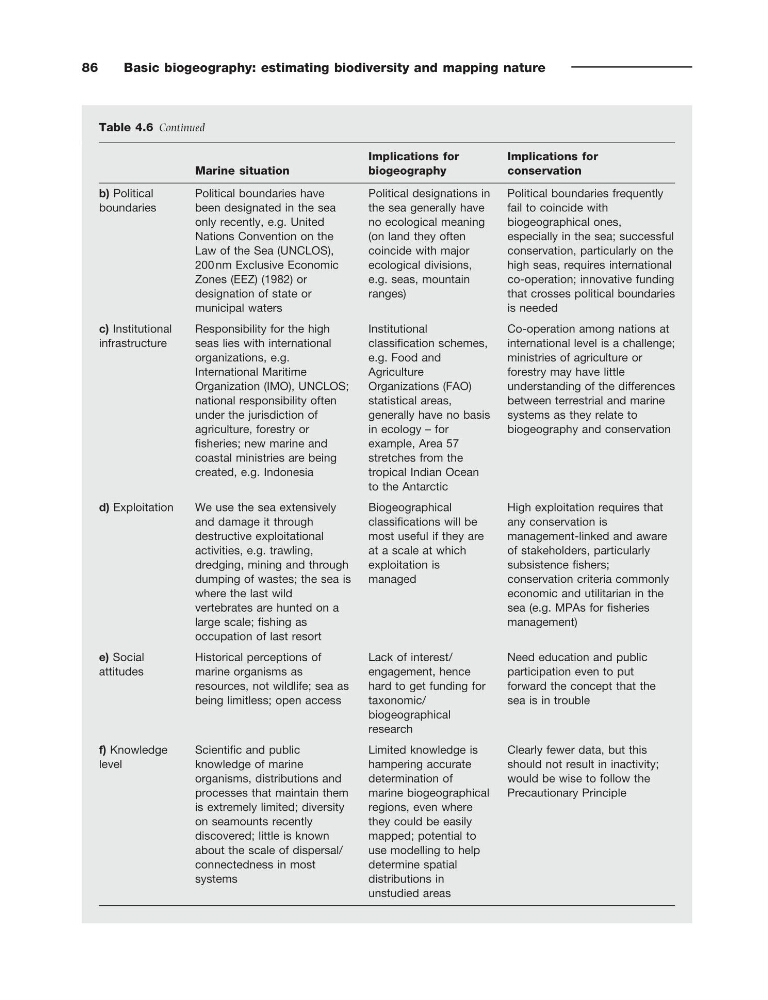
Table 4.6 Continued
Marine situation
Implications for
biogeography
Implications for
conservation
b) Political
boundaries
Political boundaries have
been designated in the sea
only recently, e.g. United
Nations Convention on the
Law of the Sea (UNCLOS),
200 nm Exclusive Economic
Zones (EEZ) (1982) or
designation of state or
municipal waters
Political designations in
the sea generally have
no ecological meaning
(on land they often
coincide with major
ecological divisions,
e.g. seas, mountain
ranges)
Political boundaries frequently
fail to coincide with
biogeographical ones,
especially in the sea; successful
conservation, particularly on the
high seas, requires international
co - operation; innovative funding
that crosses political boundaries
is needed
c) Institutional
infrastructure
Responsibility for the high
seas lies with international
organizations, e.g.
International Maritime
Organization (IMO), UNCLOS;
national responsibility often
under the jurisdiction of
agriculture, forestry or
fi sheries; new marine and
coastal ministries are being
created, e.g. Indonesia
Institutional
classifi cation schemes,
e.g. Food and
Agriculture
Organizations (FAO)
statistical areas,
generally have no basis
in ecology – for
example, Area 57
stretches from the
tropical Indian Ocean
to the Antarctic
Co - operation among nations at
international level is a challenge;
ministries of agriculture or
forestry may have little
understanding of the differences
between terrestrial and marine
systems as they relate to
biogeography and conservation
d) Exploitation
We use the sea extensively
and damage it through
destructive exploitational
activities, e.g. trawling,
dredging, mining and through
dumping of wastes; the sea is
where the last wild
vertebrates are hunted on a
large scale; fi shing as
occupation of last resort
Biogeographical
classifi cations will be
most useful if they are
at a scale at which
exploitation is
managed
High exploitation requires that
any conservation is
management - linked and aware
of stakeholders, particularly
subsistence fi shers;
conservation criteria commonly
economic and utilitarian in the
sea (e.g. MPAs for fi sheries
management)
e) Social
attitudes
Historical perceptions of
marine organisms as
resources, not wildlife; sea as
being limitless; open access
Lack of interest/
engagement, hence
hard to get funding for
taxonomic/
biogeographical
research
Need education and public
participation even to put
forward the concept that the
sea is in trouble
f) Knowledge
level
Scientifi c and public
knowledge of marine
organisms, distributions and
processes that maintain them
is extremely limited; diversity
on seamounts recently
discovered; little is known
about the scale of dispersal/
connectedness in most
systems
Limited knowledge is
hampering accurate
determination of
marine biogeographical
regions, even where
they could be easily
mapped; potential to
use modelling to help
determine spatial
distributions in
unstudied areas
Clearly fewer data, but this
should not result in inactivity;
would be wise to follow the
Precautionary Principle
Basic biogeography: estimating biodiversity and mapping nature
Table 4.6 Continued
Marine situation
Implications for
biogeography
Implications for
conservation
b) Political
boundaries
Political boundaries have
been designated in the sea
only recently, e.g. United
Nations Convention on the
Law of the Sea (UNCLOS),
200 nm Exclusive Economic
Zones (EEZ) (1982) or
designation of state or
municipal waters
Political designations in
the sea generally have
no ecological meaning
(on land they often
coincide with major
ecological divisions,
e.g. seas, mountain
ranges)
Political boundaries frequently
fail to coincide with
biogeographical ones,
especially in the sea; successful
conservation, particularly on the
high seas, requires international
co - operation; innovative funding
that crosses political boundaries
is needed
c) Institutional
infrastructure
Responsibility for the high
seas lies with international
organizations, e.g.
International Maritime
Organization (IMO), UNCLOS;
national responsibility often
under the jurisdiction of
agriculture, forestry or
fi sheries; new marine and
coastal ministries are being
created, e.g. Indonesia
Institutional
classifi cation schemes,
e.g. Food and
Agriculture
Organizations (FAO)
statistical areas,
generally have no basis
in ecology – for
example, Area 57
stretches from the
tropical Indian Ocean
to the Antarctic
Co - operation among nations at
international level is a challenge;
ministries of agriculture or
forestry may have little
understanding of the differences
between terrestrial and marine
systems as they relate to
biogeography and conservation
d) Exploitation
We use the sea extensively
and damage it through
destructive exploitational
activities, e.g. trawling,
dredging, mining and through
dumping of wastes; the sea is
where the last wild
vertebrates are hunted on a
large scale; fi shing as
occupation of last resort
Biogeographical
classifi cations will be
most useful if they are
at a scale at which
exploitation is
managed
High exploitation requires that
any conservation is
management - linked and aware
of stakeholders, particularly
subsistence fi shers;
conservation criteria commonly
economic and utilitarian in the
sea (e.g. MPAs for fi sheries
management)
e) Social
attitudes
Historical perceptions of
marine organisms as
resources, not wildlife; sea as
being limitless; open access
Lack of interest/
engagement, hence
hard to get funding for
taxonomic/
biogeographical
research
Need education and public
participation even to put
forward the concept that the
sea is in trouble
f) Knowledge
level
Scientifi c and public
knowledge of marine
organisms, distributions and
processes that maintain them
is extremely limited; diversity
on seamounts recently
discovered; little is known
about the scale of dispersal/
connectedness in most
systems
Limited knowledge is
hampering accurate
determination of
marine biogeographical
regions, even where
they could be easily
mapped; potential to
use modelling to help
determine spatial
distributions in
unstudied areas
Clearly fewer data, but this
should not result in inactivity;
would be wise to follow the
Precautionary Principle