

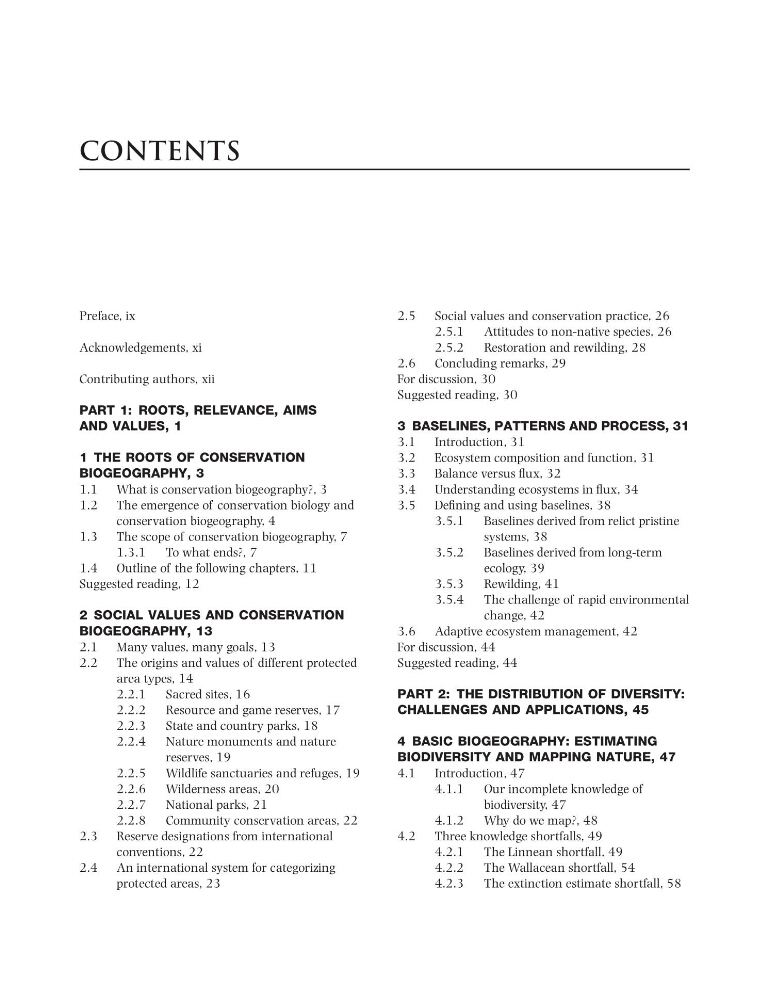
Contents
Preface, ix
Acknowledgements, xi
Contributing authors, xii
PART 1: ROOTS, RELEVANCE, AIMS
AND VALUES, 1
1 THE ROOTS OF CONSERVATION
BIOGEOGRAPHY, 3
1.1 What is conservation biogeography?, 3
1.2 The emergence of conservation biology and
conservation biogeography, 4
1.3 The scope of conservation biogeography, 7
1.3.1
To what ends?, 7
1.4 Outline of the following chapters, 11
Suggested reading, 12
2 SOCIAL VALUES AND CONSERVATION
BIOGEOGRAPHY, 13
2.1 Many values, many goals, 13
2.2 The origins and values of different protected
area types, 14
2.2.1
Sacred sites, 16
2.2.2
Resource and game reserves, 17
2.2.3
State and country parks, 18
2.2.4
Nature monuments and nature
reserves, 19
2.2.5
Wildlife sanctuaries and refuges, 19
2.2.6
Wilderness areas, 20
2.2.7
National parks, 21
2.2.8
Community conservation areas, 22
2.3 Reserve designations from international
conventions, 22
2.4 An international system for categorizing
protected areas, 23
2.5 Social values and conservation practice, 26
2.5.1
Attitudes to non-native species, 26
2.5.2
Restoration and rewilding, 28
2.6 Concluding remarks, 29
For discussion, 30
Suggested reading, 30
3 BASELINES, PATTERNS AND PROCESS, 31
3.1 Introduction, 31
3.2 Ecosystem composition and function, 31
3.3 Balance versus fl ux, 32
3.4 Understanding ecosystems in fl ux, 34
3.5 Defi ning and using baselines, 38
3.5.1
Baselines derived from relict pristine
systems, 38
3.5.2
Baselines derived from long-term
ecology, 39
3.5.3
Rewilding, 41
3.5.4
The challenge of rapid environmental
change, 42
3.6 Adaptive ecosystem management, 42
For discussion, 44
Suggested reading, 44
PART 2: THE DISTRIBUTION OF DIVERSITY:
CHALLENGES AND APPLICATIONS, 45
4 BASIC BIOGEOGRAPHY: ESTIMATING
BIODIVERSITY AND MAPPING NATURE, 47
4.1 Introduction, 47
4.1.1
Our incomplete knowledge of
biodiversity, 47
4.1.2
Why do we map?, 48
4.2 Three knowledge shortfalls, 49
4.2.1
The Linnean shortfall, 49
4.2.2
The Wallacean shortfall, 54
4.2.3
The extinction estimate shortfall, 58
Preface, ix
Acknowledgements, xi
Contributing authors, xii
PART 1: ROOTS, RELEVANCE, AIMS
AND VALUES, 1
1 THE ROOTS OF CONSERVATION
BIOGEOGRAPHY, 3
1.1 What is conservation biogeography?, 3
1.2 The emergence of conservation biology and
conservation biogeography, 4
1.3 The scope of conservation biogeography, 7
1.3.1
To what ends?, 7
1.4 Outline of the following chapters, 11
Suggested reading, 12
2 SOCIAL VALUES AND CONSERVATION
BIOGEOGRAPHY, 13
2.1 Many values, many goals, 13
2.2 The origins and values of different protected
area types, 14
2.2.1
Sacred sites, 16
2.2.2
Resource and game reserves, 17
2.2.3
State and country parks, 18
2.2.4
Nature monuments and nature
reserves, 19
2.2.5
Wildlife sanctuaries and refuges, 19
2.2.6
Wilderness areas, 20
2.2.7
National parks, 21
2.2.8
Community conservation areas, 22
2.3 Reserve designations from international
conventions, 22
2.4 An international system for categorizing
protected areas, 23
2.5 Social values and conservation practice, 26
2.5.1
Attitudes to non-native species, 26
2.5.2
Restoration and rewilding, 28
2.6 Concluding remarks, 29
For discussion, 30
Suggested reading, 30
3 BASELINES, PATTERNS AND PROCESS, 31
3.1 Introduction, 31
3.2 Ecosystem composition and function, 31
3.3 Balance versus fl ux, 32
3.4 Understanding ecosystems in fl ux, 34
3.5 Defi ning and using baselines, 38
3.5.1
Baselines derived from relict pristine
systems, 38
3.5.2
Baselines derived from long-term
ecology, 39
3.5.3
Rewilding, 41
3.5.4
The challenge of rapid environmental
change, 42
3.6 Adaptive ecosystem management, 42
For discussion, 44
Suggested reading, 44
PART 2: THE DISTRIBUTION OF DIVERSITY:
CHALLENGES AND APPLICATIONS, 45
4 BASIC BIOGEOGRAPHY: ESTIMATING
BIODIVERSITY AND MAPPING NATURE, 47
4.1 Introduction, 47
4.1.1
Our incomplete knowledge of
biodiversity, 47
4.1.2
Why do we map?, 48
4.2 Three knowledge shortfalls, 49
4.2.1
The Linnean shortfall, 49
4.2.2
The Wallacean shortfall, 54
4.2.3
The extinction estimate shortfall, 58