

16
Social values and conservation biogeography
In the following examples, we describe a variety of
types of protected areas and the values that have infl uenced their formation and management, and which,
by extension, underpin the contemporary protected
area system. The list of protected area types is by no
means exhaustive, but rather has been chosen to refl ect
types of protected area that are both numerically
important for modern conservation and which refl ect
a distinctive suite of values.
2.2.1 Sacred s ites
Despite the deeply rooted and universal emotional
human attachment to life and living processes (Wilson,
1984, 1993 ), the history of human societies has been
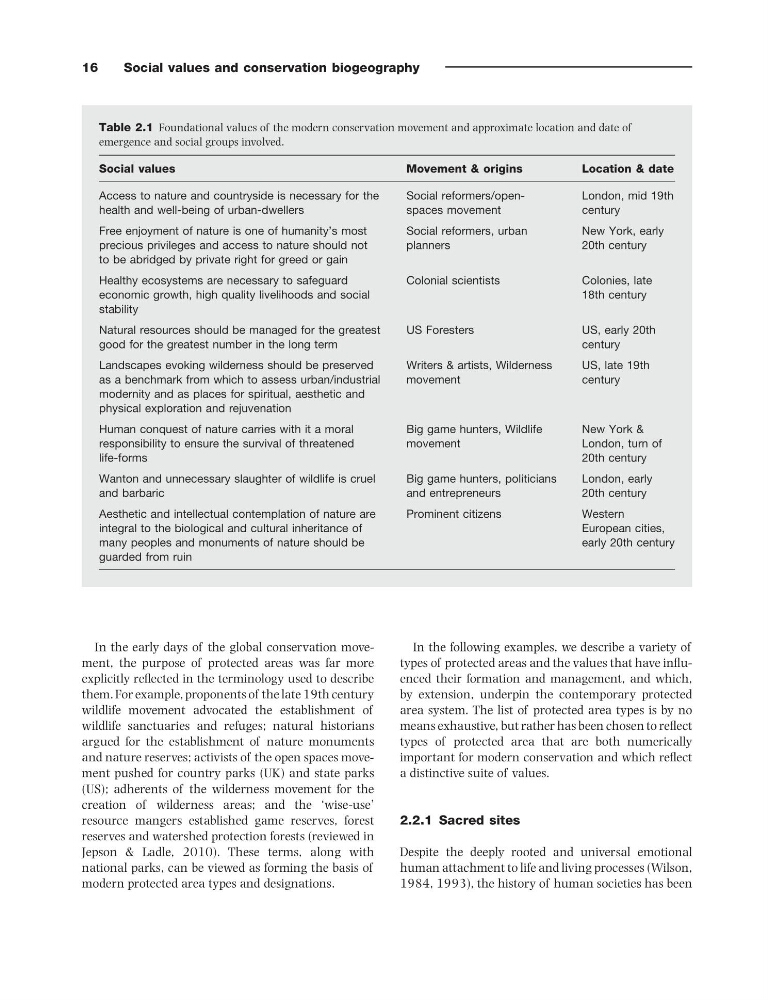
In the early days of the global conservation movement, the purpose of protected areas was far more
explicitly refl ected in the terminology used to describe
them. For example, proponents of the late 19th century
wildlife movement advocated the establishment of
wildlife sanctuaries and refuges; natural historians
argued for the establishment of nature monuments
and nature reserves; activists of the open spaces movement pushed for country parks (UK) and state parks
(US); adherents of the wilderness movement for the
creation of wilderness areas; and the ‘ wise - use ’
resource mangers established game reserves, forest
reserves and watershed protection forests (reviewed in
Jepson & Ladle, 2010 ). These terms, along with
national parks, can be viewed as forming the basis of
modern protected area types and designations.
Table 2.1 Foundational values of the modern conservation movement and approximate location and date of
emergence and social groups involved.
Social values
Movement & origins
Location & date
Access to nature and countryside is necessary for the
health and well - being of urban - dwellers
Social reformers/open -
spaces movement
London, mid 19th
century
Free enjoyment of nature is one of humanity ’ s most
precious privileges and access to nature should not
to be abridged by private right for greed or gain
Social reformers, urban
planners
New York, early
20th century
Healthy ecosystems are necessary to safeguard
economic growth, high quality livelihoods and social
stability
Colonial scientists
Colonies, late
18th century
Natural resources should be managed for the greatest
good for the greatest number in the long term
US Foresters
US, early 20th
century
Landscapes evoking wilderness should be preserved
as a benchmark from which to assess urban/industrial
modernity and as places for spiritual, aesthetic and
physical exploration and rejuvenation
Writers & artists, Wilderness
movement
US, late 19th
century
Human conquest of nature carries with it a moral
responsibility to ensure the survival of threatened
life - forms
Big game hunters, Wildlife
movement
New York &
London, turn of
20th century
Wanton and unnecessary slaughter of wildlife is cruel
and barbaric
Big game hunters, politicians
and entrepreneurs
London, early
20th century
Aesthetic and intellectual contemplation of nature are
integral to the biological and cultural inheritance of
many peoples and monuments of nature should be
guarded from ruin
Prominent citizens
Western
European cities,
early 20th century
Social values and conservation biogeography
In the following examples, we describe a variety of
types of protected areas and the values that have infl uenced their formation and management, and which,
by extension, underpin the contemporary protected
area system. The list of protected area types is by no
means exhaustive, but rather has been chosen to refl ect
types of protected area that are both numerically
important for modern conservation and which refl ect
a distinctive suite of values.
2.2.1 Sacred s ites
Despite the deeply rooted and universal emotional
human attachment to life and living processes (Wilson,
1984, 1993 ), the history of human societies has been
In the early days of the global conservation movement, the purpose of protected areas was far more
explicitly refl ected in the terminology used to describe
them. For example, proponents of the late 19th century
wildlife movement advocated the establishment of
wildlife sanctuaries and refuges; natural historians
argued for the establishment of nature monuments
and nature reserves; activists of the open spaces movement pushed for country parks (UK) and state parks
(US); adherents of the wilderness movement for the
creation of wilderness areas; and the ‘ wise - use ’
resource mangers established game reserves, forest
reserves and watershed protection forests (reviewed in
Jepson & Ladle, 2010 ). These terms, along with
national parks, can be viewed as forming the basis of
modern protected area types and designations.
Table 2.1 Foundational values of the modern conservation movement and approximate location and date of
emergence and social groups involved.
Social values
Movement & origins
Location & date
Access to nature and countryside is necessary for the
health and well - being of urban - dwellers
Social reformers/open -
spaces movement
London, mid 19th
century
Free enjoyment of nature is one of humanity ’ s most
precious privileges and access to nature should not
to be abridged by private right for greed or gain
Social reformers, urban
planners
New York, early
20th century
Healthy ecosystems are necessary to safeguard
economic growth, high quality livelihoods and social
stability
Colonial scientists
Colonies, late
18th century
Natural resources should be managed for the greatest
good for the greatest number in the long term
US Foresters
US, early 20th
century
Landscapes evoking wilderness should be preserved
as a benchmark from which to assess urban/industrial
modernity and as places for spiritual, aesthetic and
physical exploration and rejuvenation
Writers & artists, Wilderness
movement
US, late 19th
century
Human conquest of nature carries with it a moral
responsibility to ensure the survival of threatened
life - forms
Big game hunters, Wildlife
movement
New York &
London, turn of
20th century
Wanton and unnecessary slaughter of wildlife is cruel
and barbaric
Big game hunters, politicians
and entrepreneurs
London, early
20th century
Aesthetic and intellectual contemplation of nature are
integral to the biological and cultural inheritance of
many peoples and monuments of nature should be
guarded from ruin
Prominent citizens
Western
European cities,
early 20th century