

254
Prospects and challenges
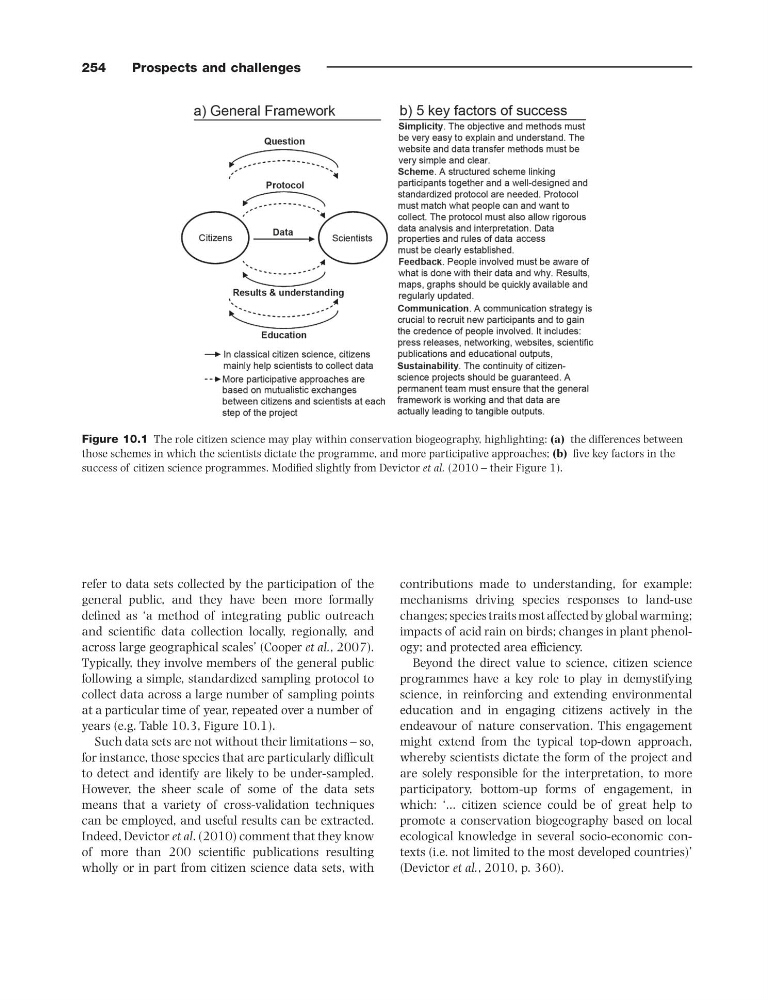
Figure 10.1 The role citizen science may play within conservation biogeography, highlighting: (a) the differences between
those schemes in which the scientists dictate the programme, and more participative approaches; (b) fi ve key factors in the
success of citizen science programmes. Modifi ed slightly from Devictor et al. ( 2010 – their Figure 1).
refer to data sets collected by the participation of the
general public, and they have been more formally
defi ned as ‘ a method of integrating public outreach
and scientifi c data collection locally, regionally, and
across large geographical scales ’ (Cooper et al. , 2007 ).
Typically, they involve members of the general public
following a simple, standardized sampling protocol to
collect data across a large number of sampling points
at a particular time of year, repeated over a number of
years (e.g. Table 10.3 , Figure 10.1 ).
Such data sets are not without their limitations – so,
for instance, those species that are particularly diffi cult
to detect and identify are likely to be under - sampled.
However, the sheer scale of some of the data sets
means that a variety of cross - validation techniques
can be employed, and useful results can be extracted.
Indeed, Devictor et al . (2010) comment that they know
of more than 200 scientifi c publications resulting
wholly or in part from citizen science data sets, with
contributions made to understanding, for example:
mechanisms driving species responses to land - use
changes; species traits most affected by global warming;
impacts of acid rain on birds; changes in plant phenology; and protected area effi ciency.
Beyond the direct value to science, citizen science
programmes have a key role to play in demystifying
science, in reinforcing and extending environmental
education and in engaging citizens actively in the
endeavour of nature conservation. This engagement
might extend from the typical top - down approach,
whereby scientists dictate the form of the project and
are solely responsible for the interpretation, to more
participatory, bottom - up forms of engagement, in
which: ‘ … citizen science could be of great help to
promote a conservation biogeography based on local
ecological knowledge in several socio - economic contexts (i.e. not limited to the most developed countries) ’
(Devictor et al. , 2010 , p. 360).
Prospects and challenges
Figure 10.1 The role citizen science may play within conservation biogeography, highlighting: (a) the differences between
those schemes in which the scientists dictate the programme, and more participative approaches; (b) fi ve key factors in the
success of citizen science programmes. Modifi ed slightly from Devictor et al. ( 2010 – their Figure 1).
refer to data sets collected by the participation of the
general public, and they have been more formally
defi ned as ‘ a method of integrating public outreach
and scientifi c data collection locally, regionally, and
across large geographical scales ’ (Cooper et al. , 2007 ).
Typically, they involve members of the general public
following a simple, standardized sampling protocol to
collect data across a large number of sampling points
at a particular time of year, repeated over a number of
years (e.g. Table 10.3 , Figure 10.1 ).
Such data sets are not without their limitations – so,
for instance, those species that are particularly diffi cult
to detect and identify are likely to be under - sampled.
However, the sheer scale of some of the data sets
means that a variety of cross - validation techniques
can be employed, and useful results can be extracted.
Indeed, Devictor et al . (2010) comment that they know
of more than 200 scientifi c publications resulting
wholly or in part from citizen science data sets, with
contributions made to understanding, for example:
mechanisms driving species responses to land - use
changes; species traits most affected by global warming;
impacts of acid rain on birds; changes in plant phenology; and protected area effi ciency.
Beyond the direct value to science, citizen science
programmes have a key role to play in demystifying
science, in reinforcing and extending environmental
education and in engaging citizens actively in the
endeavour of nature conservation. This engagement
might extend from the typical top - down approach,
whereby scientists dictate the form of the project and
are solely responsible for the interpretation, to more
participatory, bottom - up forms of engagement, in
which: ‘ … citizen science could be of great help to
promote a conservation biogeography based on local
ecological knowledge in several socio - economic contexts (i.e. not limited to the most developed countries) ’
(Devictor et al. , 2010 , p. 360).