

Future directions
253
credibility of environmental science. It is equally clear
that conservation biogeographers will struggle to
counter misrepresentations if, like most scientists, they
restrict their pronouncements and debates to academic
journals and conferences. On the other hand, efforts by
scientists to communicate via traditional media often
run into the diffi culty that these media are not receptive
to representing complex and highly technical content
without a great deal of simplifi cation, and they are
generally highly resistant to scientists checking and
correcting the way their information is represented.
An approach that one of us has advocated is the
engagement of scientists in blogs (also known as
weblogs), which are web - based interactive forums in
which topical issues can be freely debated by anyone
with access to the internet who is interested in the
issue (Ashlin & Ladle, 2006 ). However, uncontrolled,
unregulated debating sites on controversial scientifi c
issues often appear to generate more heat than light,
and it is by no means clear that they provide the most
effective means of scientists engaging in public dissemination and outreach.
Devictor et al . (2010) highlight a rather different
means of engagement between conservation biogeographers and the public, through the medium of citizen
science (Figure 10.1 ). Citizen science programmes
analyses are broadly representative of all terrestrial
species. In fact, the selected 1,103 species were all
endemics within their respective study areas, mostly
having rather restricted geographical ranges and thus
comparatively narrow climate envelopes and more vulnerability to climate change (see Box 7.3 ).
Despite the huge degree of uncertainty associated
with the projections within the paper, the story made
the front pages. The paper has been extremely highly
cited since, featuring not just in scientifi c discourse but
also in such places as the Stern Review on the economic implications of climate change, commissioned
by the UK government, in which it was used to support
an estimate of at least ten per cent species extinctions
globally in response to a 1 ° C global temperature
increase.
The climate change/extinction story was also
actively discussed on the internet, but here the representation was far more variable. Several sites ranked
highly on popular search engines were critical of the
underlying science, while traditional media sites (e.g.
newspapers, newswires, etc.) were, like the print newspapers, generally uncritical and factually incorrect
(Ladle et al. , 2005 ). Such polarization of representations and oversimplifi cation, to the point of misrepresentation, has in our view the potential to damage the
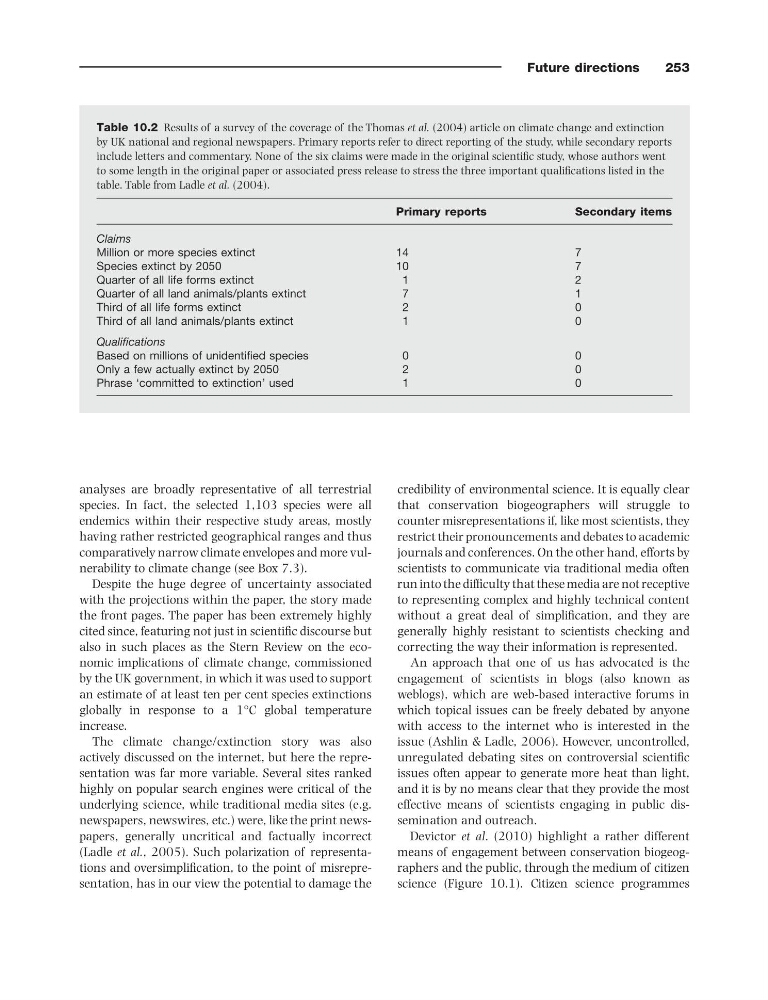
Table 10.2 Results of a survey of the coverage of the Thomas et al. (2004) article on climate change and extinction
by UK national and regional newspapers. Primary reports refer to direct reporting of the study, while secondary reports
include letters and commentary. None of the six claims were made in the original scientifi c study, whose authors went
to some length in the original paper or associated press release to stress the three important qualifi cations listed in the
table. Table from Ladle et al. (2004) .
Primary reports
Secondary items
Claims
Million or more species extinct
14
7
Species extinct by 2050
10
7
Quarter of all life forms extinct
1
2
Quarter of all land animals/plants extinct
7
1
Third of all life forms extinct
2
0
Third of all land animals/plants extinct
1
0
Qualifi cations
Based on millions of unidentifi ed species
0
0
Only a few actually extinct by 2050
2
0
Phrase ‘ committed to extinction ’ used
1
0
253
credibility of environmental science. It is equally clear
that conservation biogeographers will struggle to
counter misrepresentations if, like most scientists, they
restrict their pronouncements and debates to academic
journals and conferences. On the other hand, efforts by
scientists to communicate via traditional media often
run into the diffi culty that these media are not receptive
to representing complex and highly technical content
without a great deal of simplifi cation, and they are
generally highly resistant to scientists checking and
correcting the way their information is represented.
An approach that one of us has advocated is the
engagement of scientists in blogs (also known as
weblogs), which are web - based interactive forums in
which topical issues can be freely debated by anyone
with access to the internet who is interested in the
issue (Ashlin & Ladle, 2006 ). However, uncontrolled,
unregulated debating sites on controversial scientifi c
issues often appear to generate more heat than light,
and it is by no means clear that they provide the most
effective means of scientists engaging in public dissemination and outreach.
Devictor et al . (2010) highlight a rather different
means of engagement between conservation biogeographers and the public, through the medium of citizen
science (Figure 10.1 ). Citizen science programmes
analyses are broadly representative of all terrestrial
species. In fact, the selected 1,103 species were all
endemics within their respective study areas, mostly
having rather restricted geographical ranges and thus
comparatively narrow climate envelopes and more vulnerability to climate change (see Box 7.3 ).
Despite the huge degree of uncertainty associated
with the projections within the paper, the story made
the front pages. The paper has been extremely highly
cited since, featuring not just in scientifi c discourse but
also in such places as the Stern Review on the economic implications of climate change, commissioned
by the UK government, in which it was used to support
an estimate of at least ten per cent species extinctions
globally in response to a 1 ° C global temperature
increase.
The climate change/extinction story was also
actively discussed on the internet, but here the representation was far more variable. Several sites ranked
highly on popular search engines were critical of the
underlying science, while traditional media sites (e.g.
newspapers, newswires, etc.) were, like the print newspapers, generally uncritical and factually incorrect
(Ladle et al. , 2005 ). Such polarization of representations and oversimplifi cation, to the point of misrepresentation, has in our view the potential to damage the
Table 10.2 Results of a survey of the coverage of the Thomas et al. (2004) article on climate change and extinction
by UK national and regional newspapers. Primary reports refer to direct reporting of the study, while secondary reports
include letters and commentary. None of the six claims were made in the original scientifi c study, whose authors went
to some length in the original paper or associated press release to stress the three important qualifi cations listed in the
table. Table from Ladle et al. (2004) .
Primary reports
Secondary items
Claims
Million or more species extinct
14
7
Species extinct by 2050
10
7
Quarter of all life forms extinct
1
2
Quarter of all land animals/plants extinct
7
1
Third of all life forms extinct
2
0
Third of all land animals/plants extinct
1
0
Qualifi cations
Based on millions of unidentifi ed species
0
0
Only a few actually extinct by 2050
2
0
Phrase ‘ committed to extinction ’ used
1
0