

Conservation planning in a changing world
235
regions exhibited a 2.8 per cent increase in community
similarity. Signifi cant spatial variation in patterns of
homogenization existed. Low - lying western regions
exhibiting low historical species richness showed the
greatest increase in resemblance by converging towards
those avifaunas more characteristic of eastern regions.
Based on breeding bird surveys for North America
(exclusive of Mexico), La Sorte and Boecklen (2005)
showed substantial change in the diversity structure
of avian assemblages at the local scale in non - urban
areas from 1968 to 2003. However, there was little
evidence that overall similarity in species composition
was increasing – in fact, the general trend was towards
a two per cent level of biotic differentiation. Despite
resulted in slight differentiation, but by 2001 the range
expansion of previously established non - native species
caused biotic homogenization in some regions and the
continuing addition of new non - native species led to
biotic differentiation in others.
9.3.2 Birds
Avifaunal homogenization has been another area of
recent focus, although the number of studies are
limited compared to fi shes. In the Netherlands, Van
Turnhout et al . (2007) evaluated changes in breeding
bird composition over a 25 - year period and found that
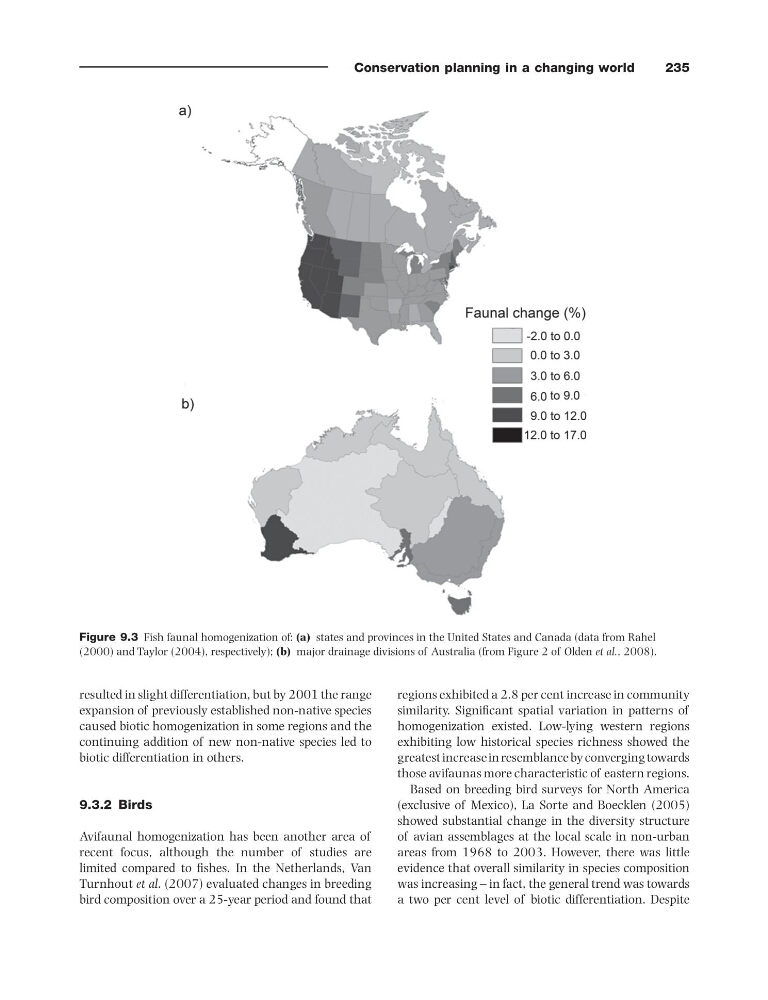
Figure 9.3 Fish faunal homogenization of: (a) states and provinces in the United States and Canada (data from Rahel
(2000) and Taylor (2004) , respectively); (b) major drainage divisions of Australia (from Figure 2 of Olden et al. , 2008 ).
235
regions exhibited a 2.8 per cent increase in community
similarity. Signifi cant spatial variation in patterns of
homogenization existed. Low - lying western regions
exhibiting low historical species richness showed the
greatest increase in resemblance by converging towards
those avifaunas more characteristic of eastern regions.
Based on breeding bird surveys for North America
(exclusive of Mexico), La Sorte and Boecklen (2005)
showed substantial change in the diversity structure
of avian assemblages at the local scale in non - urban
areas from 1968 to 2003. However, there was little
evidence that overall similarity in species composition
was increasing – in fact, the general trend was towards
a two per cent level of biotic differentiation. Despite
resulted in slight differentiation, but by 2001 the range
expansion of previously established non - native species
caused biotic homogenization in some regions and the
continuing addition of new non - native species led to
biotic differentiation in others.
9.3.2 Birds
Avifaunal homogenization has been another area of
recent focus, although the number of studies are
limited compared to fi shes. In the Netherlands, Van
Turnhout et al . (2007) evaluated changes in breeding
bird composition over a 25 - year period and found that
Figure 9.3 Fish faunal homogenization of: (a) states and provinces in the United States and Canada (data from Rahel
(2000) and Taylor (2004) , respectively); (b) major drainage divisions of Australia (from Figure 2 of Olden et al. , 2008 ).