

236
Biological invasions and the homogenization of faunas and fl oras
among archipelagos but, in general, avian assemblages
tended to show increased similarity over time to other
islands within their archipelago, compared with islands
outside their archipelago. Islands in the Indian Ocean
exhibited the greatest homogenization, whereas biotic
differentiation occurred for most islands in the Atlantic
Ocean. However, although avifaunal homogenization
was apparently the rule rather than the exception for
islands in the Indian Ocean, the authors found that the
relationship of this change to initial similarity was
this, their study did fi nd that more highly populated
regions located closer to the Atlantic and the Pacifi c
coasts of the United States experienced the strongest
patterns of homogenization.
At the global scale, Cassey et al . (2007) explored patterns of invasion and extirpation and their infl uence
on the similarity of oceanic island bird assemblages
from the Atlantic, the Caribbean, and the Indian and
Pacifi c Oceans. The authors found that patterns of
homogenization differed signifi cantly between and
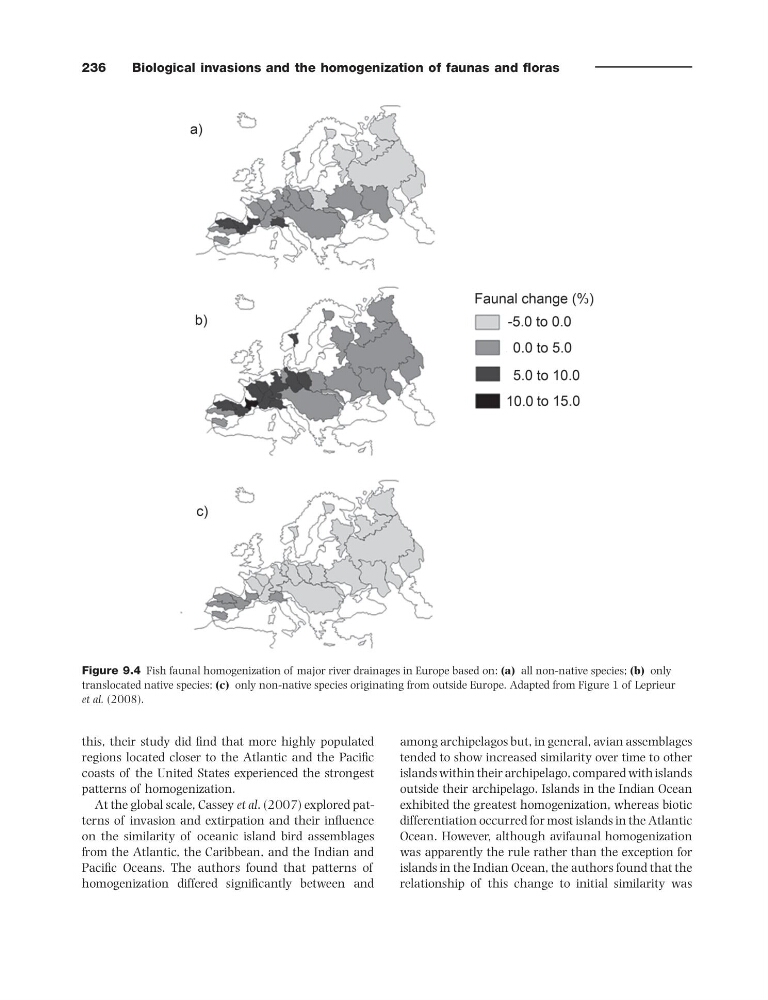
Figure 9.4 Fish faunal homogenization of major river drainages in Europe based on: (a) all non - native species; (b) only
translocated native species; (c) only non - native species originating from outside Europe. Adapted from Figure 1 of Leprieur
et al. (2008) .
Biological invasions and the homogenization of faunas and fl oras
among archipelagos but, in general, avian assemblages
tended to show increased similarity over time to other
islands within their archipelago, compared with islands
outside their archipelago. Islands in the Indian Ocean
exhibited the greatest homogenization, whereas biotic
differentiation occurred for most islands in the Atlantic
Ocean. However, although avifaunal homogenization
was apparently the rule rather than the exception for
islands in the Indian Ocean, the authors found that the
relationship of this change to initial similarity was
this, their study did fi nd that more highly populated
regions located closer to the Atlantic and the Pacifi c
coasts of the United States experienced the strongest
patterns of homogenization.
At the global scale, Cassey et al . (2007) explored patterns of invasion and extirpation and their infl uence
on the similarity of oceanic island bird assemblages
from the Atlantic, the Caribbean, and the Indian and
Pacifi c Oceans. The authors found that patterns of
homogenization differed signifi cantly between and
Figure 9.4 Fish faunal homogenization of major river drainages in Europe based on: (a) all non - native species; (b) only
translocated native species; (c) only non - native species originating from outside Europe. Adapted from Figure 1 of Leprieur
et al. (2008) .