

234
Biological invasions and the homogenization of faunas and fl oras
contrasting effects on the changes in community similarity (Leprieur et al. , 2008 ). Although biological invasions have resulted in an overall increase in faunal
similarity on the order of 2.2 per cent (Figure 9.4 a),
this research found that translocated native species (i.e.
species introduced by humans into regions where they
were not historically found) promoted homogenization
among basins ( + 5.0 per cent: Figure 9.4 b), whereas
exotic species (i.e. species originating from outside
Europe) tended to decrease their compositional similarity ( − 1.6 per cent: Figure 9.4 c). This fi nding is highly
consistent with patterns in fl oral homogenization (discussed in Section 9.3.3 ), suggesting that differences in
the geographical distribution of exotic and translocated species may play an important role in shaping
patterns of homogenization.
Clavero and Garc í a - Berthou (2006) used distributional data for freshwater fi sh in four time periods to
assess the temporal dynamics of biotic homogenization
among river basins in the Iberian Peninsula. They
found strong evidence for biotic homogenization, with
faunal similarity among rivers basins increasing by
17.1 per cent from historical times to the present day.
Changes in faunal similarity were highly dynamic in
time. The establishment of non - native species in 1995
invasion of 48 non - native fi shes over the past century
(Figure 9.3 a).
Similar broad - scale efforts have been conducted in
other parts of the world. Recent evidence points to the
homogenization of Australian fi sh faunas in response
to human - mediated species introductions (Olden et al. ,
2008 ). Fish compositional similarity among major
drainages increased 3.0 per cent, from a historical
similarity of 17.1 per cent to a present - day similarity
of 20.1 per cent. Sometimes, the degree of faunal
similarity between drainages doubled or even tripled
with time. This trend was particularly obvious in the
southern corners of the continent – areas which are
highly populated relative to other regions of Australia
(Figure 9.3 b). Similar to the United States and
Canada, fi sh faunal homogenization in Australia was
the result of the widespread introduction and subsequent escape/spread of non - native fi shes for recreation
(rainbow trout), aquaculture (common carp) and mosquito control (western mosquito fi sh, Gambusia affi nis ),
and from the ornamental/aquarium trade (goldfi sh,
Carassius auratus ; guppy, Poecilia reticulata ).
Recent efforts in Europe have shown that exotic and
translocated native species generate distinct geographical patterns of biotic homogenization because of their
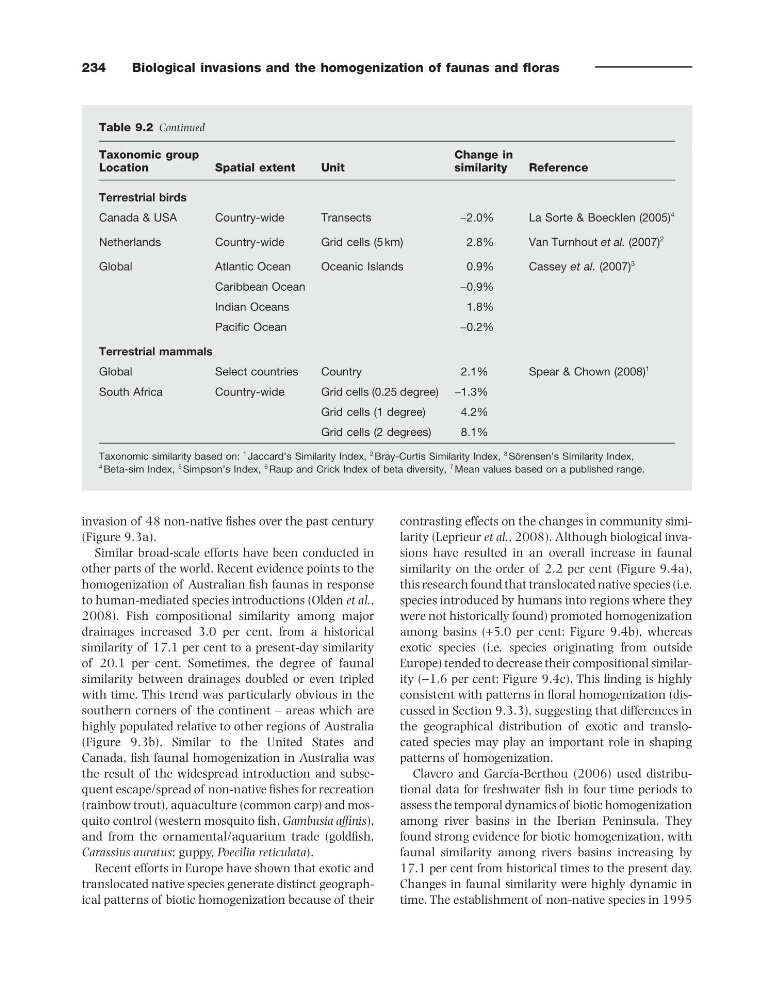
Table 9.2 Continued
Taxonomic group
Location
Spatial extent
Unit
Change in
similarity
Reference
Terrestrial birds
Canada & USA
Country - wide
Transects
− 2.0%
La Sorte & Boecklen (2005)
4
Netherlands
Country - wide
Grid cells (5 km)
2.8%
Van Turnhout et al. (2007)
2
Global
Atlantic Ocean
Oceanic Islands
0.9%
Cassey et al. (2007)
3
Caribbean Ocean
− 0.9%
Indian Oceans
1.8%
Pacifi c Ocean
− 0.2%
Terrestrial mammals
Global
Select countries
Country
2.1%
Spear & Chown (2008)
1
South Africa
Country - wide
Grid cells (0.25 degree) − 1.3%
Grid cells (1 degree)
4.2%
Grid cells (2 degrees)
8.1%
Taxonomic similarity based on:
1 Jaccard ’ s Similarity Index,
2 Bray - Curtis Similarity Index,
3 S ö rensen ’ s Similarity Index,
4 Beta - sim Index,
5 Simpson ’ s Index,
6 Raup and Crick Index of beta diversity,
7 Mean values based on a published range.
Biological invasions and the homogenization of faunas and fl oras
contrasting effects on the changes in community similarity (Leprieur et al. , 2008 ). Although biological invasions have resulted in an overall increase in faunal
similarity on the order of 2.2 per cent (Figure 9.4 a),
this research found that translocated native species (i.e.
species introduced by humans into regions where they
were not historically found) promoted homogenization
among basins ( + 5.0 per cent: Figure 9.4 b), whereas
exotic species (i.e. species originating from outside
Europe) tended to decrease their compositional similarity ( − 1.6 per cent: Figure 9.4 c). This fi nding is highly
consistent with patterns in fl oral homogenization (discussed in Section 9.3.3 ), suggesting that differences in
the geographical distribution of exotic and translocated species may play an important role in shaping
patterns of homogenization.
Clavero and Garc í a - Berthou (2006) used distributional data for freshwater fi sh in four time periods to
assess the temporal dynamics of biotic homogenization
among river basins in the Iberian Peninsula. They
found strong evidence for biotic homogenization, with
faunal similarity among rivers basins increasing by
17.1 per cent from historical times to the present day.
Changes in faunal similarity were highly dynamic in
time. The establishment of non - native species in 1995
invasion of 48 non - native fi shes over the past century
(Figure 9.3 a).
Similar broad - scale efforts have been conducted in
other parts of the world. Recent evidence points to the
homogenization of Australian fi sh faunas in response
to human - mediated species introductions (Olden et al. ,
2008 ). Fish compositional similarity among major
drainages increased 3.0 per cent, from a historical
similarity of 17.1 per cent to a present - day similarity
of 20.1 per cent. Sometimes, the degree of faunal
similarity between drainages doubled or even tripled
with time. This trend was particularly obvious in the
southern corners of the continent – areas which are
highly populated relative to other regions of Australia
(Figure 9.3 b). Similar to the United States and
Canada, fi sh faunal homogenization in Australia was
the result of the widespread introduction and subsequent escape/spread of non - native fi shes for recreation
(rainbow trout), aquaculture (common carp) and mosquito control (western mosquito fi sh, Gambusia affi nis ),
and from the ornamental/aquarium trade (goldfi sh,
Carassius auratus ; guppy, Poecilia reticulata ).
Recent efforts in Europe have shown that exotic and
translocated native species generate distinct geographical patterns of biotic homogenization because of their
Table 9.2 Continued
Taxonomic group
Location
Spatial extent
Unit
Change in
similarity
Reference
Terrestrial birds
Canada & USA
Country - wide
Transects
− 2.0%
La Sorte & Boecklen (2005)
4
Netherlands
Country - wide
Grid cells (5 km)
2.8%
Van Turnhout et al. (2007)
2
Global
Atlantic Ocean
Oceanic Islands
0.9%
Cassey et al. (2007)
3
Caribbean Ocean
− 0.9%
Indian Oceans
1.8%
Pacifi c Ocean
− 0.2%
Terrestrial mammals
Global
Select countries
Country
2.1%
Spear & Chown (2008)
1
South Africa
Country - wide
Grid cells (0.25 degree) − 1.3%
Grid cells (1 degree)
4.2%
Grid cells (2 degrees)
8.1%
Taxonomic similarity based on:
1 Jaccard ’ s Similarity Index,
2 Bray - Curtis Similarity Index,
3 S ö rensen ’ s Similarity Index,
4 Beta - sim Index,
5 Simpson ’ s Index,
6 Raup and Crick Index of beta diversity,
7 Mean values based on a published range.