

The distribution of diversity: challenges and applications
107
were used as an aid, together with other locality and
habitat data. Where there were particularly complex
patterns of shared species, it was decided to take the
commonest ‘ sharing pattern ’ to identify the EBAs. For
example, the north Venezuelan mountains were made
a separate EBA, despite sharing 12 species with fi ve
other EBAs, because there are six species confi ned to
them.
In total, 218 EBAs were identifi ed. They vary in
size from a few square kilometres to more than
100,000 km
2 , and the numbers of restricted - range
bird species they support varies from two to 80.
The development of the EBA scheme was linked to
the re - naming and re - branding of the ICBP as BirdLife
International, providing in the process both a more
strategic approach to international conservation and a
platform for the opening of new regional offi ces and
co - operative agreements with governments. The fi rst
national - scale application of the EBA approach was
again in Indonesia, where 24 EBAs were delimited
(Figure 5.5 ). As biogeographical entities they nested
within the biounits identifi ed by MacKinnon and Wind
(1981) and were used as an advocacy tool to give fresh
impetus to implementation of the Indonesian NCP and
in particular to draw attention to the conservation
importance of the region of Wallacea. This approach
complemented work by other international conservation groups that had focused their attention on reserve
development in western Indonesia, where it was easier
to attract funding due to the presence of charismatic
megafauna, including the orang - utan.
endemism and to launch this as an accessible policy
brief under the title ‘ Putting Biodiversity on the Map ’
at the 1992 Earth Summit.
The Endemic Bird Areas (EBA) scheme is a form of
global hotspots analysis because it advocates greater
targeting of resources on discrete areas that are rich in
unique kinds of organisms that are, or may become,
endangered (Table 5.4 ). The method of identifying and
mapping EBAs was informed by earlier analyses of bird
distributions in Africa by Hall & Moreau (1962) , and
in South America (Colombia and Ecuador) by Terborgh
& Winter (1983) . In particular, the latter study mapped
bird species with ranges less than 50,000 km
2 so as to
locate areas of concentrated endemism for designation
as reserves. The ICBP team adopted the same
50,000 km
2 criterion to delimit 2,649 ‘ restricted -
range ’ bird species globally (Long et al ., 1996 ). Locality
data for these species were collated from published
sources, museum catalogues and ICBPs observer networks and their distributions were then mapped
(involving some interpolation and extrapolation) and
overlaid. Areas where two or more of these range -
restricted species co - occurred, and where their global
ranges were confi ned, were termed endemic bird areas
(ICBP, 1992 ; Long et al ., 1996 ; Stattersfi eld et al .,
1998 ).
Many EBAs were found to be geographically discrete
and thus easy to determine. However, in some areas,
with complex distributional patterns, there could be
multiple possible confi gurations. To deal with this complexity, multivariate numerical classifi cation analyses
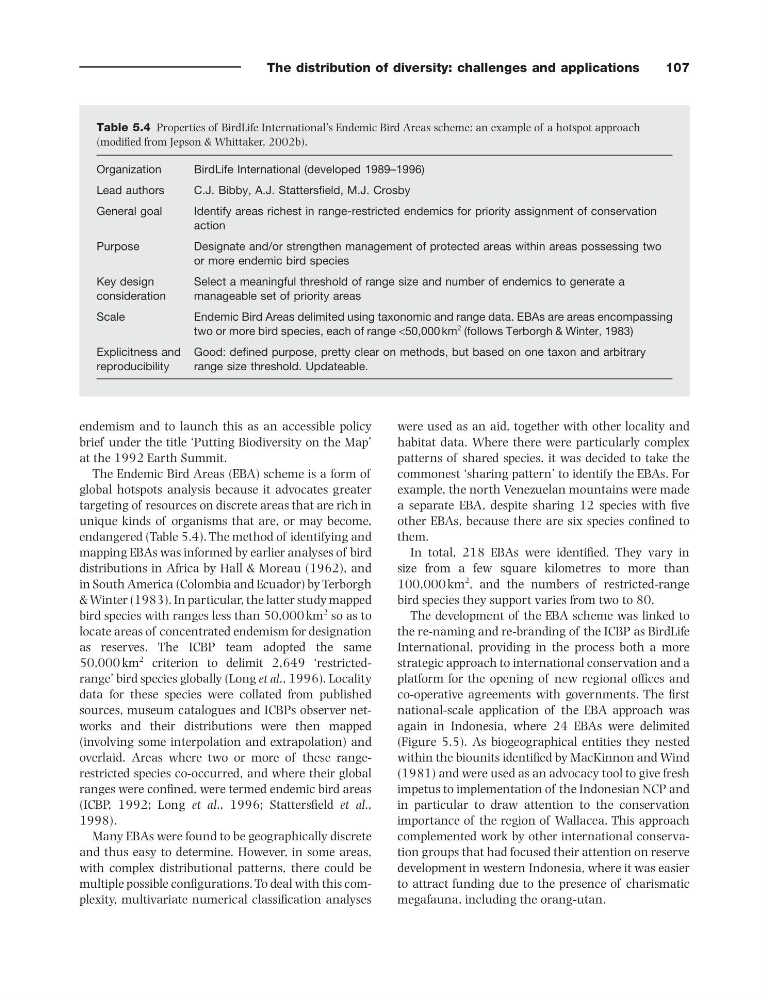
Table 5.4 Properties of BirdLife International ’ s Endemic Bird Areas scheme: an example of a hotspot approach
(modifi ed from Jepson & Whittaker, 2002b ) .
Organization
BirdLife International (developed 1989 – 1996)
Lead authors
C.J. Bibby, A.J. Stattersfi eld, M.J. Crosby
General goal
Identify areas richest in range - restricted endemics for priority assignment of conservation
action
Purpose
Designate and/or strengthen management of protected areas within areas possessing two
or more endemic bird species
Key design
consideration
Select a meaningful threshold of range size and number of endemics to generate a
manageable set of priority areas
Scale
Endemic Bird Areas delimited using taxonomic and range data. EBAs are areas encompassing
two or more bird species, each of range < 50,000 km
2 (follows Terborgh & Winter, 1983 )
Explicitness and
reproducibility
Good: defi ned purpose, pretty clear on methods, but based on one taxon and arbitrary
range size threshold. Updateable.
107
were used as an aid, together with other locality and
habitat data. Where there were particularly complex
patterns of shared species, it was decided to take the
commonest ‘ sharing pattern ’ to identify the EBAs. For
example, the north Venezuelan mountains were made
a separate EBA, despite sharing 12 species with fi ve
other EBAs, because there are six species confi ned to
them.
In total, 218 EBAs were identifi ed. They vary in
size from a few square kilometres to more than
100,000 km
2 , and the numbers of restricted - range
bird species they support varies from two to 80.
The development of the EBA scheme was linked to
the re - naming and re - branding of the ICBP as BirdLife
International, providing in the process both a more
strategic approach to international conservation and a
platform for the opening of new regional offi ces and
co - operative agreements with governments. The fi rst
national - scale application of the EBA approach was
again in Indonesia, where 24 EBAs were delimited
(Figure 5.5 ). As biogeographical entities they nested
within the biounits identifi ed by MacKinnon and Wind
(1981) and were used as an advocacy tool to give fresh
impetus to implementation of the Indonesian NCP and
in particular to draw attention to the conservation
importance of the region of Wallacea. This approach
complemented work by other international conservation groups that had focused their attention on reserve
development in western Indonesia, where it was easier
to attract funding due to the presence of charismatic
megafauna, including the orang - utan.
endemism and to launch this as an accessible policy
brief under the title ‘ Putting Biodiversity on the Map ’
at the 1992 Earth Summit.
The Endemic Bird Areas (EBA) scheme is a form of
global hotspots analysis because it advocates greater
targeting of resources on discrete areas that are rich in
unique kinds of organisms that are, or may become,
endangered (Table 5.4 ). The method of identifying and
mapping EBAs was informed by earlier analyses of bird
distributions in Africa by Hall & Moreau (1962) , and
in South America (Colombia and Ecuador) by Terborgh
& Winter (1983) . In particular, the latter study mapped
bird species with ranges less than 50,000 km
2 so as to
locate areas of concentrated endemism for designation
as reserves. The ICBP team adopted the same
50,000 km
2 criterion to delimit 2,649 ‘ restricted -
range ’ bird species globally (Long et al ., 1996 ). Locality
data for these species were collated from published
sources, museum catalogues and ICBPs observer networks and their distributions were then mapped
(involving some interpolation and extrapolation) and
overlaid. Areas where two or more of these range -
restricted species co - occurred, and where their global
ranges were confi ned, were termed endemic bird areas
(ICBP, 1992 ; Long et al ., 1996 ; Stattersfi eld et al .,
1998 ).
Many EBAs were found to be geographically discrete
and thus easy to determine. However, in some areas,
with complex distributional patterns, there could be
multiple possible confi gurations. To deal with this complexity, multivariate numerical classifi cation analyses
Table 5.4 Properties of BirdLife International ’ s Endemic Bird Areas scheme: an example of a hotspot approach
(modifi ed from Jepson & Whittaker, 2002b ) .
Organization
BirdLife International (developed 1989 – 1996)
Lead authors
C.J. Bibby, A.J. Stattersfi eld, M.J. Crosby
General goal
Identify areas richest in range - restricted endemics for priority assignment of conservation
action
Purpose
Designate and/or strengthen management of protected areas within areas possessing two
or more endemic bird species
Key design
consideration
Select a meaningful threshold of range size and number of endemics to generate a
manageable set of priority areas
Scale
Endemic Bird Areas delimited using taxonomic and range data. EBAs are areas encompassing
two or more bird species, each of range < 50,000 km
2 (follows Terborgh & Winter, 1983 )
Explicitness and
reproducibility
Good: defi ned purpose, pretty clear on methods, but based on one taxon and arbitrary
range size threshold. Updateable.