

96
The shaping of the global protected area estate
Zonal:
• Representation - compositionalist (biogeographical pattern): conserve an outstanding example of each major
ecosystem type, biogeographical region, etc., whereby
the key criteria for defi ning the units focus on natural
units of differing composition and the main goal is to
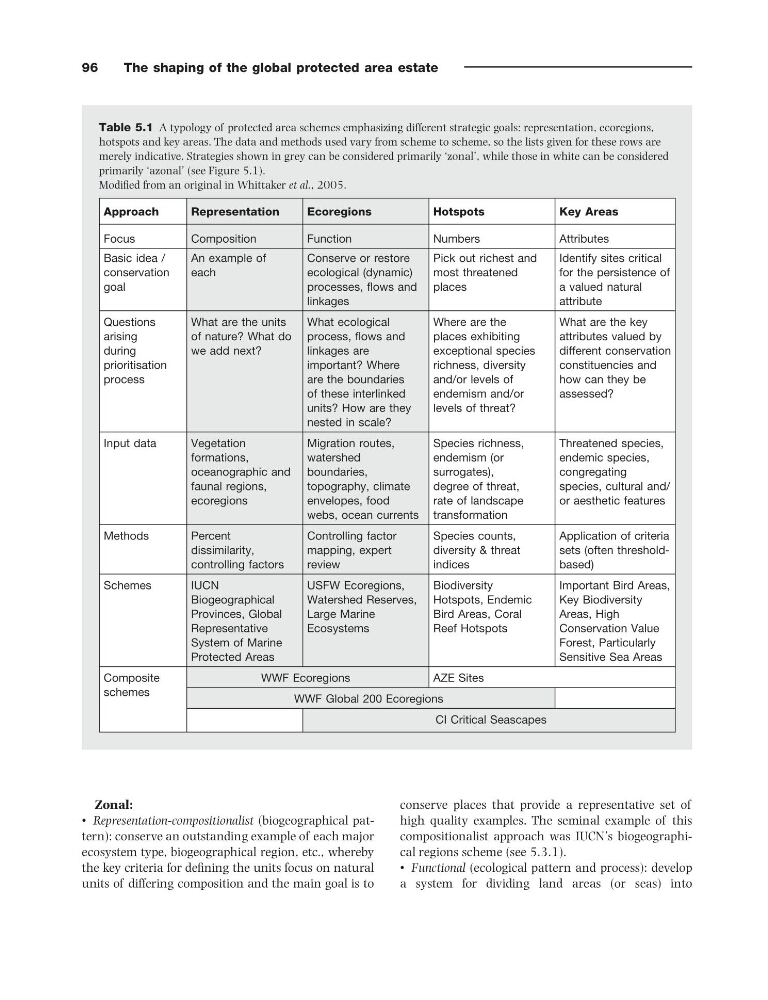
Table 5.1 A typology of protected area schemes emphasizing different strategic goals: representation, ecoregions,
hotspots and key areas. The data and methods used vary from scheme to scheme, so the lists given for these rows are
merely indicative. Strategies shown in grey can be considered primarily ‘ zonal ’ , while those in white can be considered
primarily ‘ azonal ’ (see Figure 5.1 ).
Modifi ed from an original in Whittaker et al. , 2005 .
Approach
Representation
Ecoregions
Hotspots
Key Areas
Focus
Composition
Function
Numbers
Attributes
Basic idea /
conservation
goal
An example of
each
Conserve or restore
ecological (dynamic)
processes, fl ows and
linkages
Pick out richest and
most threatened
places
Identify sites critical
for the persistence of
a valued natural
attribute
Questions
arising
during
prioritisation
process
What are the units
of nature? What do
we add next?
What ecological
process, fl ows and
linkages are
important? Where
are the boundaries
of these interlinked
units? How are they
nested in scale?
Where are the
places exhibiting
exceptional species
richness, diversity
and/or levels of
endemism and/or
levels of threat?
What are the key
attributes valued by
different conservation
constituencies and
how can they be
assessed?
Input data
Vegetation
formations,
oceanographic and
faunal regions,
ecoregions
Migration routes,
watershed
boundaries,
topography, climate
envelopes, food
webs, ocean currents
Species richness,
endemism (or
surrogates),
degree of threat,
rate of landscape
transformation
Threatened species,
endemic species,
congregating
species, cultural and/
or aesthetic features
Methods
Percent
dissimilarity,
controlling factors
Controlling factor
mapping, expert
review
Species counts,
diversity & threat
indices
Application of criteria
sets (often threshold -
based)
Schemes
IUCN
Biogeographical
Provinces, Global
Representative
System of Marine
Protected Areas
USFW Ecoregions,
Watershed Reserves,
Large Marine
Ecosystems
Biodiversity
Hotspots, Endemic
Bird Areas, Coral
Reef Hotspots
Important Bird Areas,
Key Biodiversity
Areas, High
Conservation Value
Forest, Particularly
Sensitive Sea Areas
Composite
schemes
WWF Ecoregions
AZE Sites
WWF Global 200 Ecoregions
CI Critical Seascapes
conserve places that provide a representative set of
high quality examples. The seminal example of this
compositionalist approach was IUCN ’ s biogeographical regions scheme (see 5.3.1).
• Functional (ecological pattern and process): develop
a system for dividing land areas (or seas) into
The shaping of the global protected area estate
Zonal:
• Representation - compositionalist (biogeographical pattern): conserve an outstanding example of each major
ecosystem type, biogeographical region, etc., whereby
the key criteria for defi ning the units focus on natural
units of differing composition and the main goal is to
Table 5.1 A typology of protected area schemes emphasizing different strategic goals: representation, ecoregions,
hotspots and key areas. The data and methods used vary from scheme to scheme, so the lists given for these rows are
merely indicative. Strategies shown in grey can be considered primarily ‘ zonal ’ , while those in white can be considered
primarily ‘ azonal ’ (see Figure 5.1 ).
Modifi ed from an original in Whittaker et al. , 2005 .
Approach
Representation
Ecoregions
Hotspots
Key Areas
Focus
Composition
Function
Numbers
Attributes
Basic idea /
conservation
goal
An example of
each
Conserve or restore
ecological (dynamic)
processes, fl ows and
linkages
Pick out richest and
most threatened
places
Identify sites critical
for the persistence of
a valued natural
attribute
Questions
arising
during
prioritisation
process
What are the units
of nature? What do
we add next?
What ecological
process, fl ows and
linkages are
important? Where
are the boundaries
of these interlinked
units? How are they
nested in scale?
Where are the
places exhibiting
exceptional species
richness, diversity
and/or levels of
endemism and/or
levels of threat?
What are the key
attributes valued by
different conservation
constituencies and
how can they be
assessed?
Input data
Vegetation
formations,
oceanographic and
faunal regions,
ecoregions
Migration routes,
watershed
boundaries,
topography, climate
envelopes, food
webs, ocean currents
Species richness,
endemism (or
surrogates),
degree of threat,
rate of landscape
transformation
Threatened species,
endemic species,
congregating
species, cultural and/
or aesthetic features
Methods
Percent
dissimilarity,
controlling factors
Controlling factor
mapping, expert
review
Species counts,
diversity & threat
indices
Application of criteria
sets (often threshold -
based)
Schemes
IUCN
Biogeographical
Provinces, Global
Representative
System of Marine
Protected Areas
USFW Ecoregions,
Watershed Reserves,
Large Marine
Ecosystems
Biodiversity
Hotspots, Endemic
Bird Areas, Coral
Reef Hotspots
Important Bird Areas,
Key Biodiversity
Areas, High
Conservation Value
Forest, Particularly
Sensitive Sea Areas
Composite
schemes
WWF Ecoregions
AZE Sites
WWF Global 200 Ecoregions
CI Critical Seascapes
conserve places that provide a representative set of
high quality examples. The seminal example of this
compositionalist approach was IUCN ’ s biogeographical regions scheme (see 5.3.1).
• Functional (ecological pattern and process): develop
a system for dividing land areas (or seas) into