

The distribution of diversity: challenges and applications
95
Much of the expansion that has taken place (and
that is continuing today), has been guided by the
schemes reviewed in this chapter and by the infl uential
environmental organizations that have developed,
promoted and implemented them. Over time, as more
biogeographical data have become available and
computing power has increased, conservation planning exercises have increasingly adopted systematic
conservation planning methodologies, especially, as
illustrated in Chapter 6 , at regional scales of analysis.
5.2 TYPOLOGY OF FRAMEWORKS
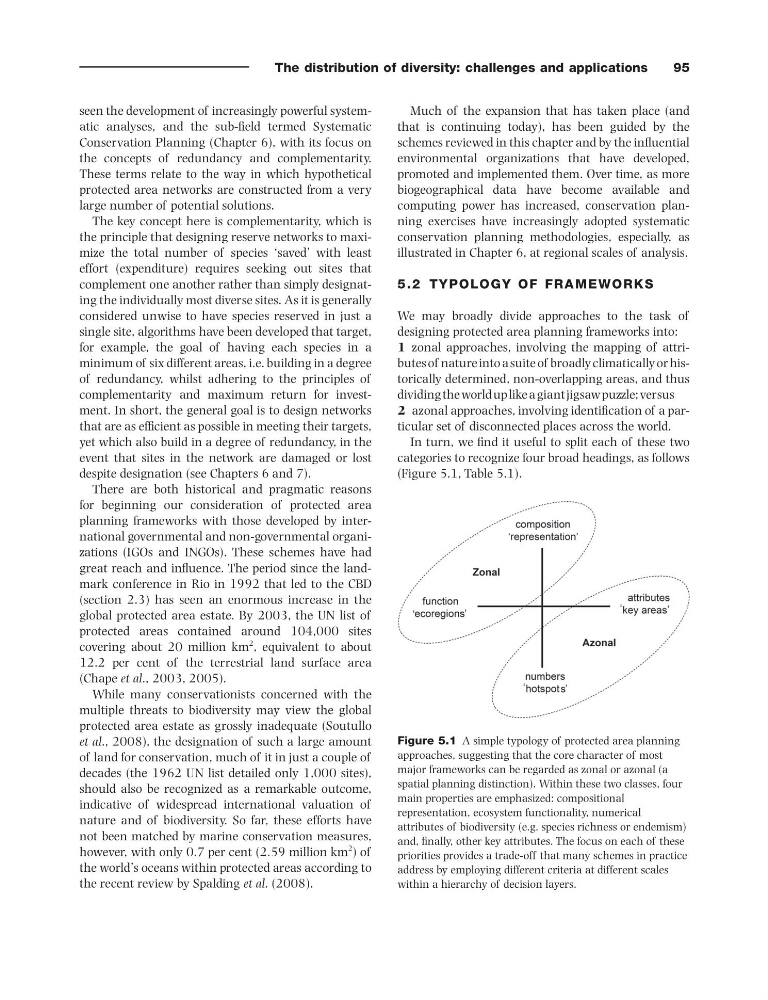
We may broadly divide approaches to the task of
designing protected area planning frameworks into:
1 zonal approaches, involving the mapping of attributes of nature into a suite of broadly climatically or historically determined, non - overlapping areas, and thus
dividing the world up like a giant jigsaw puzzle; versus
2 azonal approaches, involving identifi cation of a particular set of disconnected places across the world.
In turn, we fi nd it useful to split each of these two
categories to recognize four broad headings, as follows
(Figure 5.1 , Table 5.1 ).
seen the development of increasingly powerful systematic analyses, and the sub - fi eld termed Systematic
Conservation Planning (Chapter 6 ), with its focus on
the concepts of redundancy and complementarity.
These terms relate to the way in which hypothetical
protected area networks are constructed from a very
large number of potential solutions.
The key concept here is complementarity, which is
the principle that designing reserve networks to maximize the total number of species ‘ saved ’ with least
effort (expenditure) requires seeking out sites that
complement one another rather than simply designating the individually most diverse sites. As it is generally
considered unwise to have species reserved in just a
single site, algorithms have been developed that target,
for example, the goal of having each species in a
minimum of six different areas, i.e. building in a degree
of redundancy, whilst adhering to the principles of
complementarity and maximum return for investment. In short, the general goal is to design networks
that are as effi cient as possible in meeting their targets,
yet which also build in a degree of redundancy, in the
event that sites in the network are damaged or lost
despite designation (see Chapters 6 and 7 ).
There are both historical and pragmatic reasons
for beginning our consideration of protected area
planning frameworks with those developed by international governmental and non - governmental organizations (IGOs and INGOs). These schemes have had
great reach and infl uence. The period since the landmark conference in Rio in 1992 that led to the CBD
(section 2.3) has seen an enormous increase in the
global protected area estate. By 2003, the UN list of
protected areas contained around 104,000 sites
covering about 20 million km
2
, equivalent to about
12.2 per cent of the terrestrial land surface area
(Chape et al ., 2003 , 2005 ).
While many conservationists concerned with the
multiple threats to biodiversity may view the global
protected area estate as grossly inadequate (Soutullo
et al ., 2008 ), the designation of such a large amount
of land for conservation, much of it in just a couple of
decades (the 1962 UN list detailed only 1,000 sites),
should also be recognized as a remarkable outcome,
indicative of widespread international valuation of
nature and of biodiversity. So far, these efforts have
not been matched by marine conservation measures,
however, with only 0.7 per cent (2.59 million km
2
) of
the world ’ s oceans within protected areas according to
the recent review by Spalding et al . ( 2008 ).
Figure 5.1 A simple typology of protected area planning
approaches, suggesting that the core character of most
major frameworks can be regarded as zonal or azonal (a
spatial planning distinction). Within these two classes, four
main properties are emphasized: compositional
representation, ecosystem functionality, numerical
attributes of biodiversity (e.g. species richness or endemism)
and, fi nally, other key attributes. The focus on each of these
priorities provides a trade - off that many schemes in practice
address by employing different criteria at different scales
within a hierarchy of decision layers.
95
Much of the expansion that has taken place (and
that is continuing today), has been guided by the
schemes reviewed in this chapter and by the infl uential
environmental organizations that have developed,
promoted and implemented them. Over time, as more
biogeographical data have become available and
computing power has increased, conservation planning exercises have increasingly adopted systematic
conservation planning methodologies, especially, as
illustrated in Chapter 6 , at regional scales of analysis.
5.2 TYPOLOGY OF FRAMEWORKS
We may broadly divide approaches to the task of
designing protected area planning frameworks into:
1 zonal approaches, involving the mapping of attributes of nature into a suite of broadly climatically or historically determined, non - overlapping areas, and thus
dividing the world up like a giant jigsaw puzzle; versus
2 azonal approaches, involving identifi cation of a particular set of disconnected places across the world.
In turn, we fi nd it useful to split each of these two
categories to recognize four broad headings, as follows
(Figure 5.1 , Table 5.1 ).
seen the development of increasingly powerful systematic analyses, and the sub - fi eld termed Systematic
Conservation Planning (Chapter 6 ), with its focus on
the concepts of redundancy and complementarity.
These terms relate to the way in which hypothetical
protected area networks are constructed from a very
large number of potential solutions.
The key concept here is complementarity, which is
the principle that designing reserve networks to maximize the total number of species ‘ saved ’ with least
effort (expenditure) requires seeking out sites that
complement one another rather than simply designating the individually most diverse sites. As it is generally
considered unwise to have species reserved in just a
single site, algorithms have been developed that target,
for example, the goal of having each species in a
minimum of six different areas, i.e. building in a degree
of redundancy, whilst adhering to the principles of
complementarity and maximum return for investment. In short, the general goal is to design networks
that are as effi cient as possible in meeting their targets,
yet which also build in a degree of redundancy, in the
event that sites in the network are damaged or lost
despite designation (see Chapters 6 and 7 ).
There are both historical and pragmatic reasons
for beginning our consideration of protected area
planning frameworks with those developed by international governmental and non - governmental organizations (IGOs and INGOs). These schemes have had
great reach and infl uence. The period since the landmark conference in Rio in 1992 that led to the CBD
(section 2.3) has seen an enormous increase in the
global protected area estate. By 2003, the UN list of
protected areas contained around 104,000 sites
covering about 20 million km
2
, equivalent to about
12.2 per cent of the terrestrial land surface area
(Chape et al ., 2003 , 2005 ).
While many conservationists concerned with the
multiple threats to biodiversity may view the global
protected area estate as grossly inadequate (Soutullo
et al ., 2008 ), the designation of such a large amount
of land for conservation, much of it in just a couple of
decades (the 1962 UN list detailed only 1,000 sites),
should also be recognized as a remarkable outcome,
indicative of widespread international valuation of
nature and of biodiversity. So far, these efforts have
not been matched by marine conservation measures,
however, with only 0.7 per cent (2.59 million km
2
) of
the world ’ s oceans within protected areas according to
the recent review by Spalding et al . ( 2008 ).
Figure 5.1 A simple typology of protected area planning
approaches, suggesting that the core character of most
major frameworks can be regarded as zonal or azonal (a
spatial planning distinction). Within these two classes, four
main properties are emphasized: compositional
representation, ecosystem functionality, numerical
attributes of biodiversity (e.g. species richness or endemism)
and, fi nally, other key attributes. The focus on each of these
priorities provides a trade - off that many schemes in practice
address by employing different criteria at different scales
within a hierarchy of decision layers.