

The distribution of diversity: challenges and applications
89
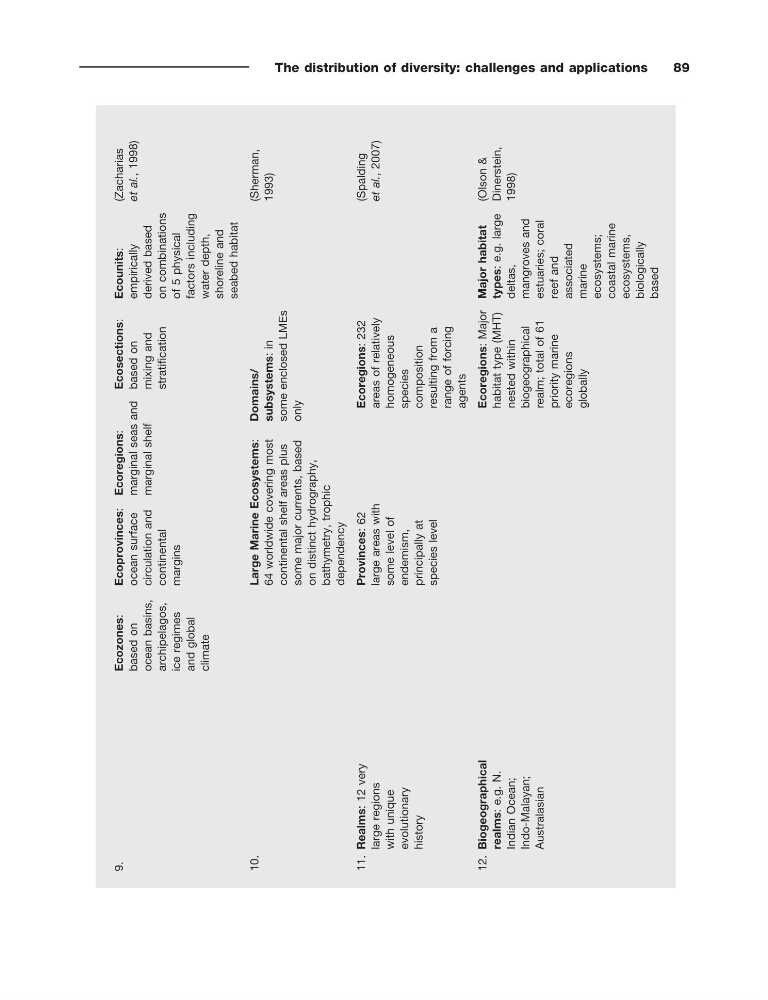
9.
Ecozones:
based on
ocean basins,
archipelagos,
ice regimes
and global
climate
Ecoprovinces:
ocean surface
circulation and
continental
margins
Ecoregions:
marginal seas and
marginal shelf
Ecosections:
based on
mixing and
stratification
Ecounits:
empirically
derived based
on combinations
of 5 physical
factors including
water depth,
shoreline and
seabed habitat
(Zacharias
et al., 1998)
10.
Large Marine Ecosystems:
64 worldwide
covering most
continental shelf areas
plus
some major currents, based
on distinct hydrography,
bathymetry, trophic
dependency
Domains/
subsystems:
in
some
enclosed LMEs
only
(Sherman,
1993)
11. Realms:
12 very
large regions
with unique
evolutionary
history
Provinces:
62
large
areas with
some level of
endemism,
principally at
species level
Ecoregions:
232
areas
of relatively
homogeneous
species
composition
resulting
from a
range of forcing
agents
(Spalding
et al., 2007)
12. Biogeographical
realms:
e.g. N.
Indian Ocean;
Indo-Malayan;
Australasian
Ecoregions:
Major
habitat
type (MHT)
nested within
biogeographical
realm; total of 61
priority marine
ecoregions
globally
Major habitat
types:
e.g. large
deltas,
mangroves and
estuaries; coral
reef and
associated
marine
ecosystems;
coastal marine
ecosystems,
biologically
based
(Olson
&
Dinerstein,
1998)
89
9.
Ecozones:
based on
ocean basins,
archipelagos,
ice regimes
and global
climate
Ecoprovinces:
ocean surface
circulation and
continental
margins
Ecoregions:
marginal seas and
marginal shelf
Ecosections:
based on
mixing and
stratification
Ecounits:
empirically
derived based
on combinations
of 5 physical
factors including
water depth,
shoreline and
seabed habitat
(Zacharias
et al., 1998)
10.
Large Marine Ecosystems:
64 worldwide
covering most
continental shelf areas
plus
some major currents, based
on distinct hydrography,
bathymetry, trophic
dependency
Domains/
subsystems:
in
some
enclosed LMEs
only
(Sherman,
1993)
11. Realms:
12 very
large regions
with unique
evolutionary
history
Provinces:
62
large
areas with
some level of
endemism,
principally at
species level
Ecoregions:
232
areas
of relatively
homogeneous
species
composition
resulting
from a
range of forcing
agents
(Spalding
et al., 2007)
12. Biogeographical
realms:
e.g. N.
Indian Ocean;
Indo-Malayan;
Australasian
Ecoregions:
Major
habitat
type (MHT)
nested within
biogeographical
realm; total of 61
priority marine
ecoregions
globally
Major habitat
types:
e.g. large
deltas,
mangroves and
estuaries; coral
reef and
associated
marine
ecosystems;
coastal marine
ecosystems,
biologically
based
(Olson
&
Dinerstein,
1998)