

REPRODUCTION, DEVELOPMENT AND LIFE-HISTORY TRAITS
387
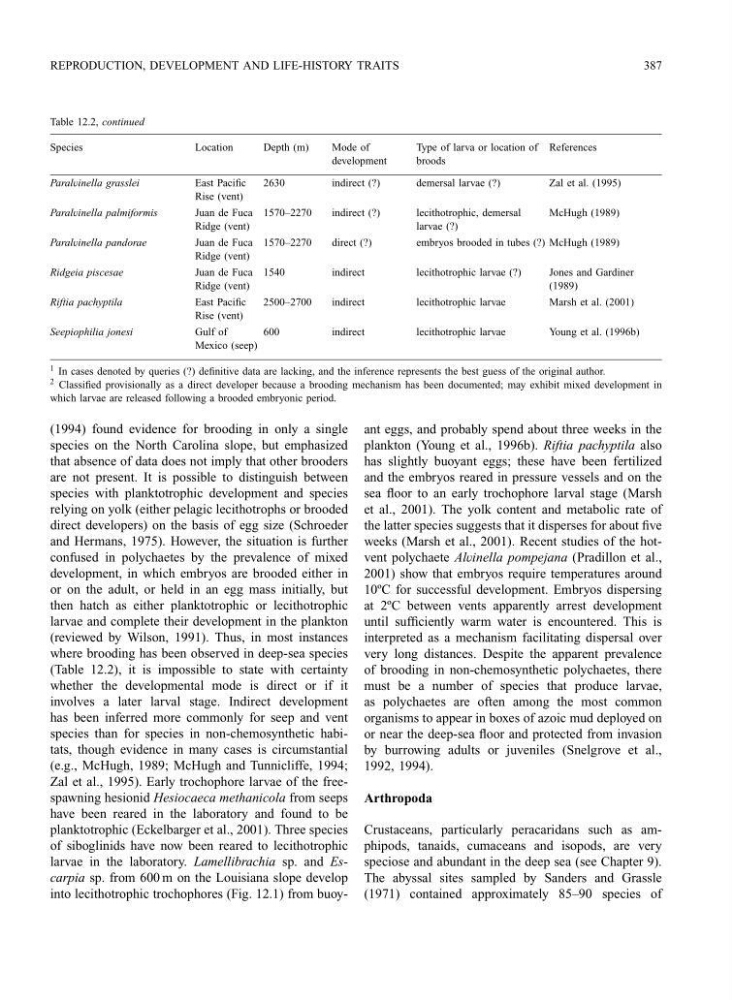
Table 12.2, continued
Species
Location
Depth (m)
Mode of
development
Type of larva or location of
broods
References
Paralvinella grasslei
East Pacific
Rise (vent)
2630
indirect (?)
demersal larvae (?)
Zal et al. (1995)
Paralvinella palmiformis
Juan de Fuca
Ridge (vent)
1570–2270
indirect (?)
lecithotrophic, demersal
larvae (?)
McHugh (1989)
Paralvinella pandorae
Juan de Fuca
Ridge (vent)
1570–2270
direct (?)
embryos brooded in tubes (?) McHugh (1989)
Ridgeia piscesae
Juan de Fuca
Ridge (vent)
1540
indirect
lecithotrophic larvae (?)
Jones and Gardiner
(1989)
Riftia pachyptila
East Pacific
Rise (vent)
2500–2700
indirect
lecithotrophic larvae
Marsh et al. (2001)
Seepiophilia jonesi
Gulf of
Mexico (seep)
600
indirect
lecithotrophic larvae
Young et al. (1996b)
1 In cases denoted by queries (?) definitive data are lacking, and the inference represents the best guess of the original author.
2 Classified provisionally as a direct developer because a brooding mechanism has been documented; may exhibit mixed development in
which larvae are released following a brooded embryonic period.
(1994) found evidence for brooding in only a single
species on the North Carolina slope, but emphasized
that absence of data does not imply that other brooders
are not present. It is possible to distinguish between
species with planktotrophic development and species
relying on yolk (either pelagic lecithotrophs or brooded
direct developers) on the basis of egg size (Schroeder
and Hermans, 1975). However, the situation is further
confused in polychaetes by the prevalence of mixed
development, in which embryos are brooded either in
or on the adult, or held in an egg mass initially, but
then hatch as either planktotrophic or lecithotrophic
larvae and complete their development in the plankton
(reviewed by Wilson, 1991). Thus, in most instances
where brooding has been observed in deep-sea species
(Table 12.2), it is impossible to state with certainty
whether the developmental mode is direct or if it
involves a later larval stage. Indirect development
has been inferred more commonly for seep and vent
species than for species in non-chemosynthetic habitats, though evidence in many cases is circumstantial
(e.g., McHugh, 1989; McHugh and Tunnicliffe, 1994;
Zal et al., 1995). Early trochophore larvae of the freespawning hesionid Hesiocaeca methanicola from seeps
have been reared in the laboratory and found to be
planktotrophic (Eckelbarger et al., 2001). Three species
of siboglinids have now been reared to lecithotrophic
larvae in the laboratory. Lamellibrachia sp. and Escarpia sp. from 600 m on the Louisiana slope develop
into lecithotrophic trochophores (Fig. 12.1) from buoyant eggs, and probably spend about three weeks in the
plankton (Young et al., 1996b). Riftia pachyptila also
has slightly buoyant eggs; these have been fertilized
and the embryos reared in pressure vessels and on the
sea floor to an early trochophore larval stage (Marsh
et al., 2001). The yolk content and metabolic rate of
the latter species suggests that it disperses for about five
weeks (Marsh et al., 2001). Recent studies of the hotvent polychaete Alvinella pompejana (Pradillon et al.,
2001) show that embryos require temperatures around
10ºC for successful development. Embryos dispersing
at 2ºC between vents apparently arrest development
until sufficiently warm water is encountered. This is
interpreted as a mechanism facilitating dispersal over
very long distances. Despite the apparent prevalence
of brooding in non-chemosynthetic polychaetes, there
must be a number of species that produce larvae,
as polychaetes are often among the most common
organisms to appear in boxes of azoic mud deployed on
or near the deep-sea floor and protected from invasion
by burrowing adults or juveniles (Snelgrove et al.,
1992, 1994).
Arthropoda
Crustaceans, particularly peracaridans such as amphipods, tanaids, cumaceans and isopods, are very
speciose and abundant in the deep sea (see Chapter 9).
The abyssal sites sampled by Sanders and Grassle
(1971) contained approximately 85–90 species of
387
Table 12.2, continued
Species
Location
Depth (m)
Mode of
development
Type of larva or location of
broods
References
Paralvinella grasslei
East Pacific
Rise (vent)
2630
indirect (?)
demersal larvae (?)
Zal et al. (1995)
Paralvinella palmiformis
Juan de Fuca
Ridge (vent)
1570–2270
indirect (?)
lecithotrophic, demersal
larvae (?)
McHugh (1989)
Paralvinella pandorae
Juan de Fuca
Ridge (vent)
1570–2270
direct (?)
embryos brooded in tubes (?) McHugh (1989)
Ridgeia piscesae
Juan de Fuca
Ridge (vent)
1540
indirect
lecithotrophic larvae (?)
Jones and Gardiner
(1989)
Riftia pachyptila
East Pacific
Rise (vent)
2500–2700
indirect
lecithotrophic larvae
Marsh et al. (2001)
Seepiophilia jonesi
Gulf of
Mexico (seep)
600
indirect
lecithotrophic larvae
Young et al. (1996b)
1 In cases denoted by queries (?) definitive data are lacking, and the inference represents the best guess of the original author.
2 Classified provisionally as a direct developer because a brooding mechanism has been documented; may exhibit mixed development in
which larvae are released following a brooded embryonic period.
(1994) found evidence for brooding in only a single
species on the North Carolina slope, but emphasized
that absence of data does not imply that other brooders
are not present. It is possible to distinguish between
species with planktotrophic development and species
relying on yolk (either pelagic lecithotrophs or brooded
direct developers) on the basis of egg size (Schroeder
and Hermans, 1975). However, the situation is further
confused in polychaetes by the prevalence of mixed
development, in which embryos are brooded either in
or on the adult, or held in an egg mass initially, but
then hatch as either planktotrophic or lecithotrophic
larvae and complete their development in the plankton
(reviewed by Wilson, 1991). Thus, in most instances
where brooding has been observed in deep-sea species
(Table 12.2), it is impossible to state with certainty
whether the developmental mode is direct or if it
involves a later larval stage. Indirect development
has been inferred more commonly for seep and vent
species than for species in non-chemosynthetic habitats, though evidence in many cases is circumstantial
(e.g., McHugh, 1989; McHugh and Tunnicliffe, 1994;
Zal et al., 1995). Early trochophore larvae of the freespawning hesionid Hesiocaeca methanicola from seeps
have been reared in the laboratory and found to be
planktotrophic (Eckelbarger et al., 2001). Three species
of siboglinids have now been reared to lecithotrophic
larvae in the laboratory. Lamellibrachia sp. and Escarpia sp. from 600 m on the Louisiana slope develop
into lecithotrophic trochophores (Fig. 12.1) from buoyant eggs, and probably spend about three weeks in the
plankton (Young et al., 1996b). Riftia pachyptila also
has slightly buoyant eggs; these have been fertilized
and the embryos reared in pressure vessels and on the
sea floor to an early trochophore larval stage (Marsh
et al., 2001). The yolk content and metabolic rate of
the latter species suggests that it disperses for about five
weeks (Marsh et al., 2001). Recent studies of the hotvent polychaete Alvinella pompejana (Pradillon et al.,
2001) show that embryos require temperatures around
10ºC for successful development. Embryos dispersing
at 2ºC between vents apparently arrest development
until sufficiently warm water is encountered. This is
interpreted as a mechanism facilitating dispersal over
very long distances. Despite the apparent prevalence
of brooding in non-chemosynthetic polychaetes, there
must be a number of species that produce larvae,
as polychaetes are often among the most common
organisms to appear in boxes of azoic mud deployed on
or near the deep-sea floor and protected from invasion
by burrowing adults or juveniles (Snelgrove et al.,
1992, 1994).
Arthropoda
Crustaceans, particularly peracaridans such as amphipods, tanaids, cumaceans and isopods, are very
speciose and abundant in the deep sea (see Chapter 9).
The abyssal sites sampled by Sanders and Grassle
(1971) contained approximately 85–90 species of