

328
John D. GAGE
may supply the missing carbon necessary to balance the
supply-side deficit measured from concurrent seabed
respirometry and sediment traps in the nutrition of the
deep-sea community (e.g., K.L. Smith, 1987). Such
processes of redistribution must be taken into account
in mapping carbon fluxes on the deep-sea floor.
Resuspension
Processes of resuspension, which provide the material
transported by advection, had been inferred from some
of the earliest sediment-trap data where the volume
of material suddenly increased in traps set below
100 metres above the bottom after decreasing steadily
downwards through the water. This process is now
recognized as playing an important role in particle
dynamics in the deep sea (Gardner and Richardson,
1992). Chemical analyses of material caught in a trap
set by Honjo (1978) at 114 metres above the bottom
at a depth of 5367 m in the Sargasso Sea showed that
60% of the total mass flux was resuspended material,
mostly faecal pellets, containing 80% red clay. This
material is categorized as the rebound flux (pp. 329–
330) component of deep sediment traps (Walsh, 1992).
For resuspension to occur after its initial deposition
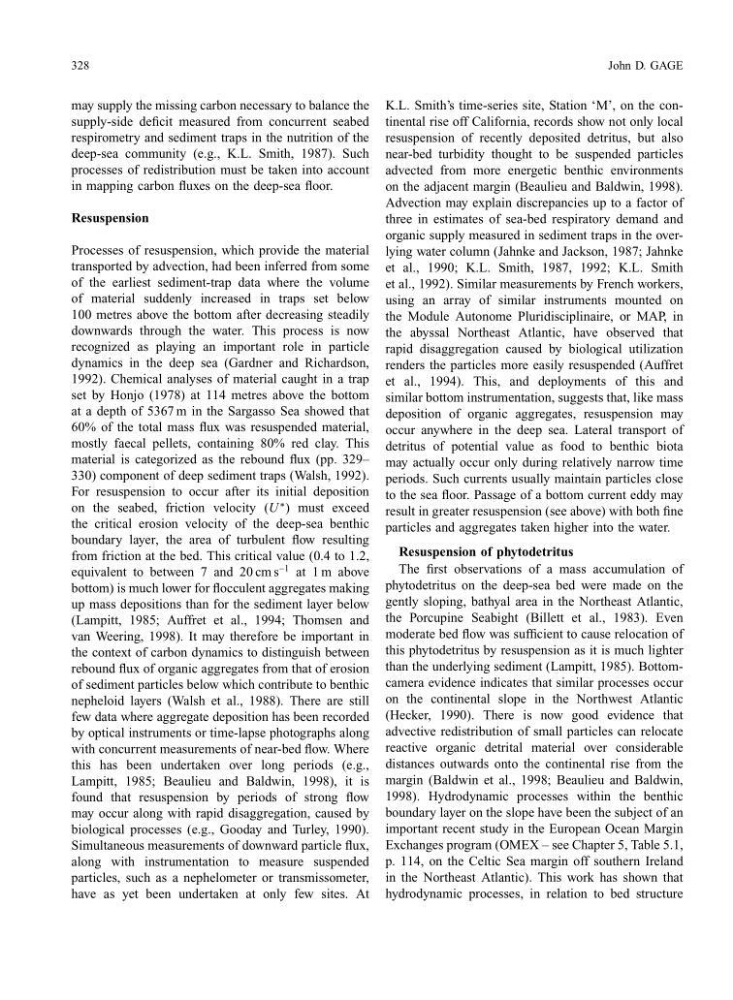
on the seabed, friction velocity (U
° ) must exceed
the critical erosion velocity of the deep-sea benthic
boundary layer, the area of turbulent flow resulting
from friction at the bed. This critical value (0.4 to 1.2,
equivalent to between 7 and 20 cm s
−1 at 1 m above
bottom) is much lower for flocculent aggregates making
up mass depositions than for the sediment layer below
(Lampitt, 1985; Auffret et al., 1994; Thomsen and
van Weering, 1998). It may therefore be important in
the context of carbon dynamics to distinguish between
rebound flux of organic aggregates from that of erosion
of sediment particles below which contribute to benthic
nepheloid layers (Walsh et al., 1988). There are still
few data where aggregate deposition has been recorded
by optical instruments or time-lapse photographs along
with concurrent measurements of near-bed flow. Where
this has been undertaken over long periods (e.g.,
Lampitt, 1985; Beaulieu and Baldwin, 1998), it is
found that resuspension by periods of strong flow
may occur along with rapid disaggregation, caused by
biological processes (e.g., Gooday and Turley, 1990).
Simultaneous measurements of downward particle flux,
along with instrumentation to measure suspended
particles, such as a nephelometer or transmissometer,
have as yet been undertaken at only few sites. At
K.L. Smith’s time-series site, Station ‘M’, on the continental rise off California, records show not only local
resuspension of recently deposited detritus, but also
near-bed turbidity thought to be suspended particles
advected from more energetic benthic environments
on the adjacent margin (Beaulieu and Baldwin, 1998).
Advection may explain discrepancies up to a factor of
three in estimates of sea-bed respiratory demand and
organic supply measured in sediment traps in the overlying water column (Jahnke and Jackson, 1987; Jahnke
et al., 1990; K.L. Smith, 1987, 1992; K.L. Smith
et al., 1992). Similar measurements by French workers,
using an array of similar instruments mounted on
the Module Autonome Pluridisciplinaire, or MAP, in
the abyssal Northeast Atlantic, have observed that
rapid disaggregation caused by biological utilization
renders the particles more easily resuspended (Auffret
et al., 1994). This, and deployments of this and
similar bottom instrumentation, suggests that, like mass
deposition of organic aggregates, resuspension may
occur anywhere in the deep sea. Lateral transport of
detritus of potential value as food to benthic biota
may actually occur only during relatively narrow time
periods. Such currents usually maintain particles close
to the sea floor. Passage of a bottom current eddy may
result in greater resuspension (see above) with both fine
particles and aggregates taken higher into the water.
Resuspension of phytodetritus
The first observations of a mass accumulation of
phytodetritus on the deep-sea bed were made on the
gently sloping, bathyal area in the Northeast Atlantic,
the Porcupine Seabight (Billett et al., 1983). Even
moderate bed flow was sufficient to cause relocation of
this phytodetritus by resuspension as it is much lighter
than the underlying sediment (Lampitt, 1985). Bottomcamera evidence indicates that similar processes occur
on the continental slope in the Northwest Atlantic
(Hecker, 1990). There is now good evidence that
advective redistribution of small particles can relocate
reactive organic detrital material over considerable
distances outwards onto the continental rise from the
margin (Baldwin et al., 1998; Beaulieu and Baldwin,
1998). Hydrodynamic processes within the benthic
boundary layer on the slope have been the subject of an
important recent study in the European Ocean Margin
Exchanges program (OMEX – see Chapter 5, Table 5.1,
p. 114, on the Celtic Sea margin off southern Ireland
in the Northeast Atlantic). This work has shown that
hydrodynamic processes, in relation to bed structure
John D. GAGE
may supply the missing carbon necessary to balance the
supply-side deficit measured from concurrent seabed
respirometry and sediment traps in the nutrition of the
deep-sea community (e.g., K.L. Smith, 1987). Such
processes of redistribution must be taken into account
in mapping carbon fluxes on the deep-sea floor.
Resuspension
Processes of resuspension, which provide the material
transported by advection, had been inferred from some
of the earliest sediment-trap data where the volume
of material suddenly increased in traps set below
100 metres above the bottom after decreasing steadily
downwards through the water. This process is now
recognized as playing an important role in particle
dynamics in the deep sea (Gardner and Richardson,
1992). Chemical analyses of material caught in a trap
set by Honjo (1978) at 114 metres above the bottom
at a depth of 5367 m in the Sargasso Sea showed that
60% of the total mass flux was resuspended material,
mostly faecal pellets, containing 80% red clay. This
material is categorized as the rebound flux (pp. 329–
330) component of deep sediment traps (Walsh, 1992).
For resuspension to occur after its initial deposition
on the seabed, friction velocity (U
° ) must exceed
the critical erosion velocity of the deep-sea benthic
boundary layer, the area of turbulent flow resulting
from friction at the bed. This critical value (0.4 to 1.2,
equivalent to between 7 and 20 cm s
−1 at 1 m above
bottom) is much lower for flocculent aggregates making
up mass depositions than for the sediment layer below
(Lampitt, 1985; Auffret et al., 1994; Thomsen and
van Weering, 1998). It may therefore be important in
the context of carbon dynamics to distinguish between
rebound flux of organic aggregates from that of erosion
of sediment particles below which contribute to benthic
nepheloid layers (Walsh et al., 1988). There are still
few data where aggregate deposition has been recorded
by optical instruments or time-lapse photographs along
with concurrent measurements of near-bed flow. Where
this has been undertaken over long periods (e.g.,
Lampitt, 1985; Beaulieu and Baldwin, 1998), it is
found that resuspension by periods of strong flow
may occur along with rapid disaggregation, caused by
biological processes (e.g., Gooday and Turley, 1990).
Simultaneous measurements of downward particle flux,
along with instrumentation to measure suspended
particles, such as a nephelometer or transmissometer,
have as yet been undertaken at only few sites. At
K.L. Smith’s time-series site, Station ‘M’, on the continental rise off California, records show not only local
resuspension of recently deposited detritus, but also
near-bed turbidity thought to be suspended particles
advected from more energetic benthic environments
on the adjacent margin (Beaulieu and Baldwin, 1998).
Advection may explain discrepancies up to a factor of
three in estimates of sea-bed respiratory demand and
organic supply measured in sediment traps in the overlying water column (Jahnke and Jackson, 1987; Jahnke
et al., 1990; K.L. Smith, 1987, 1992; K.L. Smith
et al., 1992). Similar measurements by French workers,
using an array of similar instruments mounted on
the Module Autonome Pluridisciplinaire, or MAP, in
the abyssal Northeast Atlantic, have observed that
rapid disaggregation caused by biological utilization
renders the particles more easily resuspended (Auffret
et al., 1994). This, and deployments of this and
similar bottom instrumentation, suggests that, like mass
deposition of organic aggregates, resuspension may
occur anywhere in the deep sea. Lateral transport of
detritus of potential value as food to benthic biota
may actually occur only during relatively narrow time
periods. Such currents usually maintain particles close
to the sea floor. Passage of a bottom current eddy may
result in greater resuspension (see above) with both fine
particles and aggregates taken higher into the water.
Resuspension of phytodetritus
The first observations of a mass accumulation of
phytodetritus on the deep-sea bed were made on the
gently sloping, bathyal area in the Northeast Atlantic,
the Porcupine Seabight (Billett et al., 1983). Even
moderate bed flow was sufficient to cause relocation of
this phytodetritus by resuspension as it is much lighter
than the underlying sediment (Lampitt, 1985). Bottomcamera evidence indicates that similar processes occur
on the continental slope in the Northwest Atlantic
(Hecker, 1990). There is now good evidence that
advective redistribution of small particles can relocate
reactive organic detrital material over considerable
distances outwards onto the continental rise from the
margin (Baldwin et al., 1998; Beaulieu and Baldwin,
1998). Hydrodynamic processes within the benthic
boundary layer on the slope have been the subject of an
important recent study in the European Ocean Margin
Exchanges program (OMEX – see Chapter 5, Table 5.1,
p. 114, on the Celtic Sea margin off southern Ireland
in the Northeast Atlantic). This work has shown that
hydrodynamic processes, in relation to bed structure