

FOOD INPUTS, UTILIZATION, CARBON FLOW AND ENERGETICS
327
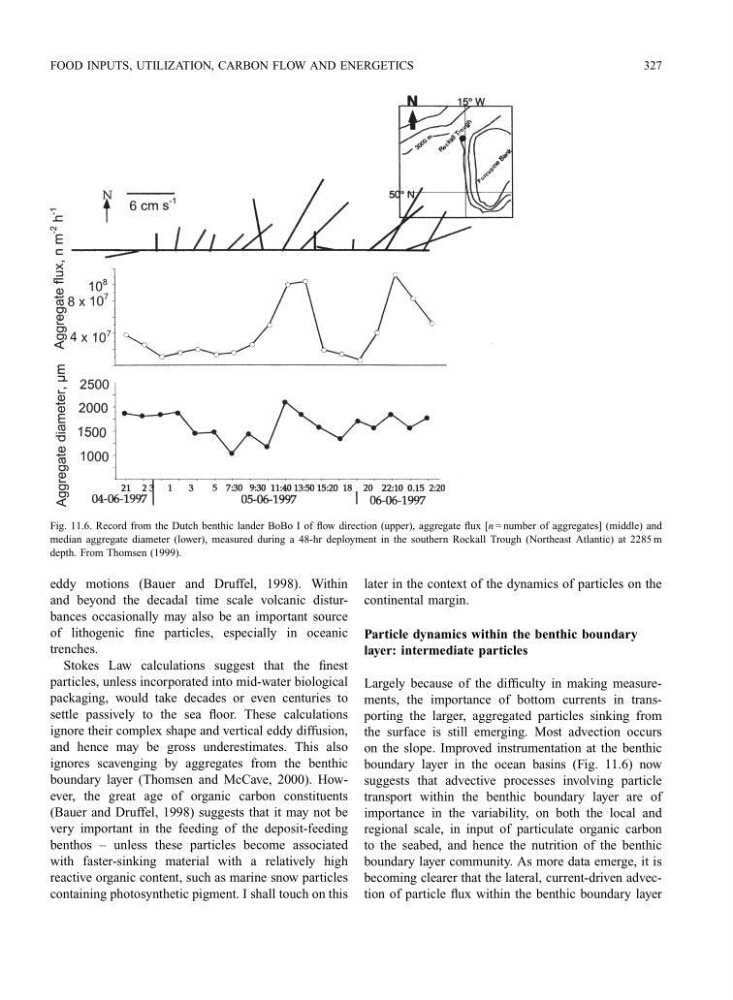
Fig. 11.6. Record from the Dutch benthic lander BoBo I of flow direction (upper), aggregate flux [n = number of aggregates] (middle) and
median aggregate diameter (lower), measured during a 48-hr deployment in the southern Rockall Trough (Northeast Atlantic) at 2285 m
depth. From Thomsen (1999).
eddy motions (Bauer and Druffel, 1998). Within
and beyond the decadal time scale volcanic disturbances occasionally may also be an important source
of lithogenic fine particles, especially in oceanic
trenches.
Stokes Law calculations suggest that the finest
particles, unless incorporated into mid-water biological
packaging, would take decades or even centuries to
settle passively to the sea floor. These calculations
ignore their complex shape and vertical eddy diffusion,
and hence may be gross underestimates. This also
ignores scavenging by aggregates from the benthic
boundary layer (Thomsen and McCave, 2000). However, the great age of organic carbon constituents
(Bauer and Druffel, 1998) suggests that it may not be
very important in the feeding of the deposit-feeding
benthos – unless these particles become associated
with faster-sinking material with a relatively high
reactive organic content, such as marine snow particles
containing photosynthetic pigment. I shall touch on this
later in the context of the dynamics of particles on the
continental margin.
Particle dynamics within the benthic boundary
layer: intermediate particles
Largely because of the difficulty in making measurements, the importance of bottom currents in transporting the larger, aggregated particles sinking from
the surface is still emerging. Most advection occurs
on the slope. Improved instrumentation at the benthic
boundary layer in the ocean basins (Fig. 11.6) now
suggests that advective processes involving particle
transport within the benthic boundary layer are of
importance in the variability, on both the local and
regional scale, in input of particulate organic carbon
to the seabed, and hence the nutrition of the benthic
boundary layer community. As more data emerge, it is
becoming clearer that the lateral, current-driven advection of particle flux within the benthic boundary layer
327
Fig. 11.6. Record from the Dutch benthic lander BoBo I of flow direction (upper), aggregate flux [n = number of aggregates] (middle) and
median aggregate diameter (lower), measured during a 48-hr deployment in the southern Rockall Trough (Northeast Atlantic) at 2285 m
depth. From Thomsen (1999).
eddy motions (Bauer and Druffel, 1998). Within
and beyond the decadal time scale volcanic disturbances occasionally may also be an important source
of lithogenic fine particles, especially in oceanic
trenches.
Stokes Law calculations suggest that the finest
particles, unless incorporated into mid-water biological
packaging, would take decades or even centuries to
settle passively to the sea floor. These calculations
ignore their complex shape and vertical eddy diffusion,
and hence may be gross underestimates. This also
ignores scavenging by aggregates from the benthic
boundary layer (Thomsen and McCave, 2000). However, the great age of organic carbon constituents
(Bauer and Druffel, 1998) suggests that it may not be
very important in the feeding of the deposit-feeding
benthos – unless these particles become associated
with faster-sinking material with a relatively high
reactive organic content, such as marine snow particles
containing photosynthetic pigment. I shall touch on this
later in the context of the dynamics of particles on the
continental margin.
Particle dynamics within the benthic boundary
layer: intermediate particles
Largely because of the difficulty in making measurements, the importance of bottom currents in transporting the larger, aggregated particles sinking from
the surface is still emerging. Most advection occurs
on the slope. Improved instrumentation at the benthic
boundary layer in the ocean basins (Fig. 11.6) now
suggests that advective processes involving particle
transport within the benthic boundary layer are of
importance in the variability, on both the local and
regional scale, in input of particulate organic carbon
to the seabed, and hence the nutrition of the benthic
boundary layer community. As more data emerge, it is
becoming clearer that the lateral, current-driven advection of particle flux within the benthic boundary layer