

322
John D. GAGE
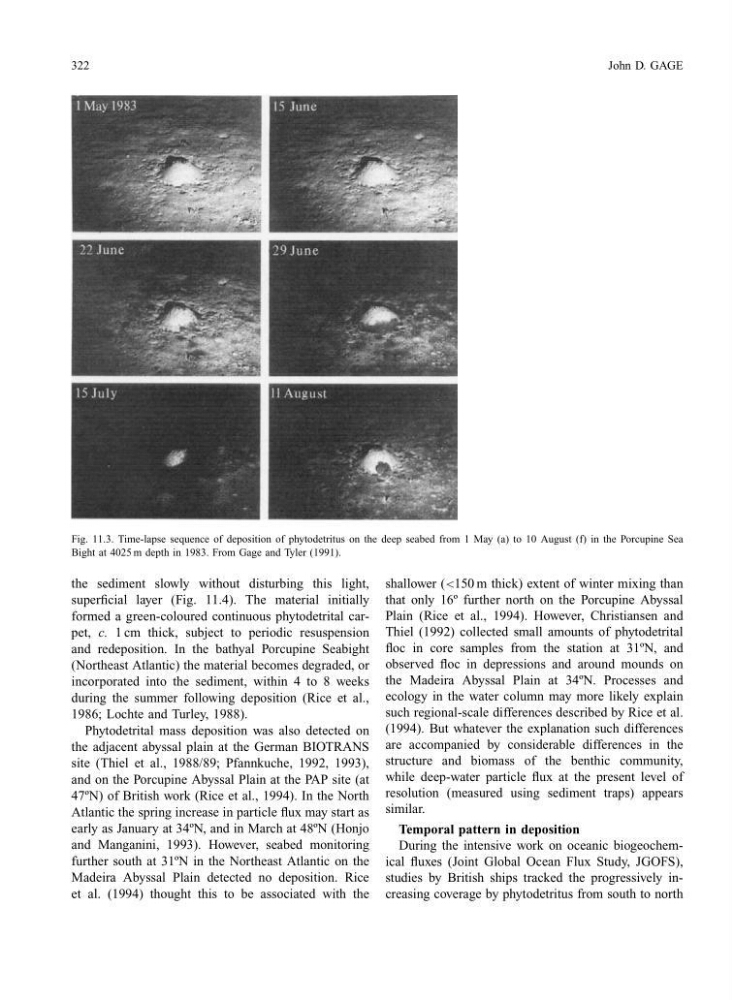
Fig. 11.3. Time-lapse sequence of deposition of phytodetritus on the deep seabed from 1 May (a) to 10 August (f) in the Porcupine Sea
Bight at 4025 m depth in 1983. From Gage and Tyler (1991).
the sediment slowly without disturbing this light,
superficial layer (Fig. 11.4). The material initially
formed a green-coloured continuous phytodetrital carpet, c. 1 cm thick, subject to periodic resuspension
and redeposition. In the bathyal Porcupine Seabight
(Northeast Atlantic) the material becomes degraded, or
incorporated into the sediment, within 4 to 8 weeks
during the summer following deposition (Rice et al.,
1986; Lochte and Turley, 1988).
Phytodetrital mass deposition was also detected on
the adjacent abyssal plain at the German BIOTRANS
site (Thiel et al., 1988/89; Pfannkuche, 1992, 1993),
and on the Porcupine Abyssal Plain at the PAP site (at
47ºN) of British work (Rice et al., 1994). In the North
Atlantic the spring increase in particle flux may start as
early as January at 34ºN, and in March at 48ºN (Honjo
and Manganini, 1993). However, seabed monitoring
further south at 31ºN in the Northeast Atlantic on the
Madeira Abyssal Plain detected no deposition. Rice
et al. (1994) thought this to be associated with the
shallower (<150 m thick) extent of winter mixing than
that only 16º further north on the Porcupine Abyssal
Plain (Rice et al., 1994). However, Christiansen and
Thiel (1992) collected small amounts of phytodetrital
floc in core samples from the station at 31ºN, and
observed floc in depressions and around mounds on
the Madeira Abyssal Plain at 34ºN. Processes and
ecology in the water column may more likely explain
such regional-scale differences described by Rice et al.
(1994). But whatever the explanation such differences
are accompanied by considerable differences in the
structure and biomass of the benthic community,
while deep-water particle flux at the present level of
resolution (measured using sediment traps) appears
similar.
Temporal pattern in deposition
During the intensive work on oceanic biogeochemical fluxes (Joint Global Ocean Flux Study, JGOFS),
studies by British ships tracked the progressively increasing coverage by phytodetritus from south to north
John D. GAGE
Fig. 11.3. Time-lapse sequence of deposition of phytodetritus on the deep seabed from 1 May (a) to 10 August (f) in the Porcupine Sea
Bight at 4025 m depth in 1983. From Gage and Tyler (1991).
the sediment slowly without disturbing this light,
superficial layer (Fig. 11.4). The material initially
formed a green-coloured continuous phytodetrital carpet, c. 1 cm thick, subject to periodic resuspension
and redeposition. In the bathyal Porcupine Seabight
(Northeast Atlantic) the material becomes degraded, or
incorporated into the sediment, within 4 to 8 weeks
during the summer following deposition (Rice et al.,
1986; Lochte and Turley, 1988).
Phytodetrital mass deposition was also detected on
the adjacent abyssal plain at the German BIOTRANS
site (Thiel et al., 1988/89; Pfannkuche, 1992, 1993),
and on the Porcupine Abyssal Plain at the PAP site (at
47ºN) of British work (Rice et al., 1994). In the North
Atlantic the spring increase in particle flux may start as
early as January at 34ºN, and in March at 48ºN (Honjo
and Manganini, 1993). However, seabed monitoring
further south at 31ºN in the Northeast Atlantic on the
Madeira Abyssal Plain detected no deposition. Rice
et al. (1994) thought this to be associated with the
shallower (<150 m thick) extent of winter mixing than
that only 16º further north on the Porcupine Abyssal
Plain (Rice et al., 1994). However, Christiansen and
Thiel (1992) collected small amounts of phytodetrital
floc in core samples from the station at 31ºN, and
observed floc in depressions and around mounds on
the Madeira Abyssal Plain at 34ºN. Processes and
ecology in the water column may more likely explain
such regional-scale differences described by Rice et al.
(1994). But whatever the explanation such differences
are accompanied by considerable differences in the
structure and biomass of the benthic community,
while deep-water particle flux at the present level of
resolution (measured using sediment traps) appears
similar.
Temporal pattern in deposition
During the intensive work on oceanic biogeochemical fluxes (Joint Global Ocean Flux Study, JGOFS),
studies by British ships tracked the progressively increasing coverage by phytodetritus from south to north