

FOOD INPUTS, UTILIZATION, CARBON FLOW AND ENERGETICS
321
proportion of organic carbon varying by up to an
order of magnitude, especially in the polar ocean. This
accompanies changes in organic composition, such as
chlorophyll and amino acids, showing a concomitant
seasonal change which can be related to whether
particles are mainly from phytoplankton or zooplankton
material (e.g., Lundgreen and Duinker, 1998).
Large-scale patterns in particle flux
Strong latitudinal trends in particle flux are surprisingly absent, despite the considerable annual variability
in bulk flux and global spatial pattern in surface
productivity which has now been well described. At
lower latitudes, there appears to be a linear relationship
between organic flux and surface primary production
when the latter is at lower levels, but at higher
values of surface production organic flux levels out
to a constant value. Furthermore, there appears to
be no latitudinal trend in organic-carbon flux at
depth. Lampitt and Antia (1997) concluded that there
is a positive relationship between surface primary
production and particle flux into the deep ocean up
to certain modest levels of surface production; above
this level the flux remains constant. In abyssal areas,
such as the central North Pacific (K.L. Smith, 1992),
remote from downslope advective inputs, particle flux
is probably predominantly controlled by the structure
and dynamics of the upper water column, and the
biogeochemical processes and plankton ecology of the
surface layer.
Seasonal variability
The idea of a slow and uniform rain of small
particles into the deep ocean which could be addressed
by a single, ‘snapshot’ measurement has given way
to a view of rapid coupling of fluxes between surface
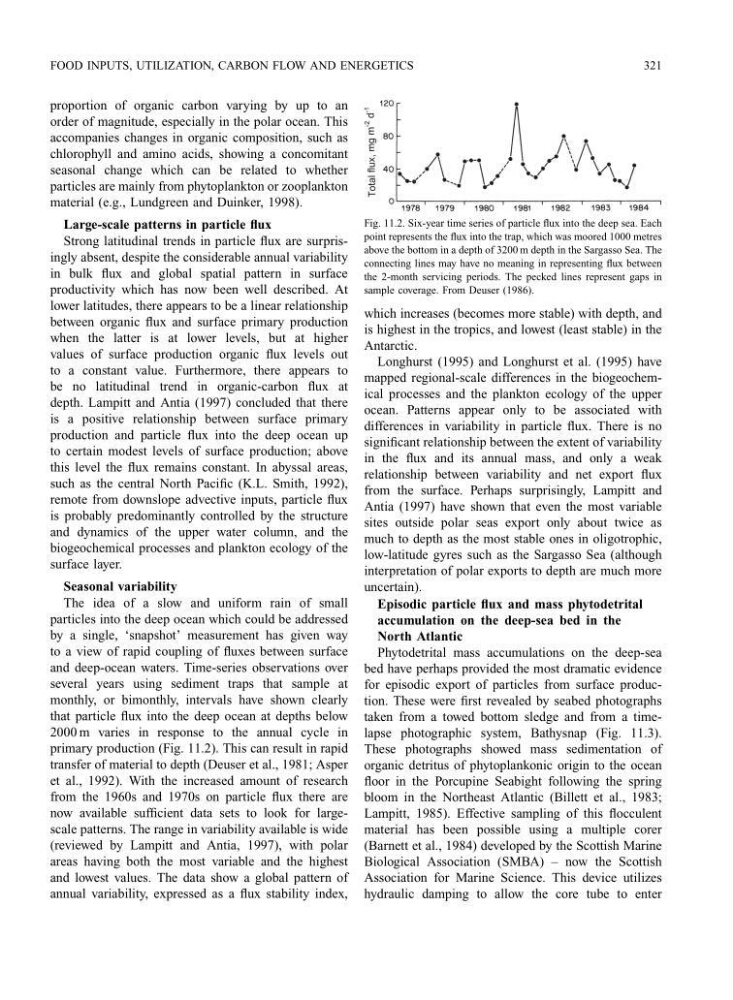
and deep-ocean waters. Time-series observations over
several years using sediment traps that sample at
monthly, or bimonthly, intervals have shown clearly
that particle flux into the deep ocean at depths below
2000 m varies in response to the annual cycle in
primary production (Fig. 11.2). This can result in rapid
transfer of material to depth (Deuser et al., 1981; Asper
et al., 1992). With the increased amount of research
from the 1960s and 1970s on particle flux there are
now available sufficient data sets to look for largescale patterns. The range in variability available is wide
(reviewed by Lampitt and Antia, 1997), with polar
areas having both the most variable and the highest
and lowest values. The data show a global pattern of
annual variability, expressed as a flux stability index,
Fig. 11.2. Six-year time series of particle flux into the deep sea. Each
point represents the flux into the trap, which was moored 1000 metres
above the bottom in a depth of 3200 m depth in the Sargasso Sea. The
connecting lines may have no meaning in representing flux between
the 2-month servicing periods. The pecked lines represent gaps in
sample coverage. From Deuser (1986).
which increases (becomes more stable) with depth, and
is highest in the tropics, and lowest (least stable) in the
Antarctic.
Longhurst (1995) and Longhurst et al. (1995) have
mapped regional-scale differences in the biogeochemical processes and the plankton ecology of the upper
ocean. Patterns appear only to be associated with
differences in variability in particle flux. There is no
significant relationship between the extent of variability
in the flux and its annual mass, and only a weak
relationship between variability and net export flux
from the surface. Perhaps surprisingly, Lampitt and
Antia (1997) have shown that even the most variable
sites outside polar seas export only about twice as
much to depth as the most stable ones in oligotrophic,
low-latitude gyres such as the Sargasso Sea (although
interpretation of polar exports to depth are much more
uncertain).
Episodic particle flux and mass phytodetrital
accumulation on the deep-sea bed in the
North Atlantic
Phytodetrital mass accumulations on the deep-sea
bed have perhaps provided the most dramatic evidence
for episodic export of particles from surface production. These were first revealed by seabed photographs
taken from a towed bottom sledge and from a timelapse photographic system, Bathysnap (Fig. 11.3).
These photographs showed mass sedimentation of
organic detritus of phytoplankonic origin to the ocean
floor in the Porcupine Seabight following the spring
bloom in the Northeast Atlantic (Billett et al., 1983;
Lampitt, 1985). Effective sampling of this flocculent
material has been possible using a multiple corer
(Barnett et al., 1984) developed by the Scottish Marine
Biological Association (SMBA) – now the Scottish
Association for Marine Science. This device utilizes
hydraulic damping to allow the core tube to enter
321
proportion of organic carbon varying by up to an
order of magnitude, especially in the polar ocean. This
accompanies changes in organic composition, such as
chlorophyll and amino acids, showing a concomitant
seasonal change which can be related to whether
particles are mainly from phytoplankton or zooplankton
material (e.g., Lundgreen and Duinker, 1998).
Large-scale patterns in particle flux
Strong latitudinal trends in particle flux are surprisingly absent, despite the considerable annual variability
in bulk flux and global spatial pattern in surface
productivity which has now been well described. At
lower latitudes, there appears to be a linear relationship
between organic flux and surface primary production
when the latter is at lower levels, but at higher
values of surface production organic flux levels out
to a constant value. Furthermore, there appears to
be no latitudinal trend in organic-carbon flux at
depth. Lampitt and Antia (1997) concluded that there
is a positive relationship between surface primary
production and particle flux into the deep ocean up
to certain modest levels of surface production; above
this level the flux remains constant. In abyssal areas,
such as the central North Pacific (K.L. Smith, 1992),
remote from downslope advective inputs, particle flux
is probably predominantly controlled by the structure
and dynamics of the upper water column, and the
biogeochemical processes and plankton ecology of the
surface layer.
Seasonal variability
The idea of a slow and uniform rain of small
particles into the deep ocean which could be addressed
by a single, ‘snapshot’ measurement has given way
to a view of rapid coupling of fluxes between surface
and deep-ocean waters. Time-series observations over
several years using sediment traps that sample at
monthly, or bimonthly, intervals have shown clearly
that particle flux into the deep ocean at depths below
2000 m varies in response to the annual cycle in
primary production (Fig. 11.2). This can result in rapid
transfer of material to depth (Deuser et al., 1981; Asper
et al., 1992). With the increased amount of research
from the 1960s and 1970s on particle flux there are
now available sufficient data sets to look for largescale patterns. The range in variability available is wide
(reviewed by Lampitt and Antia, 1997), with polar
areas having both the most variable and the highest
and lowest values. The data show a global pattern of
annual variability, expressed as a flux stability index,
Fig. 11.2. Six-year time series of particle flux into the deep sea. Each
point represents the flux into the trap, which was moored 1000 metres
above the bottom in a depth of 3200 m depth in the Sargasso Sea. The
connecting lines may have no meaning in representing flux between
the 2-month servicing periods. The pecked lines represent gaps in
sample coverage. From Deuser (1986).
which increases (becomes more stable) with depth, and
is highest in the tropics, and lowest (least stable) in the
Antarctic.
Longhurst (1995) and Longhurst et al. (1995) have
mapped regional-scale differences in the biogeochemical processes and the plankton ecology of the upper
ocean. Patterns appear only to be associated with
differences in variability in particle flux. There is no
significant relationship between the extent of variability
in the flux and its annual mass, and only a weak
relationship between variability and net export flux
from the surface. Perhaps surprisingly, Lampitt and
Antia (1997) have shown that even the most variable
sites outside polar seas export only about twice as
much to depth as the most stable ones in oligotrophic,
low-latitude gyres such as the Sargasso Sea (although
interpretation of polar exports to depth are much more
uncertain).
Episodic particle flux and mass phytodetrital
accumulation on the deep-sea bed in the
North Atlantic
Phytodetrital mass accumulations on the deep-sea
bed have perhaps provided the most dramatic evidence
for episodic export of particles from surface production. These were first revealed by seabed photographs
taken from a towed bottom sledge and from a timelapse photographic system, Bathysnap (Fig. 11.3).
These photographs showed mass sedimentation of
organic detritus of phytoplankonic origin to the ocean
floor in the Porcupine Seabight following the spring
bloom in the Northeast Atlantic (Billett et al., 1983;
Lampitt, 1985). Effective sampling of this flocculent
material has been possible using a multiple corer
(Barnett et al., 1984) developed by the Scottish Marine
Biological Association (SMBA) – now the Scottish
Association for Marine Science. This device utilizes
hydraulic damping to allow the core tube to enter