

300
Carol T. STUART et al.
gradients in sediment characteristics. Etter and Grassle
(1992) suggested that the nature of the sediments
should play an important role in structuring deepsea communities, because deposit feeders rely on
sediments for nutrition and comprise the overwhelming
majority of species (Sanders and Hessler, 1969; Jumars
and Gallagher, 1982). They argued that, if deposit feeders in the deep sea partition the sediments with respect
to size, as do shallow-water relatives (Fenchel et al.,
1975; Fenchel and Kofoed, 1976; Whitlatch, 1980;
Self and Jumars, 1988), species diversity in part may
be a function of sediment particle diversity (hereafter
referred to as sediment diversity) because it provides
greater diversity in food resources or greater habitat
complexity. Using 558 box-corer samples collected
from bathyal depths (250–3029 m) in the western North
Atlantic as part of the Atlantic Continental Slope and
Rise Study, Etter and Grassle (1992) found a strong
positive relationship between macrofaunal diversity and
grain-size diversity of the silt fraction, the particle size
typically consumed by deposit feeders (Taghon et al.,
1978; Whitlatch, 1980; Taghon, 1982; Self and Jumars,
1988). More importantly, when sediment diversity was
held constant statistically, macrofaunal diversity did
not vary with depth, suggesting that the unimodal
pattern documented in the western North Atlantic may
largely reflect a gradient in sediment diversity. This
documented correlation does not prove whether the
relationship is causal; however, unlike many other
hypotheses for spatiotemporal patterns of diversity in
the deep sea, the sediment-diversity hypothesis can be
easily tested experimentally.
It seems likely that both nutrient flux and particle size may be important in ultimately explaining
why diversity varies bathymetrically, since the nature,
amount and diversity of resources should exert a
powerful influence on the number of species within
soft-sediment communities.
Latitudinal gradients
Patterns of diversity
Latitudinal species-diversity gradients are well known
for marine biotas, in both pelagic (McGowan and
Walker, 1993; Dodge and Marshall, 1994; Angel,
1997) and coastal (Fischer, 1960; Roy et al., 1994,
1998; Culver and Buzas, 1998) habitats. Recently, they
have also been detected in the deep sea (Rex et al.,
1993, 1997; Poore and Wilson, 1993; Stuart and Rex,
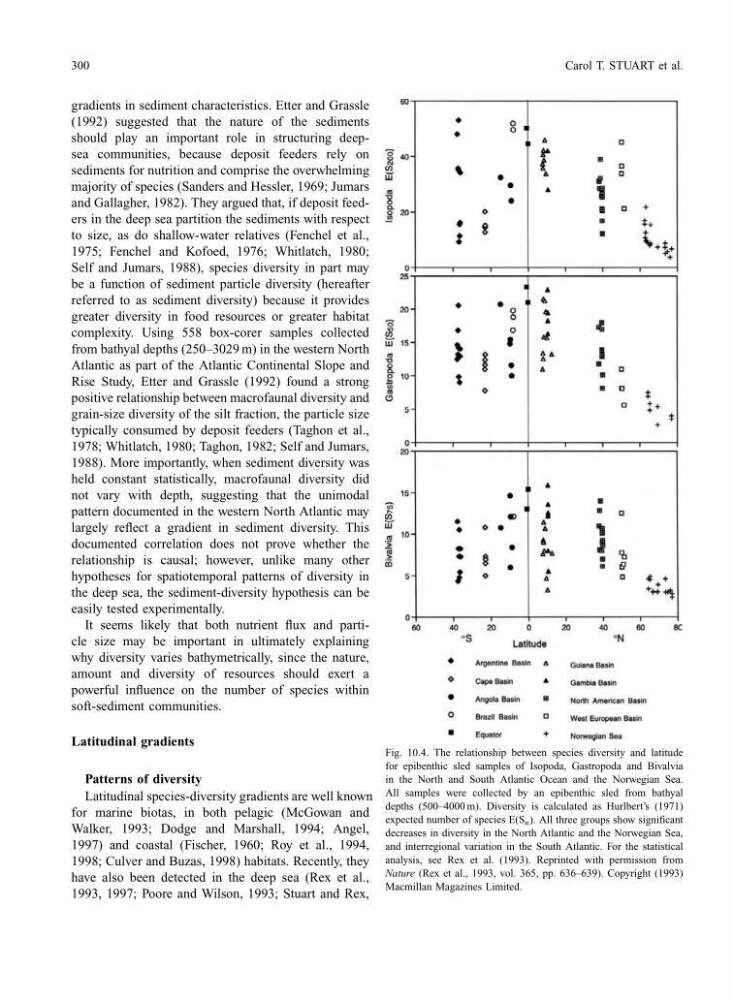
Fig. 10.4. The relationship between species diversity and latitude
for epibenthic sled samples of Isopoda, Gastropoda and Bivalvia
in the North and South Atlantic Ocean and the Norwegian Sea.
All samples were collected by an epibenthic sled from bathyal
depths (500–4000 m). Diversity is calculated as Hurlbert’s (1971)
expected number of species E(S n ). All three groups show significant
decreases in diversity in the North Atlantic and the Norwegian Sea,
and interregional variation in the South Atlantic. For the statistical
analysis, see Rex et al. (1993). Reprinted with permission from
Nature (Rex et al., 1993, vol. 365, pp. 636–639). Copyright (1993)
Macmillan Magazines Limited.
Carol T. STUART et al.
gradients in sediment characteristics. Etter and Grassle
(1992) suggested that the nature of the sediments
should play an important role in structuring deepsea communities, because deposit feeders rely on
sediments for nutrition and comprise the overwhelming
majority of species (Sanders and Hessler, 1969; Jumars
and Gallagher, 1982). They argued that, if deposit feeders in the deep sea partition the sediments with respect
to size, as do shallow-water relatives (Fenchel et al.,
1975; Fenchel and Kofoed, 1976; Whitlatch, 1980;
Self and Jumars, 1988), species diversity in part may
be a function of sediment particle diversity (hereafter
referred to as sediment diversity) because it provides
greater diversity in food resources or greater habitat
complexity. Using 558 box-corer samples collected
from bathyal depths (250–3029 m) in the western North
Atlantic as part of the Atlantic Continental Slope and
Rise Study, Etter and Grassle (1992) found a strong
positive relationship between macrofaunal diversity and
grain-size diversity of the silt fraction, the particle size
typically consumed by deposit feeders (Taghon et al.,
1978; Whitlatch, 1980; Taghon, 1982; Self and Jumars,
1988). More importantly, when sediment diversity was
held constant statistically, macrofaunal diversity did
not vary with depth, suggesting that the unimodal
pattern documented in the western North Atlantic may
largely reflect a gradient in sediment diversity. This
documented correlation does not prove whether the
relationship is causal; however, unlike many other
hypotheses for spatiotemporal patterns of diversity in
the deep sea, the sediment-diversity hypothesis can be
easily tested experimentally.
It seems likely that both nutrient flux and particle size may be important in ultimately explaining
why diversity varies bathymetrically, since the nature,
amount and diversity of resources should exert a
powerful influence on the number of species within
soft-sediment communities.
Latitudinal gradients
Patterns of diversity
Latitudinal species-diversity gradients are well known
for marine biotas, in both pelagic (McGowan and
Walker, 1993; Dodge and Marshall, 1994; Angel,
1997) and coastal (Fischer, 1960; Roy et al., 1994,
1998; Culver and Buzas, 1998) habitats. Recently, they
have also been detected in the deep sea (Rex et al.,
1993, 1997; Poore and Wilson, 1993; Stuart and Rex,
Fig. 10.4. The relationship between species diversity and latitude
for epibenthic sled samples of Isopoda, Gastropoda and Bivalvia
in the North and South Atlantic Ocean and the Norwegian Sea.
All samples were collected by an epibenthic sled from bathyal
depths (500–4000 m). Diversity is calculated as Hurlbert’s (1971)
expected number of species E(S n ). All three groups show significant
decreases in diversity in the North Atlantic and the Norwegian Sea,
and interregional variation in the South Atlantic. For the statistical
analysis, see Rex et al. (1993). Reprinted with permission from
Nature (Rex et al., 1993, vol. 365, pp. 636–639). Copyright (1993)
Macmillan Magazines Limited.