

LARGE-SCALE SPATIAL AND TEMPORAL PATTERNS OF DEEP-SEA BENTHIC SPECIES DIVERSITY
299
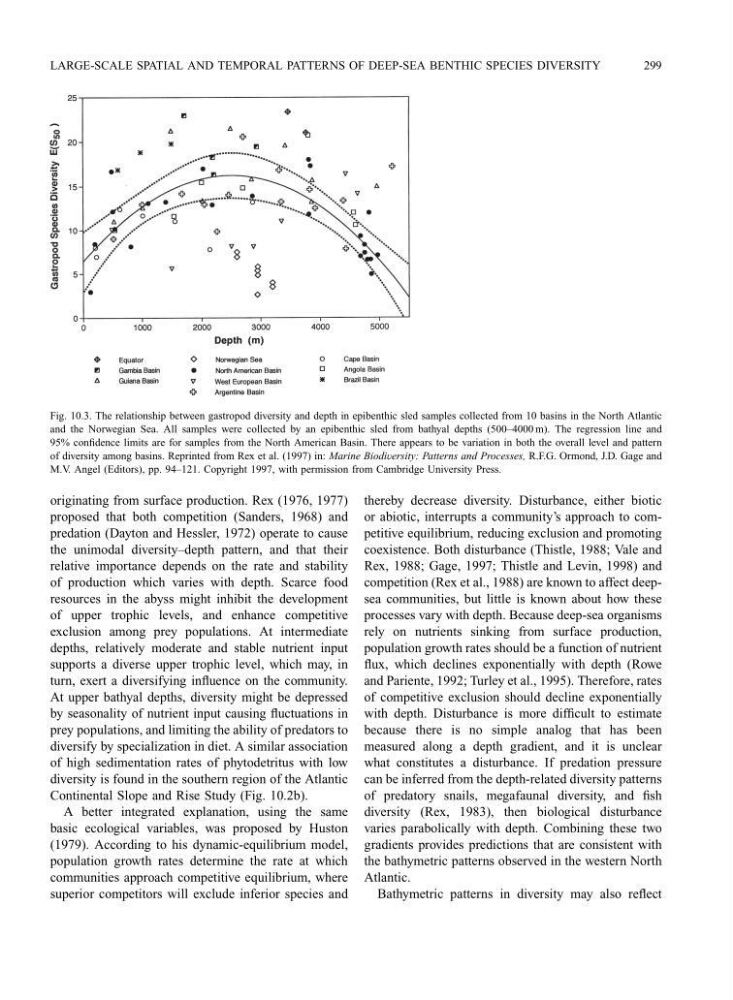
Fig. 10.3. The relationship between gastropod diversity and depth in epibenthic sled samples collected from 10 basins in the North Atlantic
and the Norwegian Sea. All samples were collected by an epibenthic sled from bathyal depths (500–4000 m). The regression line and
95% confidence limits are for samples from the North American Basin. There appears to be variation in both the overall level and pattern
of diversity among basins. Reprinted from Rex et al. (1997) in: Marine Biodiversity: Patterns and Processes, R.F.G. Ormond, J.D. Gage and
M.V. Angel (Editors), pp. 94–121. Copyright 1997, with permission from Cambridge University Press.
originating from surface production. Rex (1976, 1977)
proposed that both competition (Sanders, 1968) and
predation (Dayton and Hessler, 1972) operate to cause
the unimodal diversity–depth pattern, and that their
relative importance depends on the rate and stability
of production which varies with depth. Scarce food
resources in the abyss might inhibit the development
of upper trophic levels, and enhance competitive
exclusion among prey populations. At intermediate
depths, relatively moderate and stable nutrient input
supports a diverse upper trophic level, which may, in
turn, exert a diversifying influence on the community.
At upper bathyal depths, diversity might be depressed
by seasonality of nutrient input causing fluctuations in
prey populations, and limiting the ability of predators to
diversify by specialization in diet. A similar association
of high sedimentation rates of phytodetritus with low
diversity is found in the southern region of the Atlantic
Continental Slope and Rise Study (Fig. 10.2b).
A better integrated explanation, using the same
basic ecological variables, was proposed by Huston
(1979). According to his dynamic-equilibrium model,
population growth rates determine the rate at which
communities approach competitive equilibrium, where
superior competitors will exclude inferior species and
thereby decrease diversity. Disturbance, either biotic
or abiotic, interrupts a community’s approach to competitive equilibrium, reducing exclusion and promoting
coexistence. Both disturbance (Thistle, 1988; Vale and
Rex, 1988; Gage, 1997; Thistle and Levin, 1998) and
competition (Rex et al., 1988) are known to affect deepsea communities, but little is known about how these
processes vary with depth. Because deep-sea organisms
rely on nutrients sinking from surface production,
population growth rates should be a function of nutrient
flux, which declines exponentially with depth (Rowe
and Pariente, 1992; Turley et al., 1995). Therefore, rates
of competitive exclusion should decline exponentially
with depth. Disturbance is more difficult to estimate
because there is no simple analog that has been
measured along a depth gradient, and it is unclear
what constitutes a disturbance. If predation pressure
can be inferred from the depth-related diversity patterns
of predatory snails, megafaunal diversity, and fish
diversity (Rex, 1983), then biological disturbance
varies parabolically with depth. Combining these two
gradients provides predictions that are consistent with
the bathymetric patterns observed in the western North
Atlantic.
Bathymetric patterns in diversity may also reflect
299
Fig. 10.3. The relationship between gastropod diversity and depth in epibenthic sled samples collected from 10 basins in the North Atlantic
and the Norwegian Sea. All samples were collected by an epibenthic sled from bathyal depths (500–4000 m). The regression line and
95% confidence limits are for samples from the North American Basin. There appears to be variation in both the overall level and pattern
of diversity among basins. Reprinted from Rex et al. (1997) in: Marine Biodiversity: Patterns and Processes, R.F.G. Ormond, J.D. Gage and
M.V. Angel (Editors), pp. 94–121. Copyright 1997, with permission from Cambridge University Press.
originating from surface production. Rex (1976, 1977)
proposed that both competition (Sanders, 1968) and
predation (Dayton and Hessler, 1972) operate to cause
the unimodal diversity–depth pattern, and that their
relative importance depends on the rate and stability
of production which varies with depth. Scarce food
resources in the abyss might inhibit the development
of upper trophic levels, and enhance competitive
exclusion among prey populations. At intermediate
depths, relatively moderate and stable nutrient input
supports a diverse upper trophic level, which may, in
turn, exert a diversifying influence on the community.
At upper bathyal depths, diversity might be depressed
by seasonality of nutrient input causing fluctuations in
prey populations, and limiting the ability of predators to
diversify by specialization in diet. A similar association
of high sedimentation rates of phytodetritus with low
diversity is found in the southern region of the Atlantic
Continental Slope and Rise Study (Fig. 10.2b).
A better integrated explanation, using the same
basic ecological variables, was proposed by Huston
(1979). According to his dynamic-equilibrium model,
population growth rates determine the rate at which
communities approach competitive equilibrium, where
superior competitors will exclude inferior species and
thereby decrease diversity. Disturbance, either biotic
or abiotic, interrupts a community’s approach to competitive equilibrium, reducing exclusion and promoting
coexistence. Both disturbance (Thistle, 1988; Vale and
Rex, 1988; Gage, 1997; Thistle and Levin, 1998) and
competition (Rex et al., 1988) are known to affect deepsea communities, but little is known about how these
processes vary with depth. Because deep-sea organisms
rely on nutrients sinking from surface production,
population growth rates should be a function of nutrient
flux, which declines exponentially with depth (Rowe
and Pariente, 1992; Turley et al., 1995). Therefore, rates
of competitive exclusion should decline exponentially
with depth. Disturbance is more difficult to estimate
because there is no simple analog that has been
measured along a depth gradient, and it is unclear
what constitutes a disturbance. If predation pressure
can be inferred from the depth-related diversity patterns
of predatory snails, megafaunal diversity, and fish
diversity (Rex, 1983), then biological disturbance
varies parabolically with depth. Combining these two
gradients provides predictions that are consistent with
the bathymetric patterns observed in the western North
Atlantic.
Bathymetric patterns in diversity may also reflect