

LARGE-SCALE SPATIAL AND TEMPORAL PATTERNS OF DEEP-SEA BENTHIC SPECIES DIVERSITY
301
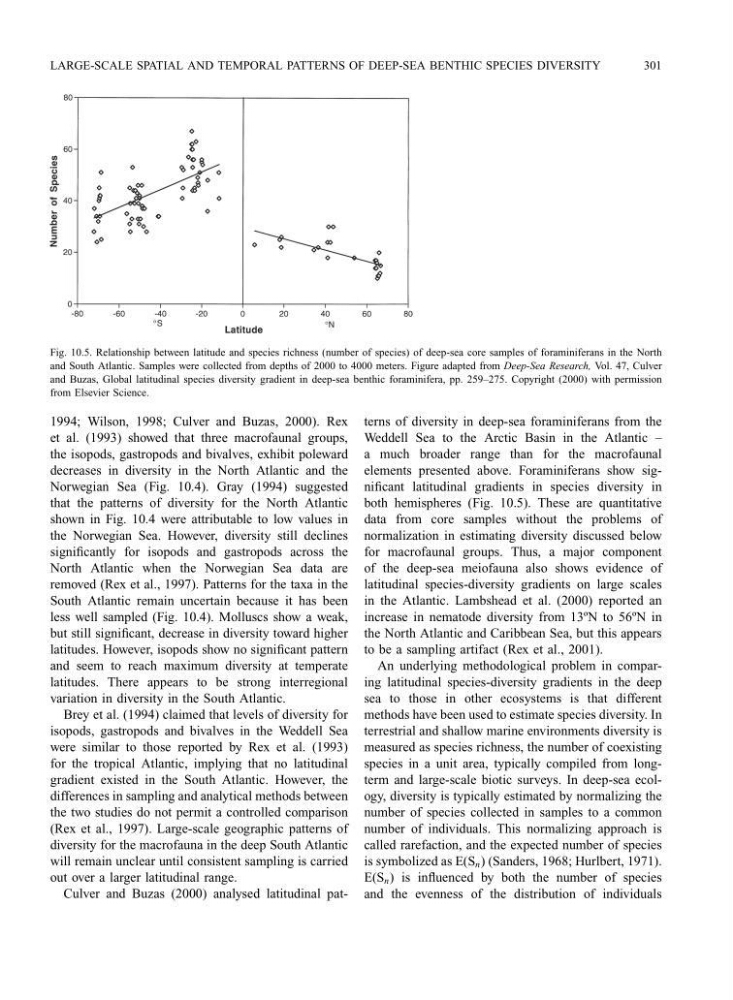
Fig. 10.5. Relationship between latitude and species richness (number of species) of deep-sea core samples of foraminiferans in the North
and South Atlantic. Samples were collected from depths of 2000 to 4000 meters. Figure adapted from Deep-Sea Research, Vol. 47, Culver
and Buzas, Global latitudinal species diversity gradient in deep-sea benthic foraminifera, pp. 259–275. Copyright (2000) with permission
from Elsevier Science.
1994; Wilson, 1998; Culver and Buzas, 2000). Rex
et al. (1993) showed that three macrofaunal groups,
the isopods, gastropods and bivalves, exhibit poleward
decreases in diversity in the North Atlantic and the
Norwegian Sea (Fig. 10.4). Gray (1994) suggested
that the patterns of diversity for the North Atlantic
shown in Fig. 10.4 were attributable to low values in
the Norwegian Sea. However, diversity still declines
significantly for isopods and gastropods across the
North Atlantic when the Norwegian Sea data are
removed (Rex et al., 1997). Patterns for the taxa in the
South Atlantic remain uncertain because it has been
less well sampled (Fig. 10.4). Molluscs show a weak,
but still significant, decrease in diversity toward higher
latitudes. However, isopods show no significant pattern
and seem to reach maximum diversity at temperate
latitudes. There appears to be strong interregional
variation in diversity in the South Atlantic.
Brey et al. (1994) claimed that levels of diversity for
isopods, gastropods and bivalves in the Weddell Sea
were similar to those reported by Rex et al. (1993)
for the tropical Atlantic, implying that no latitudinal
gradient existed in the South Atlantic. However, the
differences in sampling and analytical methods between
the two studies do not permit a controlled comparison
(Rex et al., 1997). Large-scale geographic patterns of
diversity for the macrofauna in the deep South Atlantic
will remain unclear until consistent sampling is carried
out over a larger latitudinal range.
Culver and Buzas (2000) analysed latitudinal patterns of diversity in deep-sea foraminiferans from the
Weddell Sea to the Arctic Basin in the Atlantic –
a much broader range than for the macrofaunal
elements presented above. Foraminiferans show significant latitudinal gradients in species diversity in
both hemispheres (Fig. 10.5). These are quantitative
data from core samples without the problems of
normalization in estimating diversity discussed below
for macrofaunal groups. Thus, a major component
of the deep-sea meiofauna also shows evidence of
latitudinal species-diversity gradients on large scales
in the Atlantic. Lambshead et al. (2000) reported an
increase in nematode diversity from 13ºN to 56ºN in
the North Atlantic and Caribbean Sea, but this appears
to be a sampling artifact (Rex et al., 2001).
An underlying methodological problem in comparing latitudinal species-diversity gradients in the deep
sea to those in other ecosystems is that different
methods have been used to estimate species diversity. In
terrestrial and shallow marine environments diversity is
measured as species richness, the number of coexisting
species in a unit area, typically compiled from longterm and large-scale biotic surveys. In deep-sea ecology, diversity is typically estimated by normalizing the
number of species collected in samples to a common
number of individuals. This normalizing approach is
called rarefaction, and the expected number of species
is symbolized as E(S n ) (Sanders, 1968; Hurlbert, 1971).
E(S n ) is influenced by both the number of species
and the evenness of the distribution of individuals
301
Fig. 10.5. Relationship between latitude and species richness (number of species) of deep-sea core samples of foraminiferans in the North
and South Atlantic. Samples were collected from depths of 2000 to 4000 meters. Figure adapted from Deep-Sea Research, Vol. 47, Culver
and Buzas, Global latitudinal species diversity gradient in deep-sea benthic foraminifera, pp. 259–275. Copyright (2000) with permission
from Elsevier Science.
1994; Wilson, 1998; Culver and Buzas, 2000). Rex
et al. (1993) showed that three macrofaunal groups,
the isopods, gastropods and bivalves, exhibit poleward
decreases in diversity in the North Atlantic and the
Norwegian Sea (Fig. 10.4). Gray (1994) suggested
that the patterns of diversity for the North Atlantic
shown in Fig. 10.4 were attributable to low values in
the Norwegian Sea. However, diversity still declines
significantly for isopods and gastropods across the
North Atlantic when the Norwegian Sea data are
removed (Rex et al., 1997). Patterns for the taxa in the
South Atlantic remain uncertain because it has been
less well sampled (Fig. 10.4). Molluscs show a weak,
but still significant, decrease in diversity toward higher
latitudes. However, isopods show no significant pattern
and seem to reach maximum diversity at temperate
latitudes. There appears to be strong interregional
variation in diversity in the South Atlantic.
Brey et al. (1994) claimed that levels of diversity for
isopods, gastropods and bivalves in the Weddell Sea
were similar to those reported by Rex et al. (1993)
for the tropical Atlantic, implying that no latitudinal
gradient existed in the South Atlantic. However, the
differences in sampling and analytical methods between
the two studies do not permit a controlled comparison
(Rex et al., 1997). Large-scale geographic patterns of
diversity for the macrofauna in the deep South Atlantic
will remain unclear until consistent sampling is carried
out over a larger latitudinal range.
Culver and Buzas (2000) analysed latitudinal patterns of diversity in deep-sea foraminiferans from the
Weddell Sea to the Arctic Basin in the Atlantic –
a much broader range than for the macrofaunal
elements presented above. Foraminiferans show significant latitudinal gradients in species diversity in
both hemispheres (Fig. 10.5). These are quantitative
data from core samples without the problems of
normalization in estimating diversity discussed below
for macrofaunal groups. Thus, a major component
of the deep-sea meiofauna also shows evidence of
latitudinal species-diversity gradients on large scales
in the Atlantic. Lambshead et al. (2000) reported an
increase in nematode diversity from 13ºN to 56ºN in
the North Atlantic and Caribbean Sea, but this appears
to be a sampling artifact (Rex et al., 2001).
An underlying methodological problem in comparing latitudinal species-diversity gradients in the deep
sea to those in other ecosystems is that different
methods have been used to estimate species diversity. In
terrestrial and shallow marine environments diversity is
measured as species richness, the number of coexisting
species in a unit area, typically compiled from longterm and large-scale biotic surveys. In deep-sea ecology, diversity is typically estimated by normalizing the
number of species collected in samples to a common
number of individuals. This normalizing approach is
called rarefaction, and the expected number of species
is symbolized as E(S n ) (Sanders, 1968; Hurlbert, 1971).
E(S n ) is influenced by both the number of species
and the evenness of the distribution of individuals