

THE PERIPHERAL DEEP SEAS
275
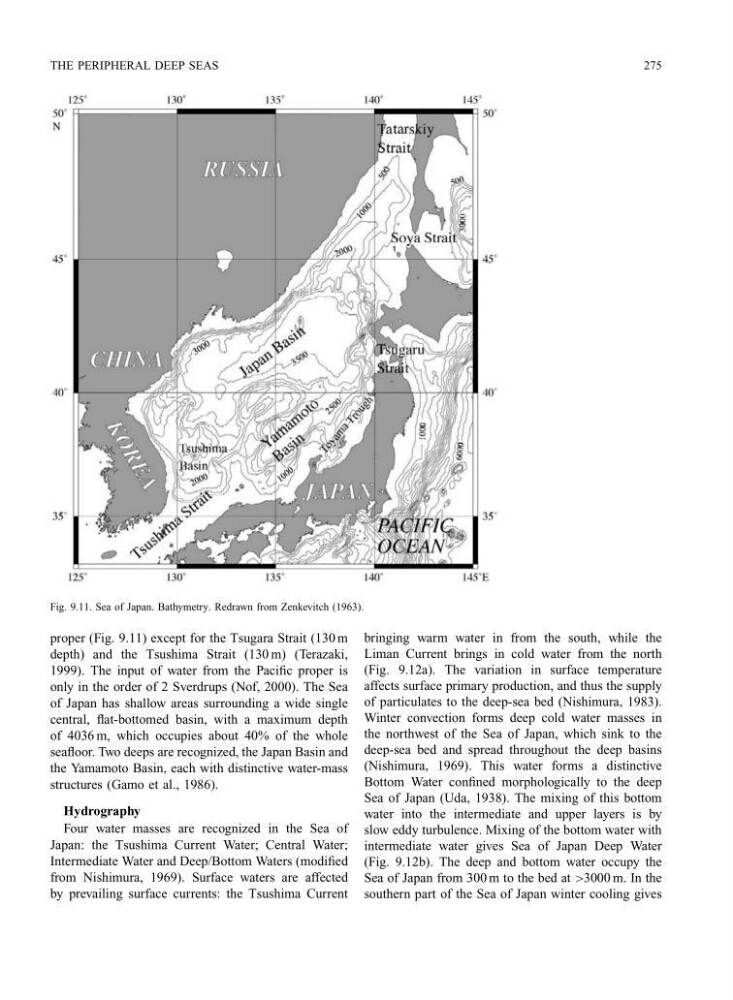
Fig. 9.11. Sea of Japan. Bathymetry. Redrawn from Zenkevitch (1963).
proper (Fig. 9.11) except for the Tsugara Strait (130 m
depth) and the Tsushima Strait (130 m) (Terazaki,
1999). The input of water from the Pacific proper is
only in the order of 2 Sverdrups (Nof, 2000). The Sea
of Japan has shallow areas surrounding a wide single
central, flat-bottomed basin, with a maximum depth
of 4036 m, which occupies about 40% of the whole
seafloor. Two deeps are recognized, the Japan Basin and
the Yamamoto Basin, each with distinctive water-mass
structures (Gamo et al., 1986).
Hydrography
Four water masses are recognized in the Sea of
Japan: the Tsushima Current Water; Central Water;
Intermediate Water and Deep/Bottom Waters (modified
from Nishimura, 1969). Surface waters are affected
by prevailing surface currents: the Tsushima Current
bringing warm water in from the south, while the
Liman Current brings in cold water from the north
(Fig. 9.12a). The variation in surface temperature
affects surface primary production, and thus the supply
of particulates to the deep-sea bed (Nishimura, 1983).
Winter convection forms deep cold water masses in
the northwest of the Sea of Japan, which sink to the
deep-sea bed and spread throughout the deep basins
(Nishimura, 1969). This water forms a distinctive
Bottom Water confined morphologically to the deep
Sea of Japan (Uda, 1938). The mixing of this bottom
water into the intermediate and upper layers is by
slow eddy turbulence. Mixing of the bottom water with
intermediate water gives Sea of Japan Deep Water
(Fig. 9.12b). The deep and bottom water occupy the
Sea of Japan from 300 m to the bed at >3000 m. In the
southern part of the Sea of Japan winter cooling gives
275
Fig. 9.11. Sea of Japan. Bathymetry. Redrawn from Zenkevitch (1963).
proper (Fig. 9.11) except for the Tsugara Strait (130 m
depth) and the Tsushima Strait (130 m) (Terazaki,
1999). The input of water from the Pacific proper is
only in the order of 2 Sverdrups (Nof, 2000). The Sea
of Japan has shallow areas surrounding a wide single
central, flat-bottomed basin, with a maximum depth
of 4036 m, which occupies about 40% of the whole
seafloor. Two deeps are recognized, the Japan Basin and
the Yamamoto Basin, each with distinctive water-mass
structures (Gamo et al., 1986).
Hydrography
Four water masses are recognized in the Sea of
Japan: the Tsushima Current Water; Central Water;
Intermediate Water and Deep/Bottom Waters (modified
from Nishimura, 1969). Surface waters are affected
by prevailing surface currents: the Tsushima Current
bringing warm water in from the south, while the
Liman Current brings in cold water from the north
(Fig. 9.12a). The variation in surface temperature
affects surface primary production, and thus the supply
of particulates to the deep-sea bed (Nishimura, 1983).
Winter convection forms deep cold water masses in
the northwest of the Sea of Japan, which sink to the
deep-sea bed and spread throughout the deep basins
(Nishimura, 1969). This water forms a distinctive
Bottom Water confined morphologically to the deep
Sea of Japan (Uda, 1938). The mixing of this bottom
water into the intermediate and upper layers is by
slow eddy turbulence. Mixing of the bottom water with
intermediate water gives Sea of Japan Deep Water
(Fig. 9.12b). The deep and bottom water occupy the
Sea of Japan from 300 m to the bed at >3000 m. In the
southern part of the Sea of Japan winter cooling gives