

274
Paul A. TYLER
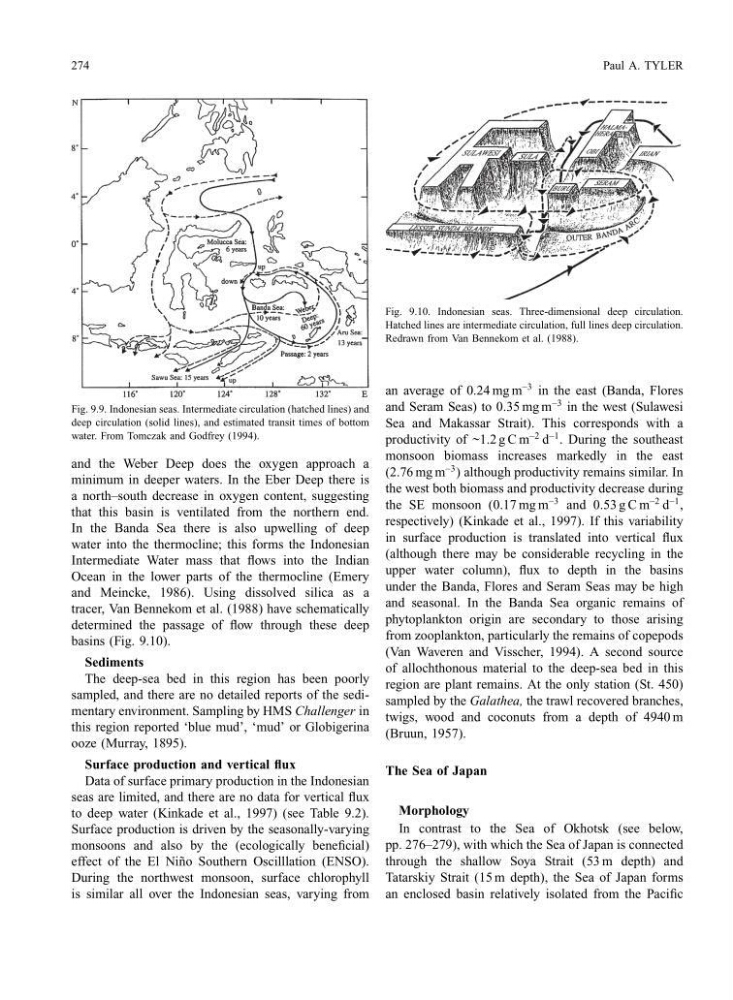
Fig. 9.9. Indonesian seas. Intermediate circulation (hatched lines) and
deep circulation (solid lines), and estimated transit times of bottom
water. From Tomczak and Godfrey (1994).
and the Weber Deep does the oxygen approach a
minimum in deeper waters. In the Eber Deep there is
a north–south decrease in oxygen content, suggesting
that this basin is ventilated from the northern end.
In the Banda Sea there is also upwelling of deep
water into the thermocline; this forms the Indonesian
Intermediate Water mass that flows into the Indian
Ocean in the lower parts of the thermocline (Emery
and Meincke, 1986). Using dissolved silica as a
tracer, Van Bennekom et al. (1988) have schematically
determined the passage of flow through these deep
basins (Fig. 9.10).
Sediments
The deep-sea bed in this region has been poorly
sampled, and there are no detailed reports of the sedimentary environment. Sampling by HMS Challenger in
this region reported ‘blue mud’, ‘mud’ or Globigerina
ooze (Murray, 1895).
Surface production and vertical flux
Data of surface primary production in the Indonesian
seas are limited, and there are no data for vertical flux
to deep water (Kinkade et al., 1997) (see Table 9.2).
Surface production is driven by the seasonally-varying
monsoons and also by the (ecologically beneficial)
effect of the El Ni˜ no Southern Oscilllation (ENSO).
During the northwest monsoon, surface chlorophyll
is similar all over the Indonesian seas, varying from
Fig. 9.10. Indonesian seas. Three-dimensional deep circulation.
Hatched lines are intermediate circulation, full lines deep circulation.
Redrawn from Van Bennekom et al. (1988).
an average of 0.24 mg m
−3 in the east (Banda, Flores
and Seram Seas) to 0.35 mg m
−3 in the west (Sulawesi
Sea and Makassar Strait). This corresponds with a
productivity of ~1.2 g C m
−2 d
−1 . During the southeast
monsoon biomass increases markedly in the east
(2.76 mg m
−3 ) although productivity remains similar. In
the west both biomass and productivity decrease during
the SE monsoon (0.17 mg m
−3 and 0.53 g C m
−2 d
−1 ,
respectively) (Kinkade et al., 1997). If this variability
in surface production is translated into vertical flux
(although there may be considerable recycling in the
upper water column), flux to depth in the basins
under the Banda, Flores and Seram Seas may be high
and seasonal. In the Banda Sea organic remains of
phytoplankton origin are secondary to those arising
from zooplankton, particularly the remains of copepods
(Van Waveren and Visscher, 1994). A second source
of allochthonous material to the deep-sea bed in this
region are plant remains. At the only station (St. 450)
sampled by the Galathea, the trawl recovered branches,
twigs, wood and coconuts from a depth of 4940 m
(Bruun, 1957).
The Sea of Japan
Morphology
In contrast to the Sea of Okhotsk (see below,
pp. 276–279), with which the Sea of Japan is connected
through the shallow Soya Strait (53 m depth) and
Tatarskiy Strait (15 m depth), the Sea of Japan forms
an enclosed basin relatively isolated from the Pacific
Paul A. TYLER
Fig. 9.9. Indonesian seas. Intermediate circulation (hatched lines) and
deep circulation (solid lines), and estimated transit times of bottom
water. From Tomczak and Godfrey (1994).
and the Weber Deep does the oxygen approach a
minimum in deeper waters. In the Eber Deep there is
a north–south decrease in oxygen content, suggesting
that this basin is ventilated from the northern end.
In the Banda Sea there is also upwelling of deep
water into the thermocline; this forms the Indonesian
Intermediate Water mass that flows into the Indian
Ocean in the lower parts of the thermocline (Emery
and Meincke, 1986). Using dissolved silica as a
tracer, Van Bennekom et al. (1988) have schematically
determined the passage of flow through these deep
basins (Fig. 9.10).
Sediments
The deep-sea bed in this region has been poorly
sampled, and there are no detailed reports of the sedimentary environment. Sampling by HMS Challenger in
this region reported ‘blue mud’, ‘mud’ or Globigerina
ooze (Murray, 1895).
Surface production and vertical flux
Data of surface primary production in the Indonesian
seas are limited, and there are no data for vertical flux
to deep water (Kinkade et al., 1997) (see Table 9.2).
Surface production is driven by the seasonally-varying
monsoons and also by the (ecologically beneficial)
effect of the El Ni˜ no Southern Oscilllation (ENSO).
During the northwest monsoon, surface chlorophyll
is similar all over the Indonesian seas, varying from
Fig. 9.10. Indonesian seas. Three-dimensional deep circulation.
Hatched lines are intermediate circulation, full lines deep circulation.
Redrawn from Van Bennekom et al. (1988).
an average of 0.24 mg m
−3 in the east (Banda, Flores
and Seram Seas) to 0.35 mg m
−3 in the west (Sulawesi
Sea and Makassar Strait). This corresponds with a
productivity of ~1.2 g C m
−2 d
−1 . During the southeast
monsoon biomass increases markedly in the east
(2.76 mg m
−3 ) although productivity remains similar. In
the west both biomass and productivity decrease during
the SE monsoon (0.17 mg m
−3 and 0.53 g C m
−2 d
−1 ,
respectively) (Kinkade et al., 1997). If this variability
in surface production is translated into vertical flux
(although there may be considerable recycling in the
upper water column), flux to depth in the basins
under the Banda, Flores and Seram Seas may be high
and seasonal. In the Banda Sea organic remains of
phytoplankton origin are secondary to those arising
from zooplankton, particularly the remains of copepods
(Van Waveren and Visscher, 1994). A second source
of allochthonous material to the deep-sea bed in this
region are plant remains. At the only station (St. 450)
sampled by the Galathea, the trawl recovered branches,
twigs, wood and coconuts from a depth of 4940 m
(Bruun, 1957).
The Sea of Japan
Morphology
In contrast to the Sea of Okhotsk (see below,
pp. 276–279), with which the Sea of Japan is connected
through the shallow Soya Strait (53 m depth) and
Tatarskiy Strait (15 m depth), the Sea of Japan forms
an enclosed basin relatively isolated from the Pacific