

270
Paul A. TYLER
Salinity
Oxygen
Potential temperature
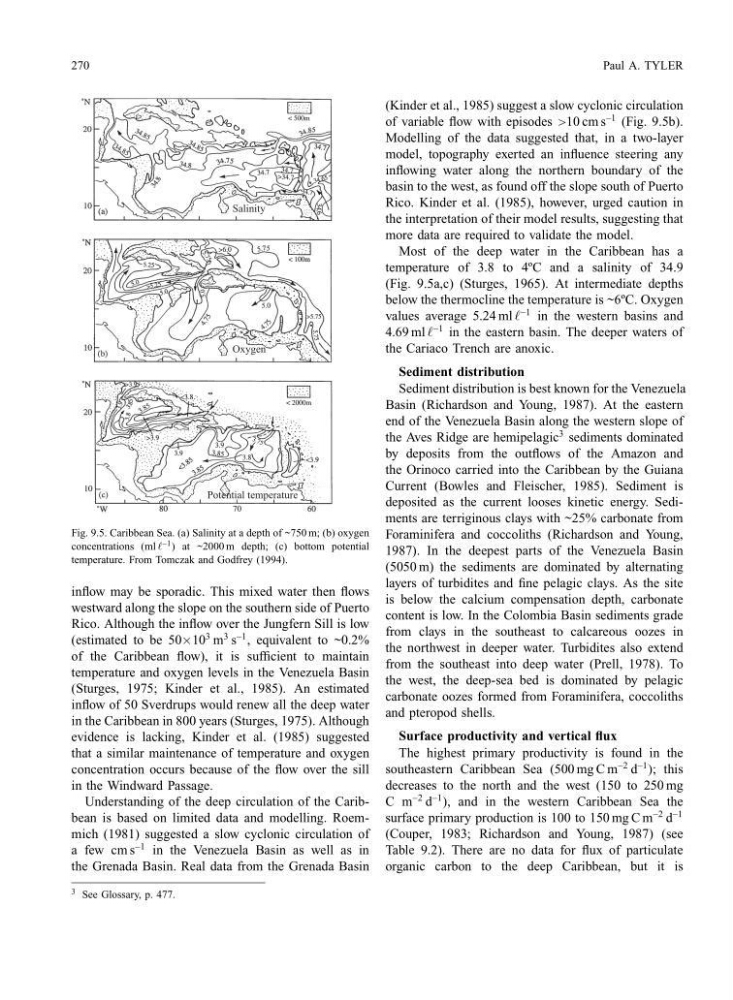
Fig. 9.5. Caribbean Sea. (a) Salinity at a depth of ~750 m; (b) oxygen
concentrations (ml ° −1 ) at ~2000 m depth; (c) bottom potential
temperature. From Tomczak and Godfrey (1994).
inflow may be sporadic. This mixed water then flows
westward along the slope on the southern side of Puerto
Rico. Although the inflow over the Jungfern Sill is low
(estimated to be 50×10
3 m
3 s
−1 , equivalent to ~0.2%
of the Caribbean flow), it is sufficient to maintain
temperature and oxygen levels in the Venezuela Basin
(Sturges, 1975; Kinder et al., 1985). An estimated
inflow of 50 Sverdrups would renew all the deep water
in the Caribbean in 800 years (Sturges, 1975). Although
evidence is lacking, Kinder et al. (1985) suggested
that a similar maintenance of temperature and oxygen
concentration occurs because of the flow over the sill
in the Windward Passage.
Understanding of the deep circulation of the Caribbean is based on limited data and modelling. Roemmich (1981) suggested a slow cyclonic circulation of
a few cm s
−1 in the Venezuela Basin as well as in
the Grenada Basin. Real data from the Grenada Basin
(Kinder et al., 1985) suggest a slow cyclonic circulation
of variable flow with episodes >10 cm s
−1 (Fig. 9.5b).
Modelling of the data suggested that, in a two-layer
model, topography exerted an influence steering any
inflowing water along the northern boundary of the
basin to the west, as found off the slope south of Puerto
Rico. Kinder et al. (1985), however, urged caution in
the interpretation of their model results, suggesting that
more data are required to validate the model.
Most of the deep water in the Caribbean has a
temperature of 3.8 to 4ºC and a salinity of 34.9
(Fig. 9.5a,c) (Sturges, 1965). At intermediate depths
below the thermocline the temperature is ~6ºC. Oxygen
values average 5.24 ml °
−1 in the western basins and
4.69 ml °
−1 in the eastern basin. The deeper waters of
the Cariaco Trench are anoxic.
Sediment distribution
Sediment distribution is best known for the Venezuela
Basin (Richardson and Young, 1987). At the eastern
end of the Venezuela Basin along the western slope of
the Aves Ridge are hemipelagic
3 sediments dominated
by deposits from the outflows of the Amazon and
the Orinoco carried into the Caribbean by the Guiana
Current (Bowles and Fleischer, 1985). Sediment is
deposited as the current looses kinetic energy. Sediments are terriginous clays with ~25% carbonate from
Foraminifera and coccoliths (Richardson and Young,
1987). In the deepest parts of the Venezuela Basin
(5050 m) the sediments are dominated by alternating
layers of turbidites and fine pelagic clays. As the site
is below the calcium compensation depth, carbonate
content is low. In the Colombia Basin sediments grade
from clays in the southeast to calcareous oozes in
the northwest in deeper water. Turbidites also extend
from the southeast into deep water (Prell, 1978). To
the west, the deep-sea bed is dominated by pelagic
carbonate oozes formed from Foraminifera, coccoliths
and pteropod shells.
Surface productivity and vertical flux
The highest primary productivity is found in the
southeastern Caribbean Sea (500 mg C m
−2 d
−1 ); this
decreases to the north and the west (150 to 250 mg
C m
−2 d
−1 ), and in the western Caribbean Sea the
surface primary production is 100 to 150 mg C m
−2 d
−1
(Couper, 1983; Richardson and Young, 1987) (see
Table 9.2). There are no data for flux of particulate
organic carbon to the deep Caribbean, but it is
3 See Glossary, p. 477.
Paul A. TYLER
Salinity
Oxygen
Potential temperature
Fig. 9.5. Caribbean Sea. (a) Salinity at a depth of ~750 m; (b) oxygen
concentrations (ml ° −1 ) at ~2000 m depth; (c) bottom potential
temperature. From Tomczak and Godfrey (1994).
inflow may be sporadic. This mixed water then flows
westward along the slope on the southern side of Puerto
Rico. Although the inflow over the Jungfern Sill is low
(estimated to be 50×10
3 m
3 s
−1 , equivalent to ~0.2%
of the Caribbean flow), it is sufficient to maintain
temperature and oxygen levels in the Venezuela Basin
(Sturges, 1975; Kinder et al., 1985). An estimated
inflow of 50 Sverdrups would renew all the deep water
in the Caribbean in 800 years (Sturges, 1975). Although
evidence is lacking, Kinder et al. (1985) suggested
that a similar maintenance of temperature and oxygen
concentration occurs because of the flow over the sill
in the Windward Passage.
Understanding of the deep circulation of the Caribbean is based on limited data and modelling. Roemmich (1981) suggested a slow cyclonic circulation of
a few cm s
−1 in the Venezuela Basin as well as in
the Grenada Basin. Real data from the Grenada Basin
(Kinder et al., 1985) suggest a slow cyclonic circulation
of variable flow with episodes >10 cm s
−1 (Fig. 9.5b).
Modelling of the data suggested that, in a two-layer
model, topography exerted an influence steering any
inflowing water along the northern boundary of the
basin to the west, as found off the slope south of Puerto
Rico. Kinder et al. (1985), however, urged caution in
the interpretation of their model results, suggesting that
more data are required to validate the model.
Most of the deep water in the Caribbean has a
temperature of 3.8 to 4ºC and a salinity of 34.9
(Fig. 9.5a,c) (Sturges, 1965). At intermediate depths
below the thermocline the temperature is ~6ºC. Oxygen
values average 5.24 ml °
−1 in the western basins and
4.69 ml °
−1 in the eastern basin. The deeper waters of
the Cariaco Trench are anoxic.
Sediment distribution
Sediment distribution is best known for the Venezuela
Basin (Richardson and Young, 1987). At the eastern
end of the Venezuela Basin along the western slope of
the Aves Ridge are hemipelagic
3 sediments dominated
by deposits from the outflows of the Amazon and
the Orinoco carried into the Caribbean by the Guiana
Current (Bowles and Fleischer, 1985). Sediment is
deposited as the current looses kinetic energy. Sediments are terriginous clays with ~25% carbonate from
Foraminifera and coccoliths (Richardson and Young,
1987). In the deepest parts of the Venezuela Basin
(5050 m) the sediments are dominated by alternating
layers of turbidites and fine pelagic clays. As the site
is below the calcium compensation depth, carbonate
content is low. In the Colombia Basin sediments grade
from clays in the southeast to calcareous oozes in
the northwest in deeper water. Turbidites also extend
from the southeast into deep water (Prell, 1978). To
the west, the deep-sea bed is dominated by pelagic
carbonate oozes formed from Foraminifera, coccoliths
and pteropod shells.
Surface productivity and vertical flux
The highest primary productivity is found in the
southeastern Caribbean Sea (500 mg C m
−2 d
−1 ); this
decreases to the north and the west (150 to 250 mg
C m
−2 d
−1 ), and in the western Caribbean Sea the
surface primary production is 100 to 150 mg C m
−2 d
−1
(Couper, 1983; Richardson and Young, 1987) (see
Table 9.2). There are no data for flux of particulate
organic carbon to the deep Caribbean, but it is
3 See Glossary, p. 477.